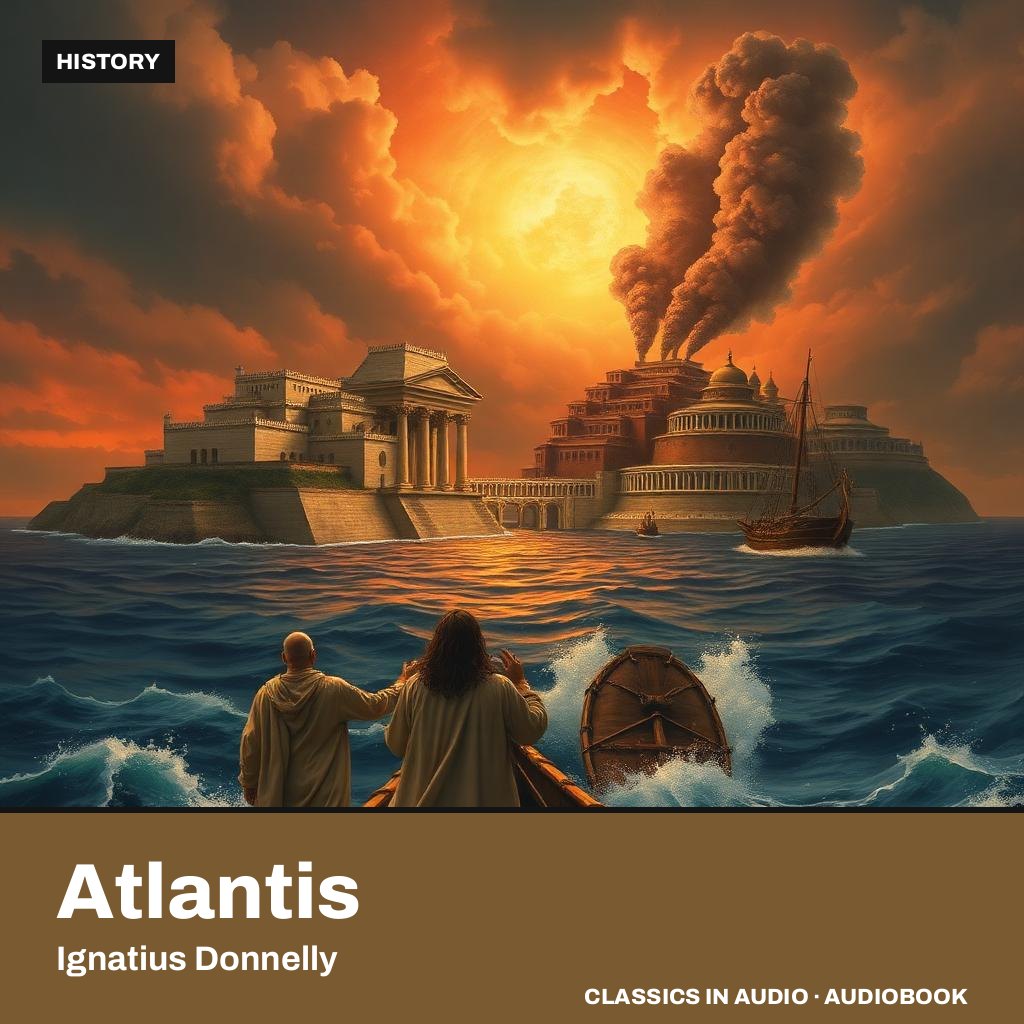
Atlantis
The Antedeluvian World
by Ignatius Donnelly (1831–1901)
Unabridged audiobook · about 13 hr 26 min · English · read by a synthetic voice · MP3, no DRM
€5.90
Buy 2 audiobooks or more: −10%. Buy 5 or more: −20%.
Secure payment by Stripe. Your download link is e-mailed to you at once: the first 30 minutes are usually ready within a few minutes, and the rest follows while you listen. Listen online or download the MP3.
Published in 1882, this book argues that Plato's account of Atlantis, the island kingdom swallowed by the sea, is literal history. Ignatius Donnelly, a Minnesota politician who served in the United States Congress, sets out thirteen propositions in his opening chapter and then spends the rest of the volume defending them. He claims that Atlantis was where civilization began, that its people settled the shores of the Mediterranean, the Gulf of Mexico and the Baltic, and that the Flood stories found around the world are memories of its destruction.
Donnelly builds his case from a wide range of material. He compares pyramids in Egypt and the Americas, sets the Phoenician and Mayan alphabets side by side, considers the Bronze Age in Europe, and reads the gods of Greece, Phoenicia and Scandinavia as kings of a lost homeland. He also looks at skull deformation, crops, and the deluge traditions of many peoples.
Historians and geologists do not accept his thesis, and the book is best heard as a document of its time. It shows Victorian curiosity about ancient migrations and how an energetic amateur could weave scattered evidence into a single grand theory. It also helped shape the modern Atlantis legend, which still circulates in popular culture, and it makes lively listening for anyone interested in how such ideas begin.
Text: Project Gutenberg edition no. 4032, read without its licence notices.
More by Ignatius Donnelly

More history
 The Dogaressas of Venice (the Wives of the Doges)Edgcumbe Staley9 hr 17 min€4.90
 Miniatures of French HistoryHilaire Belloc5 hr 44 min€4.90
 The Catholic Church and HistoryHilaire Belloc2 hr 16 min€3.90
 The History of the Peloponnesian WarThucydides18 hr 37 min€6.90
 The Anabasis of AlexanderArrian13 hr 55 min€5.90
 AnabasisXenophon8 hr 32 min€4.90