Australia in Arms
A Narrative of the Australasian Imperial Force and Their Achievement at Anzac
by Phillip F. E. Schuler (1879–1917)
Unabridged audiobook · about 11 hr 54 min · English · read by a synthetic voice · MP3, no DRM
€5.90
Buy 2 audiobooks or more: −10%. Buy 5 or more: −20%.
Secure payment by Stripe. Your download link is e-mailed to you at once: the first 30 minutes are usually ready within a few minutes, and the rest follows while you listen. Listen online or download the MP3.
Australia in Arms is a contemporary account of how the first Australian and New Zealand volunteers were raised, shipped to Egypt, trained in the desert and thrown ashore at Gallipoli in April 1915. First published in 1916, it follows the Australasian Imperial Force from the recruiting camps at home through the convoy voyage and the camp at Mena beneath the Pyramids, and on to the steep scrub-covered ridges of Anzac Cove, where the campaign was fought out in trenches only yards from the Turkish lines.
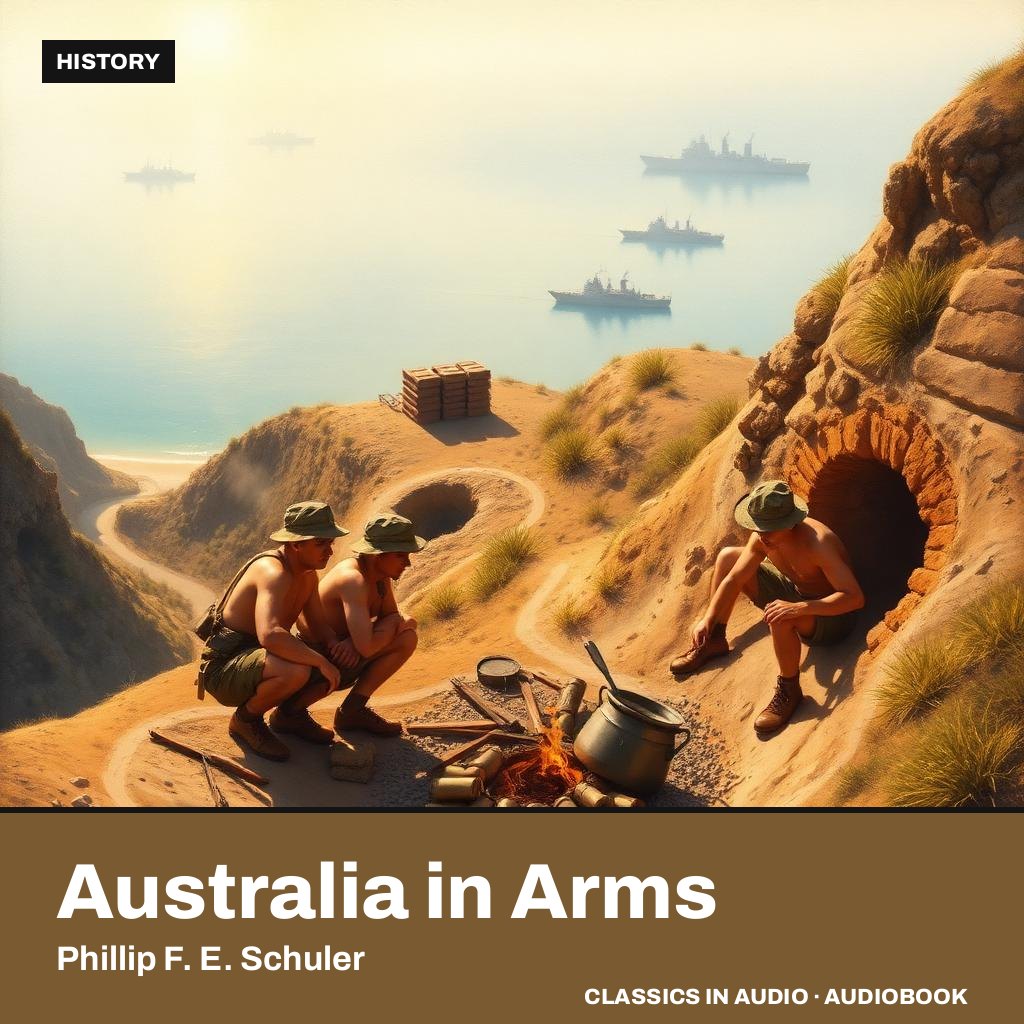
Phillip Schuler was the special war correspondent of the Melbourne Age, and he sailed with the 1st Division aboard the convoy's flagship. His book is not a claim to eyewitness testimony of every action. He leans on official papers and on the plain, vigorous stories told by the men who took part. The preface alone gives a taste of that approach, with a shirtless digger stewing bully beef over a fireplace of shell cases and failing to recognise his own general.
It is wartime writing, patriotic and openly admiring, and it should be heard that way. Its worth lies in its closeness to events: a record of how a young nation first understood its soldiers, written before the legend of Anzac had set. Schuler himself was killed in France in 1917.
Text: Project Gutenberg edition no. 46703, read without its licence notices.
More history
 The Dogaressas of Venice (the Wives of the Doges)Edgcumbe Staley9 hr 17 min€4.90
 Miniatures of French HistoryHilaire Belloc5 hr 44 min€4.90
 The Catholic Church and HistoryHilaire Belloc2 hr 16 min€3.90
 The History of the Peloponnesian WarThucydides18 hr 37 min€6.90
 The Anabasis of AlexanderArrian13 hr 55 min€5.90
 AnabasisXenophon8 hr 32 min€4.90