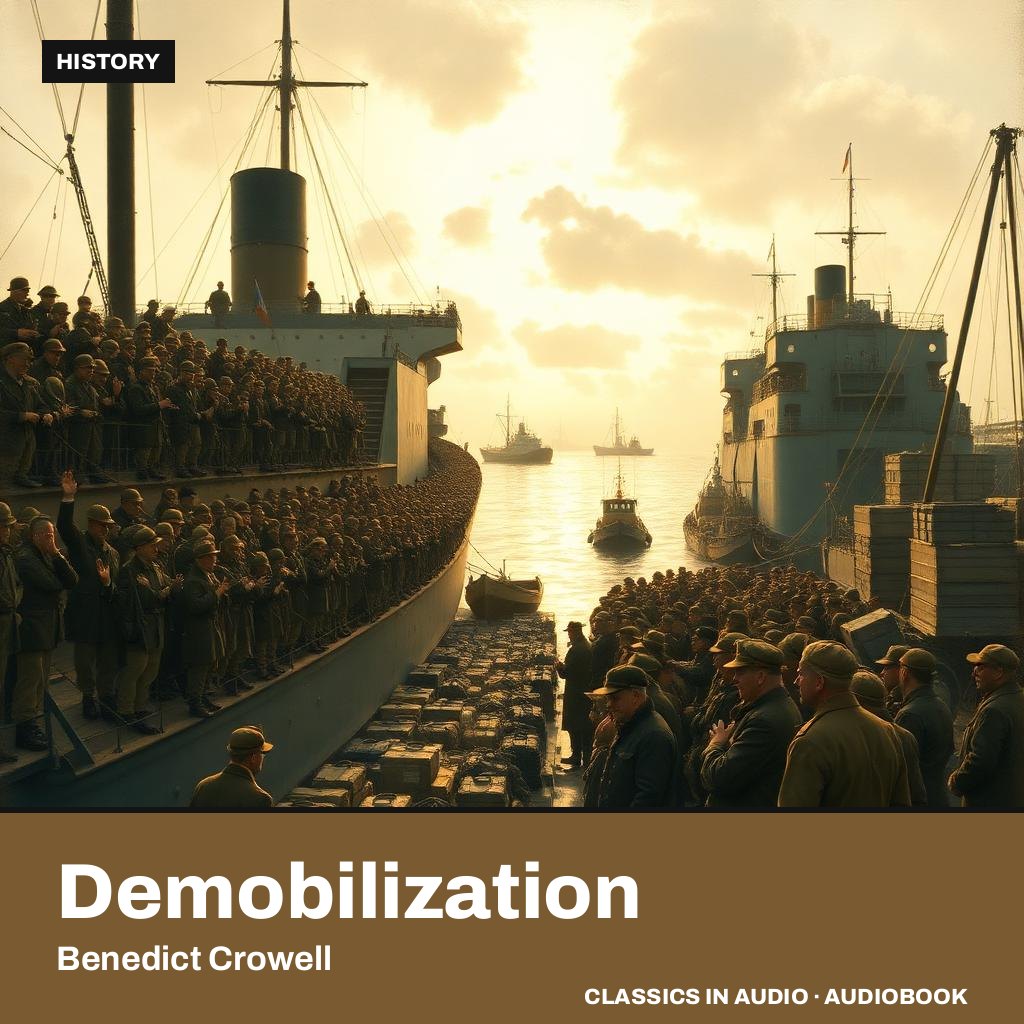
Demobilization
Our Industrial and Military Demobilization After the Armistice, 1918-1920
by Benedict Crowell (1869–1952)
Unabridged audiobook · about 11 hr 26 min · English · read by a synthetic voice · MP3, no DRM
€5.90
Buy 2 audiobooks or more: −10%. Buy 5 or more: −20%.
Secure payment by Stripe. Your download link is e-mailed to you at once: the first 30 minutes are usually ready within a few minutes, and the rest follows while you listen. Listen online or download the MP3.
When the guns stopped at eleven o'clock on November 11, 1918, the United States had about two million men in France and a vast web of factories, depots and contracts built for a war that might have run through 1919 or beyond. This book tells how that machinery was brought to a halt and taken apart, and how it was done without wrecking the country's economy.
The authors follow the process on both sides of the Atlantic. Troops are marched through delousing and clothing stations at the French ports, crowded onto transports, then paid and discharged at home camps. Other chapters turn to the grim work of gathering the dead into permanent cemeteries, the education and entertainment offered to soldiers waiting for ships, and the settling of thousands of munitions contracts. Surplus guns, aircraft engines, horses, flour and warehouses all have to be counted, sold or given away, some of it to a starving Europe.
Benedict Crowell was Assistant Secretary of War and Director of Munitions from 1917 to 1920, so he writes from inside the offices where these decisions were made. His co-author, Robert Forrest Wilson, served as a captain in the army. Published by Yale University Press in 1921, it is an official-sources account of a peacetime problem that rarely gets as much attention as the fighting.
Text: Project Gutenberg edition no. 70714, read without its licence notices.
More history
 The Dogaressas of Venice (the Wives of the Doges)Edgcumbe Staley9 hr 17 min€4.90
 Miniatures of French HistoryHilaire Belloc5 hr 44 min€4.90
 The Catholic Church and HistoryHilaire Belloc2 hr 16 min€3.90
 The History of the Peloponnesian WarThucydides18 hr 37 min€6.90
 The Anabasis of AlexanderArrian13 hr 55 min€5.90
 AnabasisXenophon8 hr 32 min€4.90