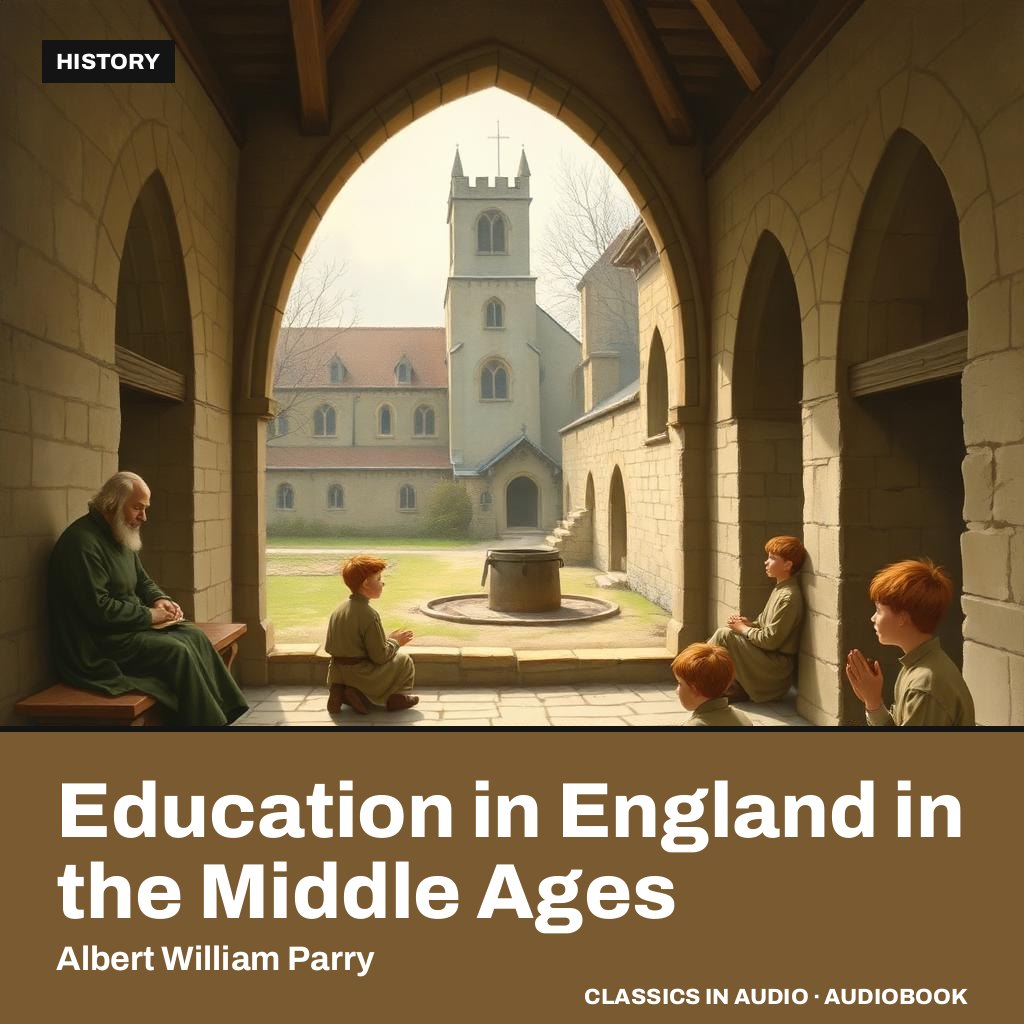
Education in England in the Middle Ages
Thesis Approved for the Degree of Doctor of Science in the University of London
by Albert William Parry (1874–1950)
Unabridged audiobook · about 8 hr 28 min · English · read by a synthetic voice · MP3, no DRM
€4.90
Buy 2 audiobooks or more: −10%. Buy 5 or more: −20%.
Secure payment by Stripe. Your download link is e-mailed to you at once: the first 30 minutes are usually ready within a few minutes, and the rest follows while you listen. Listen online or download the MP3.
This is a scholarly history of how England taught its children and young men from the arrival of Christianity to the eve of the Reformation. Albert William Parry wrote it as a doctoral thesis for the University of London, and it was published in 1920. He was principal of a teacher training college in Carmarthen, and he completed much of the work while serving in the army during the First World War.
The book follows three broad stages. It begins with the Anglo-Saxon monasteries and the schools run by the secular clergy, at a time when Church and State were hard to tell apart. It then turns to the centuries after the Norman Conquest, when the Church held a near monopoly on keeping schools and appointed and dismissed the masters. Later chapters look at how teaching moved beyond clerical control. They cover the rise of the universities, the gilds, the chantry schools, the great public schools, the colleges, and what pupils actually studied and how they were taught.
Parry cites his sources and sets out the evidence for each claim. For anyone curious about where grammar schools, Oxford and Cambridge, and the English habit of endowed schooling came from, this is a patient and well-documented account.
Text: Project Gutenberg edition no. 36553, read without its licence notices.
More history
 The Dogaressas of Venice (the Wives of the Doges)Edgcumbe Staley9 hr 17 min€4.90
 Miniatures of French HistoryHilaire Belloc5 hr 44 min€4.90
 The Catholic Church and HistoryHilaire Belloc2 hr 16 min€3.90
 The History of the Peloponnesian WarThucydides18 hr 37 min€6.90
 The Anabasis of AlexanderArrian13 hr 55 min€5.90
 AnabasisXenophon8 hr 32 min€4.90