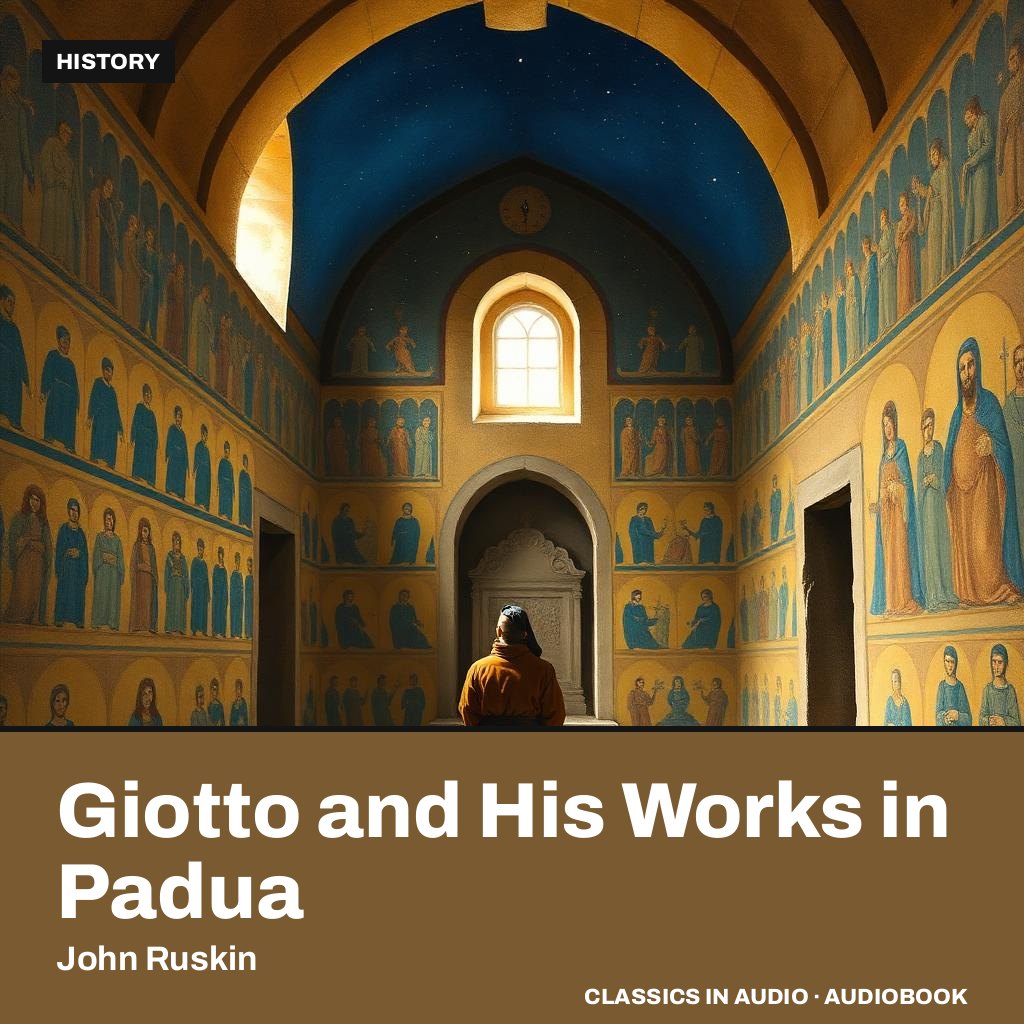
Giotto and His Works in Padua
An Explanatory Notice of the Series of Woodcuts Executed for the Arundel Society After the Frescoes in the Arena Chapel
by John Ruskin (1819–1900)
Unabridged audiobook · about 2 hr 17 min · English · read by a synthetic voice · MP3, no DRM
€3.90
Buy 2 audiobooks or more: −10%. Buy 5 or more: −20%.
Secure payment by Stripe. Your download link is e-mailed to you at once: the first 30 minutes are usually ready within a few minutes, and the rest follows while you listen. Listen online or download the MP3.
This is an art-historical guide to the frescoes Giotto painted in the Arena Chapel at Padua, written by John Ruskin for the Arundel Society, which had issued a series of woodcuts after the paintings. Ruskin supplies the background a visitor needs: how the banker's son Enrico Scrovegno bought the ruins of a Roman amphitheatre around the end of the thirteenth century, built a fortified palace on the site, and raised a chapel dedicated to the Annunciate Virgin, perhaps to atone for his father's usury. That father, Reginald, appears among the avaricious in Dante's Inferno.
Ruskin also wanders through footnotes on Dante's translators, medieval manuscripts, the Cavalieri Godenti or "Merry Brothers," and the sacred plays once staged on the spot every Lady-day. He opens with remarks on how Giotto's work relates to the art before and after him, so that readers will not look for what the painter never meant to give. Ruskin was the leading English art critic of the Victorian age, and his pages show how a very particular eye read these walls. For anyone curious about early Italian painting, the chapel's story, or how Ruskin looked at pictures, it is a patient and informative companion.
Text: Project Gutenberg edition no. 18371, read without its licence notices.
More by John Ruskin
 The Crown of Wild OliveJohn Ruskin28 hr 56 min€7.90
 Unto This Last, and Other Essays on Political EconomyJohn Ruskin11 hr 17 min€5.90
 Sesame and LiliesJohn Ruskin4 hr 25 min€3.90
 Lectures on Architecture and Painting, Delivered at Edinburgh in November 1853John Ruskin4 hr 28 min€3.90
 Love's MeinieJohn Ruskin3 hr 53 min€3.90
 Aratra Pentelici, Seven Lectures on the Elements of SculptureJohn Ruskin5 hr 23 min€4.90
More history
 The Dogaressas of Venice (the Wives of the Doges)Edgcumbe Staley9 hr 17 min€4.90
 Miniatures of French HistoryHilaire Belloc5 hr 44 min€4.90
 The Catholic Church and HistoryHilaire Belloc2 hr 16 min€3.90
 The History of the Peloponnesian WarThucydides18 hr 37 min€6.90
 The Anabasis of AlexanderArrian13 hr 55 min€5.90
 AnabasisXenophon8 hr 32 min€4.90