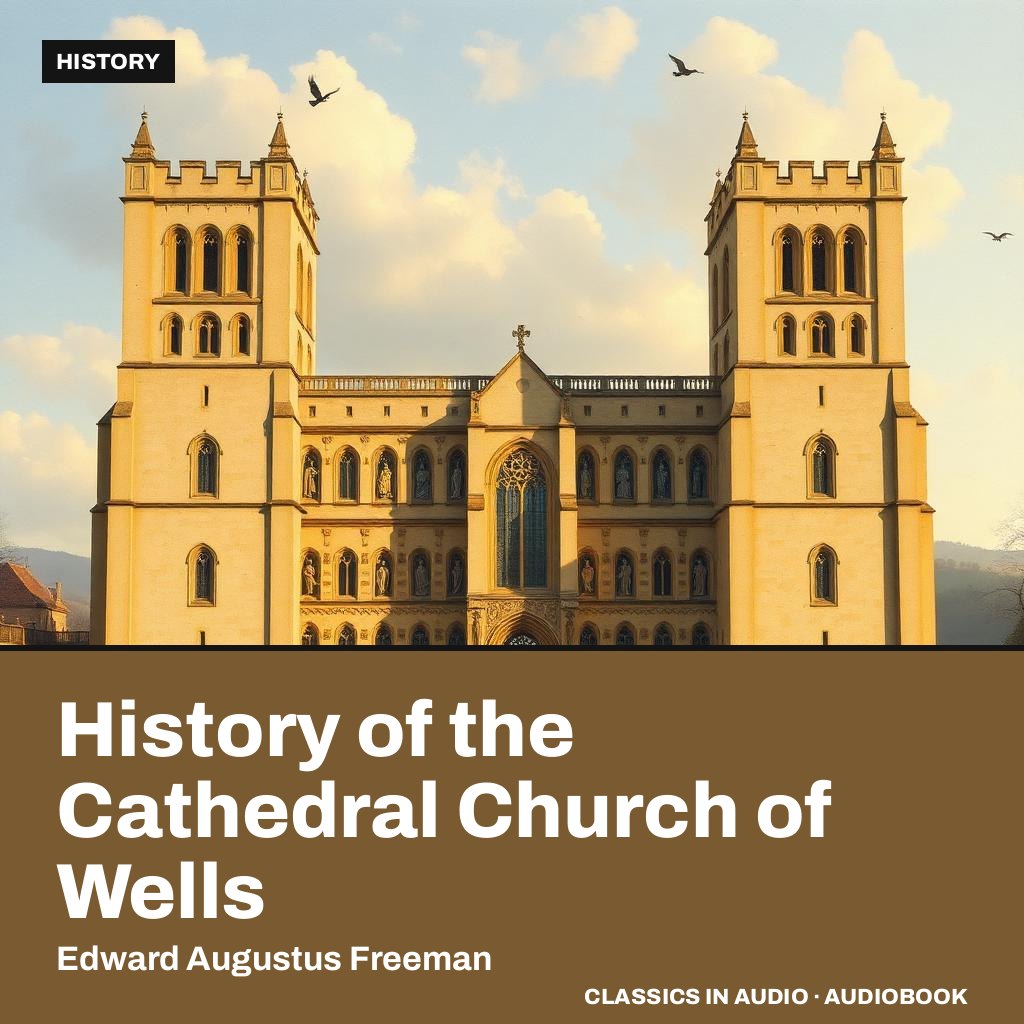
History of the Cathedral Church of Wells
As Illustrating the History of the Cathedral Churches of the Old Foundation
by Edward Augustus Freeman (1823–1892)
Unabridged audiobook · about 6 hr 07 min · English · read by a synthetic voice · MP3, no DRM
€4.90
Buy 2 audiobooks or more: −10%. Buy 5 or more: −20%.
Secure payment by Stripe. Your download link is e-mailed to you at once: the first 30 minutes are usually ready within a few minutes, and the rest follows while you listen. Listen online or download the MP3.
Edward A. Freeman's study of Wells Cathedral, first published in 1870, treats one Somerset church as a way into the wider story of England's cathedrals. Freeman, a historian best known for his large history of the Norman Conquest, wrote it while living in Wells itself, and he argues from close knowledge of the place.
The book follows the see from its early Anglo-Saxon bishops of the tenth century, through the move of the bishop's seat to Bath after the Norman Conquest, to the long union of Bath and Wells. Along the way it explains how the cathedrals of the Old Foundation, served by secular canons and not by monks, differed from those of the New Foundation. Freeman pays attention to how the chapter, the bishop and the building developed together, and a historical ground-plan helps the reader follow the church's growth.
Freeman was also a reformer with a point to make. He believed the cathedral bodies of his day had drifted far from their founders' intentions, and he says so plainly. The result is both a local history and a Victorian argument about what a cathedral is for. It suits anyone curious about medieval church life, English architecture, or how people in the nineteenth century looked back at the Middle Ages.
Text: Project Gutenberg edition no. 45435, read without its licence notices.
More by Edward Augustus Freeman
 Sketches of Travel in Normandy and MaineEdward Augustus Freeman5 hr 30 min€4.90
 The Chief Periods of European HistoryEdward Augustus Freeman6 hr 29 min€4.90
 William the ConquerorEdward Augustus Freeman5 hr 17 min€4.90
 Studies of TravelEdward Augustus Freeman4 hr 28 min€3.90
 Greater Greece and Greater BritainEdward Augustus Freeman2 hr 40 min€3.90
More history
 The Dogaressas of Venice (the Wives of the Doges)Edgcumbe Staley9 hr 17 min€4.90
 Miniatures of French HistoryHilaire Belloc5 hr 44 min€4.90
 The Catholic Church and HistoryHilaire Belloc2 hr 16 min€3.90
 The History of the Peloponnesian WarThucydides18 hr 37 min€6.90
 The Anabasis of AlexanderArrian13 hr 55 min€5.90
 AnabasisXenophon8 hr 32 min€4.90