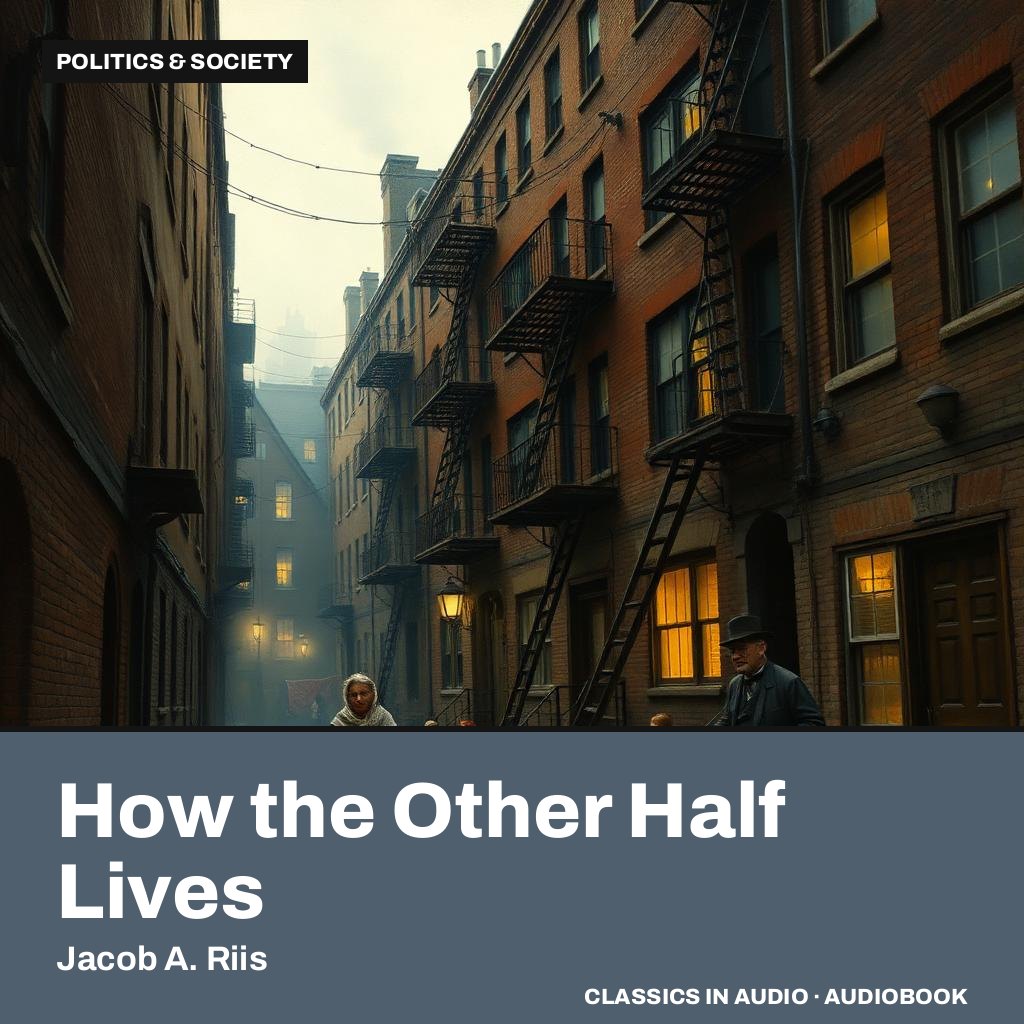
How the Other Half Lives
Studies Among the Tenements of New York
by Jacob A. Riis (1849–1914)
Unabridged audiobook · about 7 hr 39 min · English · read by a synthetic voice · MP3, no DRM
€4.90
Buy 2 audiobooks or more: −10%. Buy 5 or more: −20%.
Secure payment by Stripe. Your download link is e-mailed to you at once: the first 30 minutes are usually ready within a few minutes, and the rest follows while you listen. Listen online or download the MP3.
Published in 1890, this is a work of investigative journalism and social reform about the slums of New York's Lower East Side and the districts around it. Jacob Riis, a Danish immigrant who worked as a police reporter for the New York Tribune and the Evening Sun, spent years in the city's worst streets before writing it. He walked through back alleys, lodging-houses, sweatshops and crowded tenement rooms, and he took many of the photographs himself, using the newly developed flash powder to light dark interiors.
The book moves neighbourhood by neighbourhood and trade by trade. Chapters cover the origins of the tenement, the Italian rag-pickers, Chinatown, the Jewish garment workers, Bohemian cigarmakers in their own flats, homeless boys who slept in doorways, and the working girls who sewed for pennies. Riis gives rents, death rates and the number of people to a room, and he leans on the testimony of officials and doctors. His own moral judgments run through every page, and modern readers may notice that some of his remarks about the immigrant groups reflect the prejudices of his day.
It is worth hearing now as a record of how a city looked to someone who walked its poorest blocks, and of how one reporter's evidence helped push New York toward housing reform.
Text: Project Gutenberg edition no. 45502, read without its licence notices.
More by Jacob A. Riis
 Children of the TenementsJacob A. Riis7 hr 44 min€4.90
 The Battle with the SlumJacob A. Riis8 hr 49 min€4.90
 The Making of an AmericanJacob A. Riis8 hr 53 min€4.90
 Out of Mulberry StreetJacob A. Riis4 hr 49 min€3.90
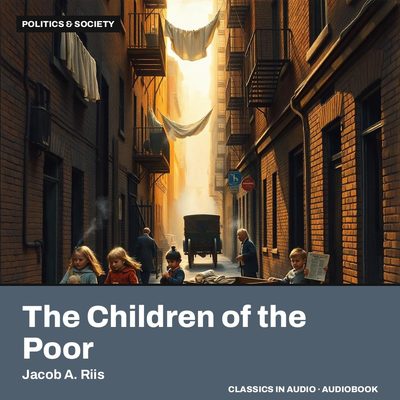 The Children of the PoorJacob A. Riis7 hr 46 min€4.90
 A Ten Years' WarJacob A. Riis4 hr 53 min€3.90
More politics & society
 The PrinceNiccolò Machiavelli4 hr 37 min€3.90
 LeviathanThomas Hobbes19 hr 44 min€6.90
 Second Treatise of GovernmentJohn Locke5 hr 07 min€4.90
 An Inquiry into the Nature and Causes of the Wealth of NationsAdam Smith36 hr 32 min€9.90
 The Eclipse of RussiaEmile Joseph Dillon14 hr 56 min€5.90
 Democracy—false or True?Sir William Blake Richmond5 hr 18 min€4.90