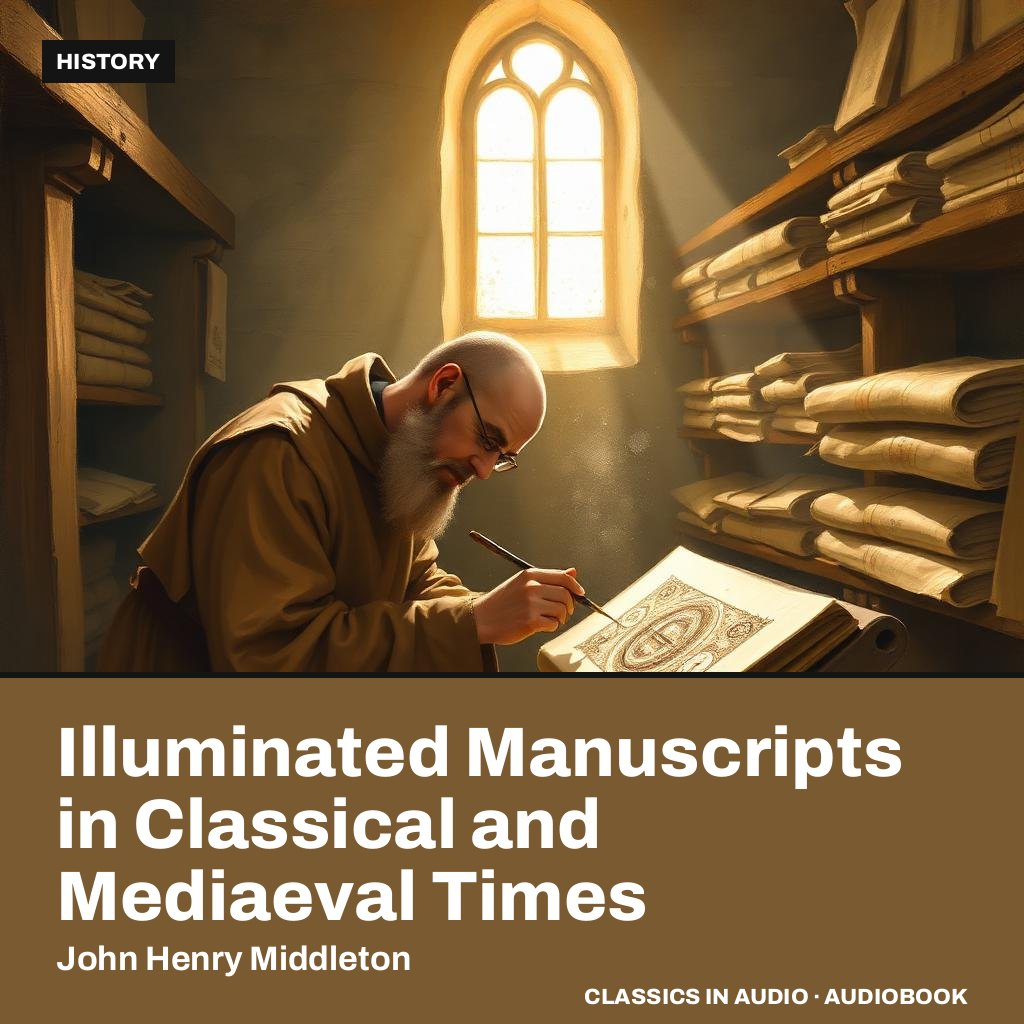
Illuminated Manuscripts in Classical and Mediaeval Times
Their Art and Their Technique
by John Henry Middleton (1846–1896)
Unabridged audiobook · about 8 hr 07 min · English · read by a synthetic voice · MP3, no DRM
€4.90
Buy 2 audiobooks or more: −10%. Buy 5 or more: −20%.
Secure payment by Stripe. Your download link is e-mailed to you at once: the first 30 minutes are usually ready within a few minutes, and the rest follows while you listen. Listen online or download the MP3.
This is a survey of how books were made and decorated before printing, from the waxed tablets and papyrus rolls of Egypt, Greece and Rome to the painted pages of the later Middle Ages. J. H. Middleton, who wrote it in the 1890s, was an architect and archaeologist who became the first Slade Professor of Fine Art at Cambridge and later directed the Fitzwilliam Museum. He knew the objects at first hand, and it shows.
The early chapters deal with materials and tools: how papyrus paper was made, why parchment and vellum took its place, what went into black carbon ink and red rubrics, and how a Roman bookseller or a slave scribe went about his work. The book then follows the art of illumination through its schools: classical miniatures known from the Vatican Virgil, Byzantine Gospels in purple and gold, the court of Charlemagne, the Irish and Northumbrian workshops behind the Book of Kells and the Gospels of St Cuthbert, and the Anglo-Saxon, Anglo-Norman and French traditions that follow.
Middleton links each style to its patrons, its monasteries and even the techniques of goldsmiths and enamellers. It suits anyone curious about how a handwritten page was physically produced, and why the results still astonish.
Text: Project Gutenberg edition no. 45332, read without its licence notices.
More history
 The Dogaressas of Venice (the Wives of the Doges)Edgcumbe Staley9 hr 17 min€4.90
 Miniatures of French HistoryHilaire Belloc5 hr 44 min€4.90
 The Catholic Church and HistoryHilaire Belloc2 hr 16 min€3.90
 The History of the Peloponnesian WarThucydides18 hr 37 min€6.90
 The Anabasis of AlexanderArrian13 hr 55 min€5.90
 AnabasisXenophon8 hr 32 min€4.90