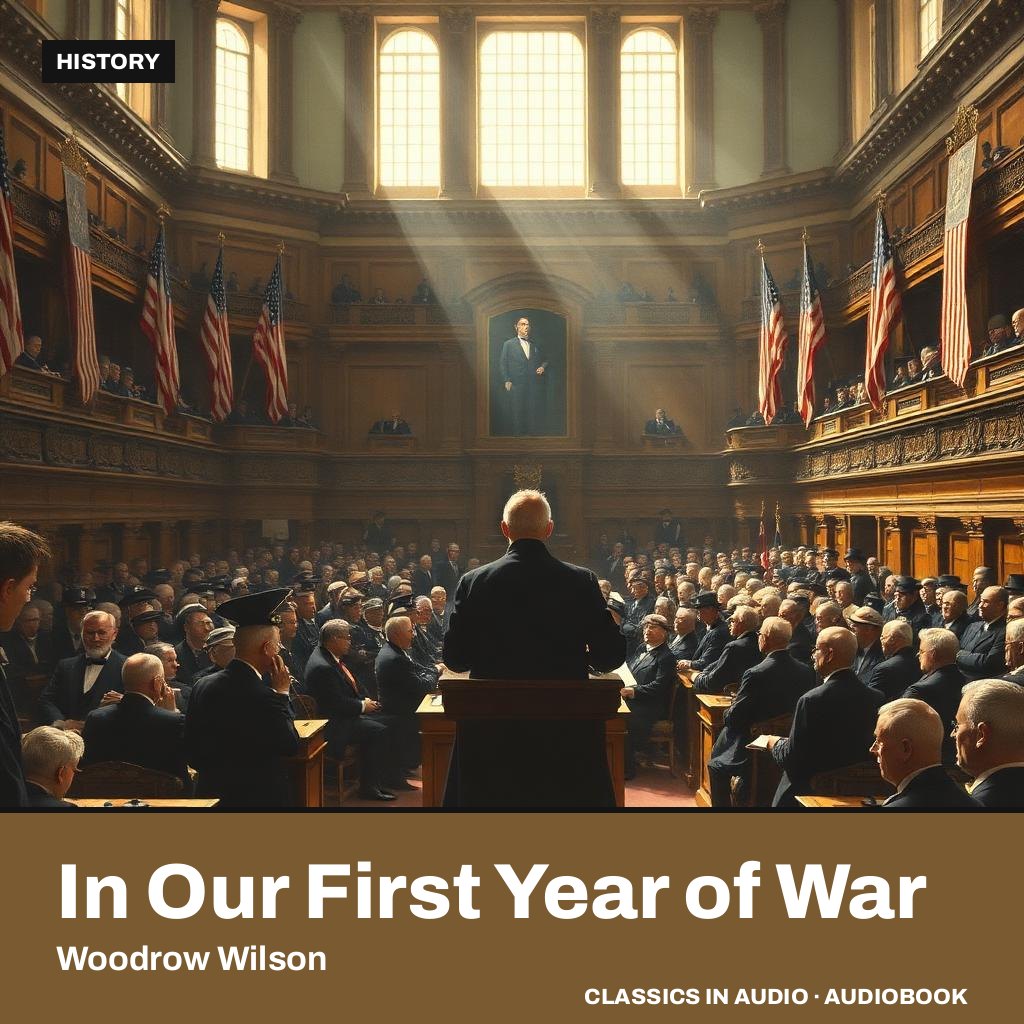
In Our First Year of War
Messages and Addresses to the Congress and the People, March 5, 1917, to January 8, 1918
by Woodrow Wilson (1856–1924)
Unabridged audiobook · about 3 hr 20 min · English · read by a synthetic voice · MP3, no DRM
€3.90
Buy 2 audiobooks or more: −10%. Buy 5 or more: −20%.
Secure payment by Stripe. Your download link is e-mailed to you at once: the first 30 minutes are usually ready within a few minutes, and the rest follows while you listen. Listen online or download the MP3.
This collection gathers the speeches, proclamations and public letters of Woodrow Wilson from his second inaugural address on March 5, 1917, to his statement of war aims on January 8, 1918. It opens with a president still hoping to guide the country through a world at war, and follows him through the declaration against Germany in April and the months in which a nation of roughly a hundred million people was turned toward the fighting.
The contents are varied. Some pieces are practical state papers: the conscription proclamation, an appeal on saving food, a plea to business leaders, a message on the government's takeover of the railroads. Others are occasional addresses for Memorial Day and Flag Day, a reply to the Pope's peace note, a statement to revolutionary Russia, and an argument that votes for women must come now. The volume ends with the terms of peace later known as the Fourteen Points.
Wilson, a former professor and president of Princeton, wrote most of his own speeches, and they show it: long, balanced sentences built to persuade. Heard together, they show how a democracy explains a war to itself, and how ideas about self-government and a lasting peace took shape while the outcome was still uncertain.
Text: Project Gutenberg edition no. 24668, read without its licence notices.
More by Woodrow Wilson
 The New FreedomWoodrow Wilson5 hr 02 min€4.90
 George WashingtonWoodrow Wilson9 hr 02 min€4.90
 Congressional GovernmentWoodrow Wilson8 hr 06 min€4.90
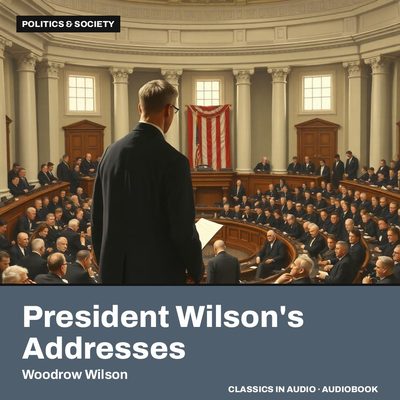 President Wilson's AddressesWoodrow Wilson8 hr 58 min€4.90
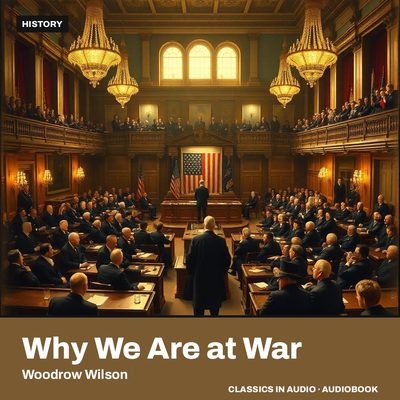 Why We Are at WarWoodrow Wilson1 hr 15 min€3.90
More history
 The Dogaressas of Venice (the Wives of the Doges)Edgcumbe Staley9 hr 17 min€4.90
 Miniatures of French HistoryHilaire Belloc5 hr 44 min€4.90
 The Catholic Church and HistoryHilaire Belloc2 hr 16 min€3.90
 The History of the Peloponnesian WarThucydides18 hr 37 min€6.90
 The Anabasis of AlexanderArrian13 hr 55 min€5.90
 AnabasisXenophon8 hr 32 min€4.90