Lancashire Folk-lore
Illustrative of the Superstitious Beliefs and Practices, Local Customs and Usages of the People of the County Palatine
by John Harland (1806–1868)
Unabridged audiobook · about 8 hr 59 min · English · read by a synthetic voice · MP3, no DRM
€4.90
Buy 2 audiobooks or more: −10%. Buy 5 or more: −20%.
Secure payment by Stripe. Your download link is e-mailed to you at once: the first 30 minutes are usually ready within a few minutes, and the rest follows while you listen. Listen online or download the MP3.
This is a nineteenth-century collection of the beliefs, charms and customs of Lancashire, gathered by two local antiquaries and first published in 1867. John Harland, a Manchester archivist and editor of old documents, worked with Thomas Turner Wilkinson, who knew the folklore of East Yorkshire as well as that of his adopted county. Each had collected material separately before they decided to combine their notes.
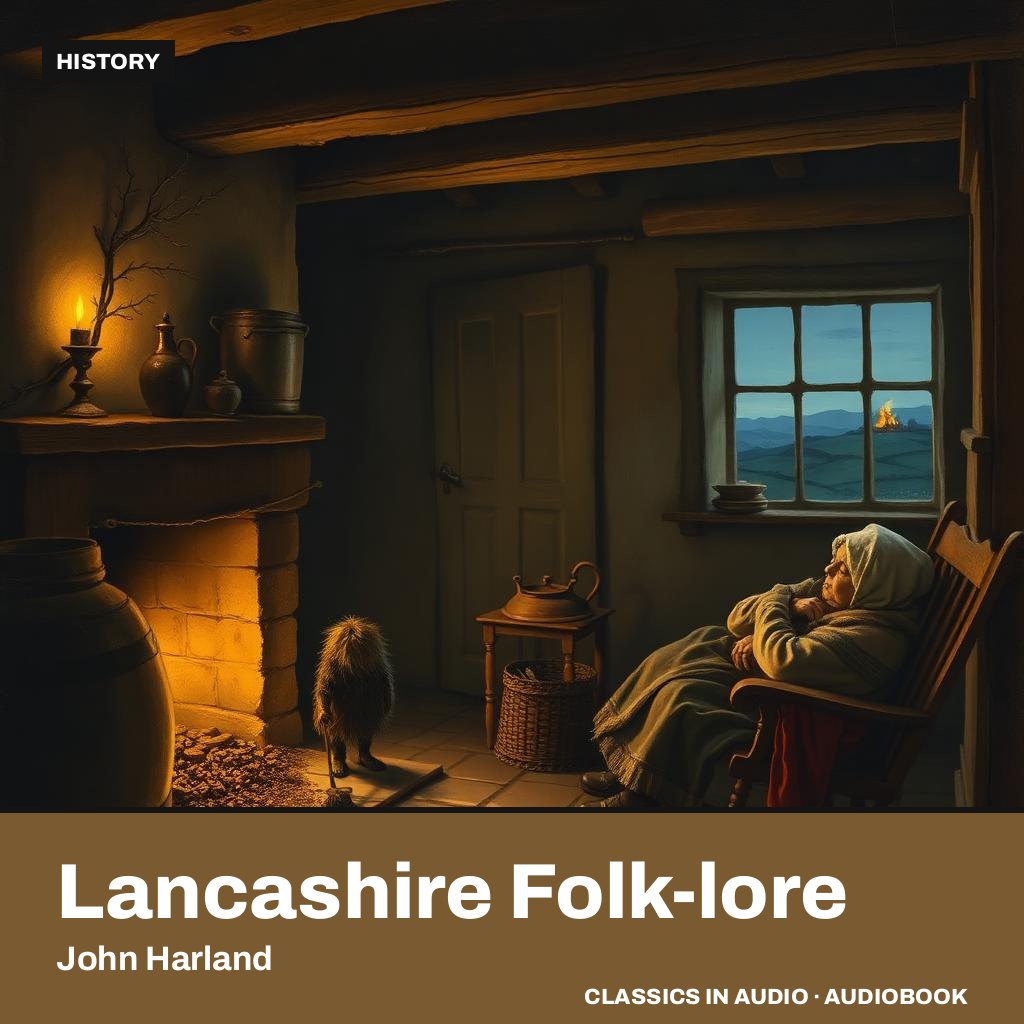
The first part deals with superstition: boggarts and haunted halls, house goblins who do the chores of a farm, bonfires thought to be relics of ancient Baal worship, local alchemists and astrologers, and charms against witchcraft, cattle sickness and toothache. The rowan tree, the ladybird and the pimpernel all have a place in these remedies. The second part follows the year and the life of a person: seasonal festivals, birth and baptism, courtship and weddings, deathbed and funeral practices, and the odd services owed under old manorial tenures.
The editors say plainly that many of these habits were fading even as they wrote, and some of what they set down comes from their own childhoods in the county. The book is a record of how ordinary people in a Celtic, Anglian, Scandinavian and Norman borderland explained luck, illness and the dead. It suits anyone curious about English folk belief or the villages and mill towns of the north-west.
Text: Project Gutenberg edition no. 41148, read without its licence notices.
More history
 The Dogaressas of Venice (the Wives of the Doges)Edgcumbe Staley9 hr 17 min€4.90
 Miniatures of French HistoryHilaire Belloc5 hr 44 min€4.90
 The Catholic Church and HistoryHilaire Belloc2 hr 16 min€3.90
 The History of the Peloponnesian WarThucydides18 hr 37 min€6.90
 The Anabasis of AlexanderArrian13 hr 55 min€5.90
 AnabasisXenophon8 hr 32 min€4.90