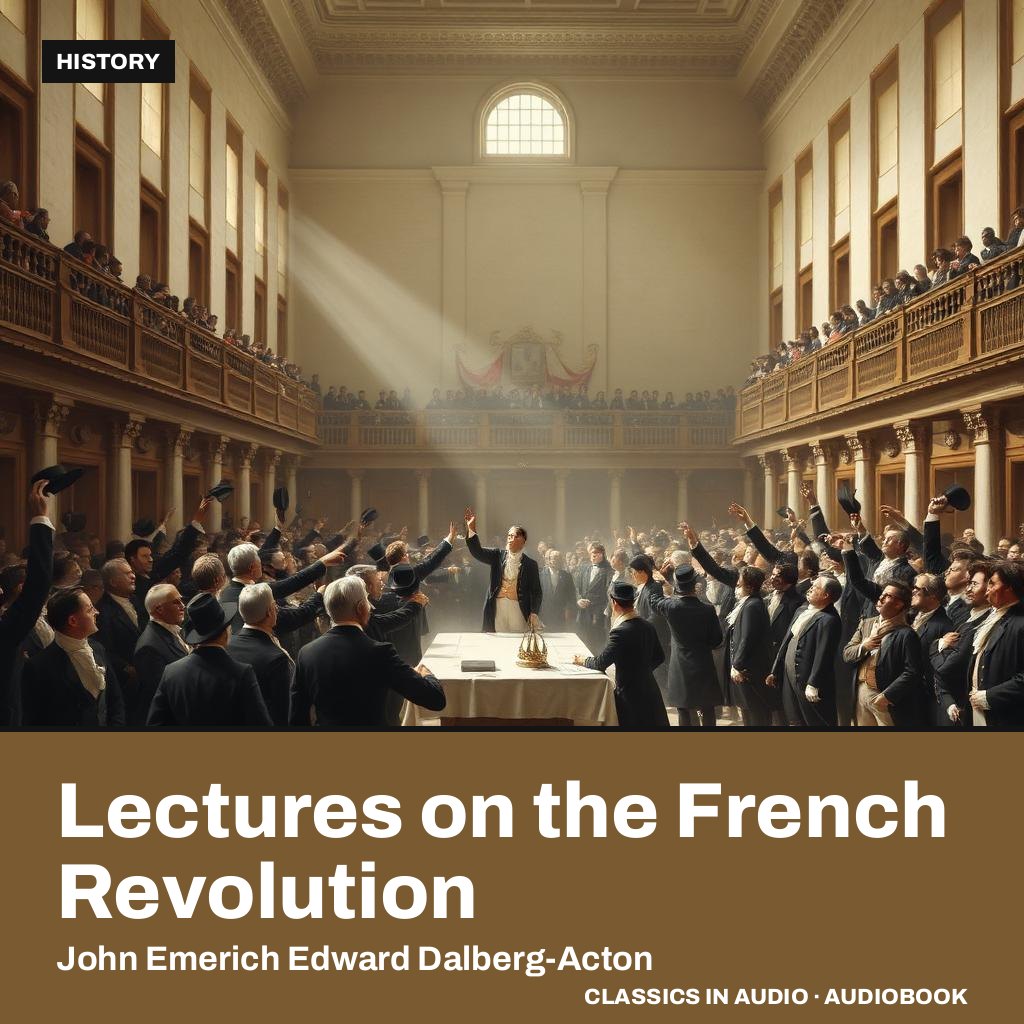
Lectures on the French Revolution
by John Emerich Edward Dalberg-Acton (1834–1902)
Unabridged audiobook · about 12 hr 37 min · English · read by a synthetic voice · MP3, no DRM
€5.90
Buy 2 audiobooks or more: −10%. Buy 5 or more: −20%.
Secure payment by Stripe. Your download link is e-mailed to you at once: the first 30 minutes are usually ready within a few minutes, and the rest follows while you listen. Listen online or download the MP3.
These twenty-two lectures were given at Cambridge in the late 1890s by Lord Acton, then Regius Professor of Modern History, for students preparing for the Historical Tripos. They follow the Revolution from 1789 to the years after the Terror, taking in the summoning of the States-General, the Tennis-Court Oath, the fall of the Bastille, the flight to Varennes, the execution of the king, the rising in the Vendée and the war against Europe. A closing appendix surveys the literature of the subject.
Acton opens with a bold claim: the Revolution was not a meteor from the unknown. He sees it as the demand of a wealthy and industrious majority, shut out from office and honour, to be governed by rulers who answered to them. He traces the ideas behind it through jurists, Protestant exiles, clerical lawyers and the courtier-bishop Fénelon, and he is as interested in why France stumbled as in why it rose.
Acton was a Catholic liberal who gathered one of the great private libraries of his age, and he judged historical actors by a strict moral standard. The lectures were edited from his notes by John Neville Figgis and Reginald Vere Laurence after his death. They offer a learned, opinionated guide to events still argued over.
Text: Project Gutenberg edition no. 27488, read without its licence notices.
More by John Emerich Edward Dalberg-Acton
 A Lecture on the Study of HistoryJohn Emerich Edward Dalberg-Acton2 hr 27 min€3.90
 The History of Freedom, and Other EssaysJohn Emerich Edward Dalberg-Acton24 hr 56 min€7.90
 Letters of Lord Acton to Mary, Daughter of the Right Hon. W. E. GladstoneJohn Emerich Edward Dalberg-Acton8 hr 53 min€4.90
 Lectures on Modern HistoryJohn Emerich Edward Dalberg-Acton12 hr 12 min€5.90
More history
 The Dogaressas of Venice (the Wives of the Doges)Edgcumbe Staley9 hr 17 min€4.90
 Miniatures of French HistoryHilaire Belloc5 hr 44 min€4.90
 The Catholic Church and HistoryHilaire Belloc2 hr 16 min€3.90
 The History of the Peloponnesian WarThucydides18 hr 37 min€6.90
 The Anabasis of AlexanderArrian13 hr 55 min€5.90
 AnabasisXenophon8 hr 32 min€4.90