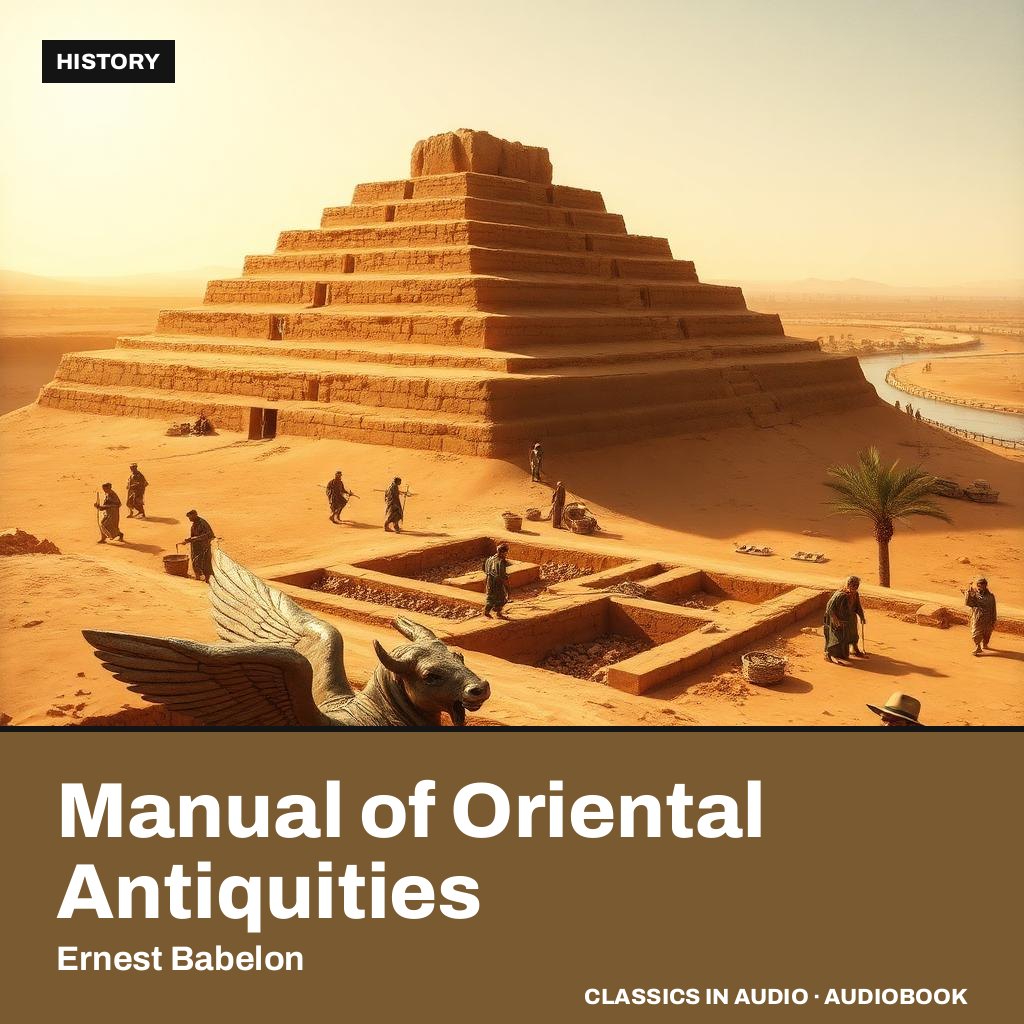
Manual of Oriental Antiquities
by Ernest Babelon (1854–1924)
Unabridged audiobook · about 7 hr 44 min · English · read by a synthetic voice · MP3, no DRM
€4.90
Buy 2 audiobooks or more: −10%. Buy 5 or more: −20%.
Secure payment by Stripe. Your download link is e-mailed to you at once: the first 30 minutes are usually ready within a few minutes, and the rest follows while you listen. Listen online or download the MP3.
Ernest Babelon's handbook surveys the art of the ancient Near East, from the first cities of the Euphrates valley to the western shores of the Mediterranean. Its argument is bold and simple: before Greece and Rome, only two great streams of artistic influence flowed, one from Egypt and one from Chaldæa and Assyria. Babelon follows the Asiatic stream. He starts in Chaldæa with architecture, statues, bas-reliefs, minor crafts and engraved seals, then moves on to Assyrian palaces, temples and staged towers. After that he traces its spread to Persia, the Hittites, Syria, the Jews, the Phoenicians and Carthage, as far as Cyprus, Sicily and Spain.
His claim that there is no purely Persian, Hittite or Phoenician art, only Egyptian and Assyrian forms recombined, is a provocative thesis, and he defends it with energy. He also faces a hard fact: the great palaces and towers of Susa, Babylon and Nineveh survive only as buried foundations, so their world has to be pieced together from excavation. Babelon was a French numismatist and archaeologist who worked at the Bibliothèque nationale. This edition was translated and expanded by B. T. A. Evetts of the British Museum, and it adds a chapter on the finds at Susa. It gives a clear picture of how scholars of the early twentieth century read the ruins of Mesopotamia.
Text: Project Gutenberg edition no. 50626, read without its licence notices.
More history
 The Dogaressas of Venice (the Wives of the Doges)Edgcumbe Staley9 hr 17 min€4.90
 Miniatures of French HistoryHilaire Belloc5 hr 44 min€4.90
 The Catholic Church and HistoryHilaire Belloc2 hr 16 min€3.90
 The History of the Peloponnesian WarThucydides18 hr 37 min€6.90
 The Anabasis of AlexanderArrian13 hr 55 min€5.90
 AnabasisXenophon8 hr 32 min€4.90