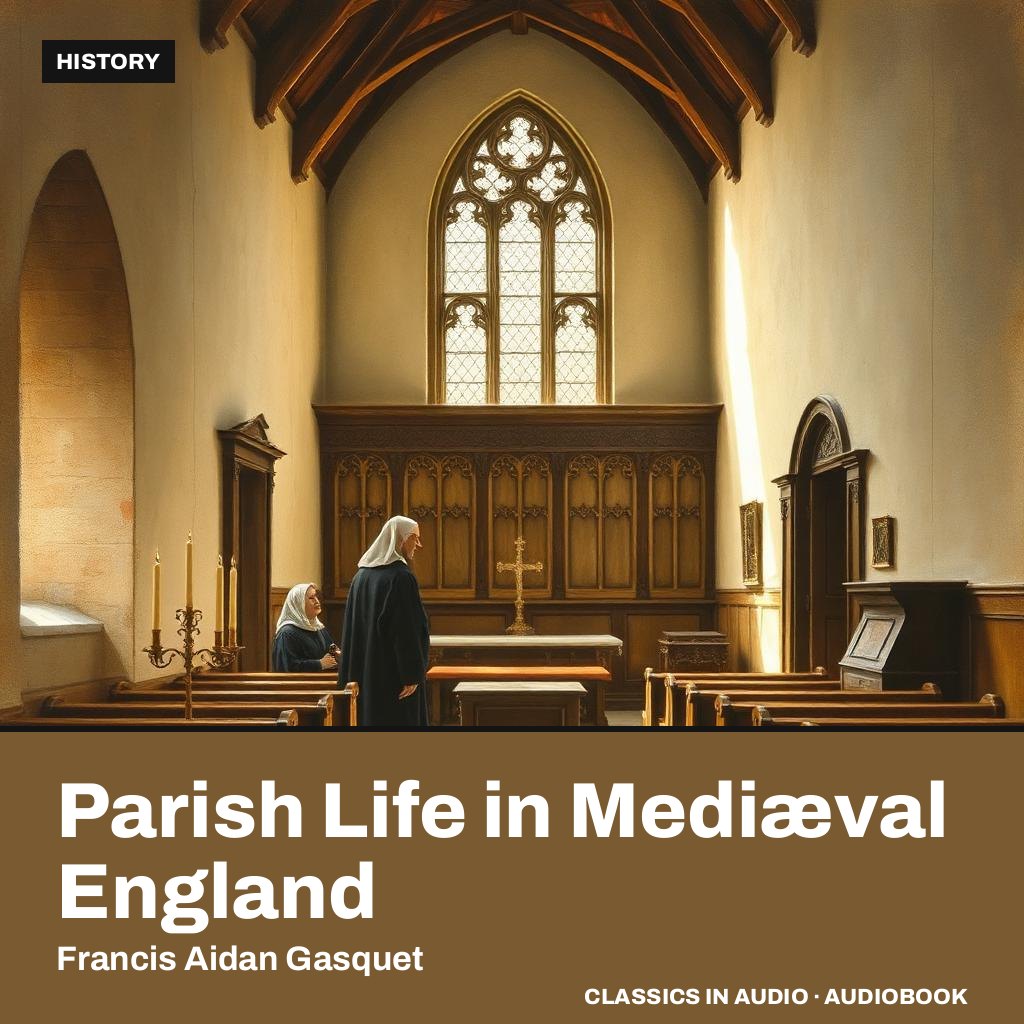
Parish Life in Mediæval England
by Francis Aidan Gasquet (1846–1929)
Unabridged audiobook · about 7 hr 24 min · English · read by a synthetic voice · MP3, no DRM
€4.90
Buy 2 audiobooks or more: −10%. Buy 5 or more: −20%.
Secure payment by Stripe. Your download link is e-mailed to you at once: the first 30 minutes are usually ready within a few minutes, and the rest follows while you listen. Listen online or download the MP3.
Parish Life in Mediæval England is a study of the ordinary village and town church in the centuries between the Norman Conquest and the Reformation. Rather than kings and battles, it looks at the building and the people who used it: the priest and his clerks, the churchwardens, the guilds and chantries, and the parishioners who paid for bells, lights, screens and windows out of their own pockets.
Francis Aidan Gasquet, an English Benedictine who later became a cardinal, wrote it as a companion to his earlier book on monastic life. He builds his picture largely from surviving churchwardens' accounts, inventories and chantry certificates, so the details are practical and often surprising. Chapters follow the furnishings of the church, the duties of the clergy, the sacraments from baptism to burial, the feast days, the teaching of the faith, and the church house where neighbours met to eat, drink and raise money for repairs.
Gasquet writes from a Catholic viewpoint, and a modern listener may want to weigh his conclusions. Still, the book keeps its attention on small, concrete things: an alms box, a holy water sprinkler, a rood-loft stair. It is a useful way to hear how medieval English communities organised their religious and social lives together.
Text: Project Gutenberg edition no. 73543, read without its licence notices.
More by Francis Aidan Gasquet
 English Monastic LifeFrancis Aidan Gasquet7 hr 50 min€4.90
 The Eve of the ReformationFrancis Aidan Gasquet14 hr 17 min€5.90
More history
 The Dogaressas of Venice (the Wives of the Doges)Edgcumbe Staley9 hr 17 min€4.90
 Miniatures of French HistoryHilaire Belloc5 hr 44 min€4.90
 The Catholic Church and HistoryHilaire Belloc2 hr 16 min€3.90
 The History of the Peloponnesian WarThucydides18 hr 37 min€6.90
 The Anabasis of AlexanderArrian13 hr 55 min€5.90
 AnabasisXenophon8 hr 32 min€4.90