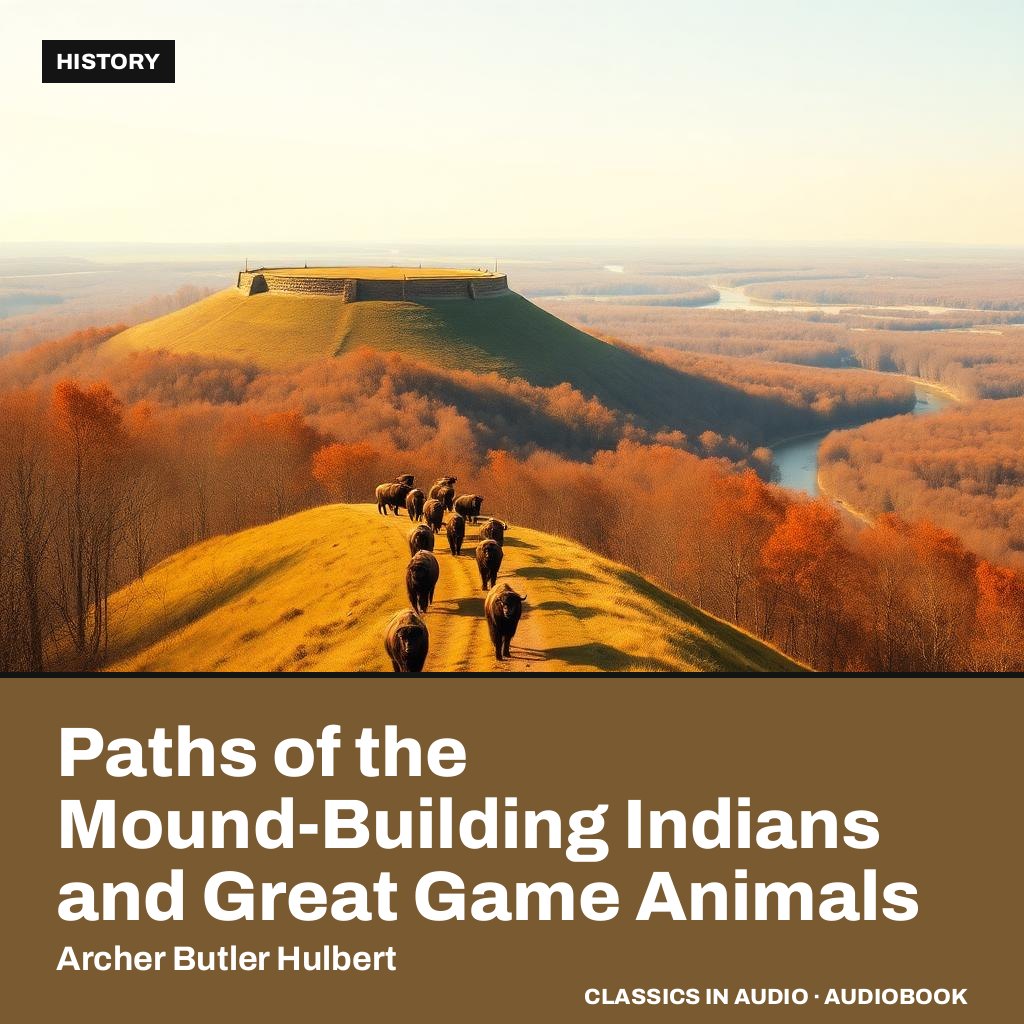
Paths of the Mound-Building Indians and Great Game Animals
by Archer Butler Hulbert (1873–1933)
Unabridged audiobook · about 1 hr 55 min · English · read by a synthetic voice · MP3, no DRM
€3.90
Buy 2 audiobooks or more: −10%. Buy 5 or more: −20%.
Secure payment by Stripe. Your download link is e-mailed to you at once: the first 30 minutes are usually ready within a few minutes, and the rest follows while you listen. Listen online or download the MP3.
Archer Butler Hulbert opens his series on America's early roads by asking a simple question: who made the first highways of the interior? His answer is surprising. The mound-builders raised enormous earthworks such as Fort Ancient and Fort Hill in what is now Ohio, and graded broad approaches around them, yet as far as anyone knows they cut no roads between their forts or villages. That work fell to the big game animals, above all the buffalo.
Hulbert argues that herds of buffalo, deer and moose, moving between feeding grounds and salt licks, broke trails along the summits of the watersheds. These routes ran across the continent, and beside them the earliest Indian paths were only narrow traces through the woods. Later travelers, surveyors and settlers followed the same ground, so the animal track became the ancestor of the trail and eventually of the road.
The book is the first volume of his Historic Highways of America. Hulbert was an American historian from Ohio who spent much of his career tracing the routes of the westward movement. Here he combines archaeology, geography and frontier history to show how need shaped the land's first thoroughfares, and why a map of old earthworks can still tell us something about how the country was crossed.
Text: Project Gutenberg edition no. 40873, read without its licence notices.
More by Archer Butler Hulbert
 The Paths of Inland CommerceArcher Butler Hulbert4 hr 28 min€3.90
 Washington's Road (Nemacolin's Path) the First Chapter of the Old French WarArcher Butler Hulbert3 hr 20 min€3.90
 Military Roads of the Mississippi BasinArcher Butler Hulbert3 hr 46 min€3.90
 Braddock's Road and Three Relative PapersArcher Butler Hulbert3 hr 13 min€3.90
 The Cumberland RoadArcher Butler Hulbert3 hr 08 min€3.90
 Boone's Wilderness RoadArcher Butler Hulbert3 hr 13 min€3.90
More history
 The Dogaressas of Venice (the Wives of the Doges)Edgcumbe Staley9 hr 17 min€4.90
 Miniatures of French HistoryHilaire Belloc5 hr 44 min€4.90
 The Catholic Church and HistoryHilaire Belloc2 hr 16 min€3.90
 The History of the Peloponnesian WarThucydides18 hr 37 min€6.90
 The Anabasis of AlexanderArrian13 hr 55 min€5.90
 AnabasisXenophon8 hr 32 min€4.90