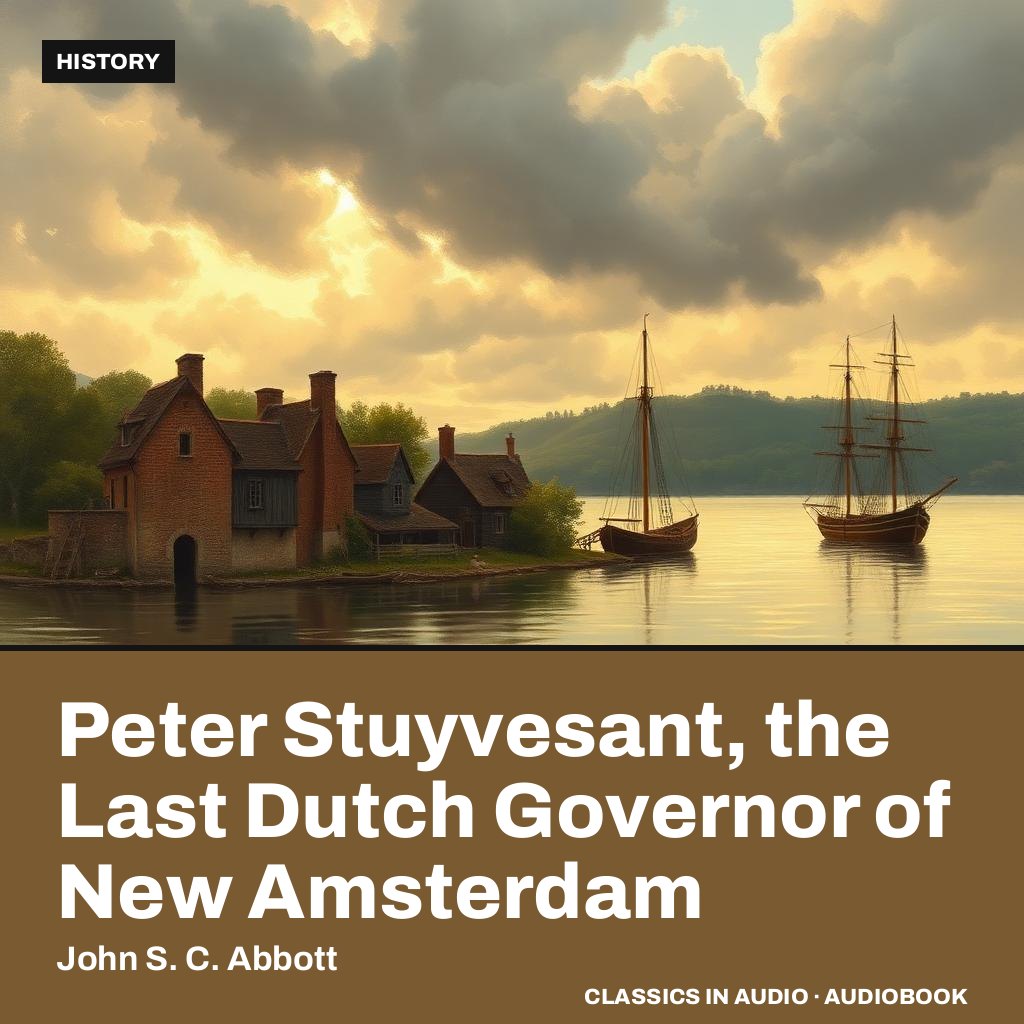
Peter Stuyvesant, the Last Dutch Governor of New Amsterdam
by John S. C. Abbott (1805–1877)
Unabridged audiobook · about 7 hr 13 min · English · read by a synthetic voice · MP3, no DRM
€4.90
Buy 2 audiobooks or more: −10%. Buy 5 or more: −20%.
Secure payment by Stripe. Your download link is e-mailed to you at once: the first 30 minutes are usually ready within a few minutes, and the rest follows while you listen. Listen online or download the MP3.
Peter Stuyvesant (1592-1672) was the last director-general of New Netherland, the Dutch colony on the Hudson, and this biography follows him through the years when New Amsterdam was a small trading town on the tip of Manhattan. John S. C. Abbott, a nineteenth-century American clergyman and historian who wrote many popular biographies, begins well before his hero arrives. He starts with Henry Hudson's voyage up the river in 1609, then follows the fur trade, the purchase of Manhattan, and the patroons who held great estates along the water.
The core of the book is Stuyvesant's rule from 1647. He governs a mixed and quarrelsome population, with settlers who resent his stern manner, wars with neighbouring Native peoples, a rivalry with Swedish settlers on the Delaware, and the persecution of Quakers and other dissenters. Meanwhile English colonies press in from Connecticut and Long Island, and the Dutch authorities at home give him little support. Abbott writes as a storyteller and has his own sympathies, which a modern listener will want to weigh.
The result is a vivid account of how a Dutch outpost became the foundation of New York, told through the stubborn, one-legged soldier who tried to hold it together.
Text: Project Gutenberg edition no. 13811, read without its licence notices.
More by John S. C. Abbott
 History of Frederick the Second, Called Frederick the GreatJohn S. C. Abbott19 hr 27 min€6.90
 Daniel BooneJohn S. C. Abbott7 hr 00 min€4.90
 Louis PhilippeJohn S. C. Abbott6 hr 51 min€4.90
 Louis XIVJohn S. C. Abbott7 hr 04 min€4.90
 The French Revolution of 1789, as Viewed in the Light of Republican InstitutionsJohn S. C. Abbott21 hr 10 min€7.90
 Benjamin FranklinJohn S. C. Abbott7 hr 49 min€4.90
More history
 The Dogaressas of Venice (the Wives of the Doges)Edgcumbe Staley9 hr 17 min€4.90
 Miniatures of French HistoryHilaire Belloc5 hr 44 min€4.90
 The Catholic Church and HistoryHilaire Belloc2 hr 16 min€3.90
 The History of the Peloponnesian WarThucydides18 hr 37 min€6.90
 The Anabasis of AlexanderArrian13 hr 55 min€5.90
 AnabasisXenophon8 hr 32 min€4.90