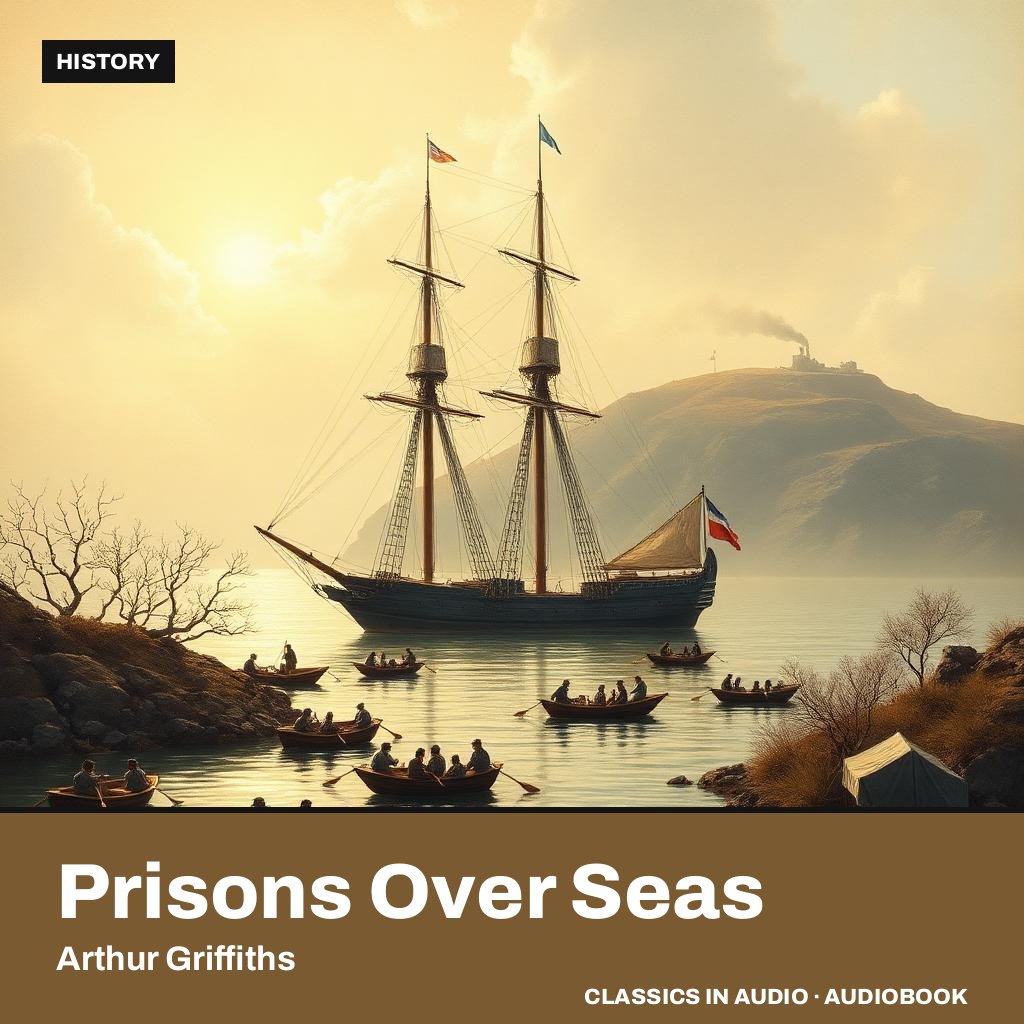
Prisons Over Seas
Deportation and Colonization; British and American Prisons of To-day
by Arthur Griffiths (1838–1908)
Unabridged audiobook · about 7 hr 59 min · English · read by a synthetic voice · MP3, no DRM
€4.90
Buy 2 audiobooks or more: −10%. Buy 5 or more: −20%.
Secure payment by Stripe. Your download link is e-mailed to you at once: the first 30 minutes are usually ready within a few minutes, and the rest follows while you listen. Listen online or download the MP3.
Prisons Over Seas is a survey of how Britain, and other nations, dealt with their convicted criminals by sending them away, and of what became of the prisons that replaced that practice. Arthur Griffiths, who served as a British army officer before becoming an inspector of prisons, wrote it around the turn of the twentieth century, when transportation was a recent memory and penal reform was a live argument.
The early chapters follow the story from the first idea of ridding the country of bad characters, through the sale of convicts as indentured servants to the American colonies and the West Indies, to the founding of a settlement at Botany Bay after the American Revolution closed the old outlet. The First Fleet sails in 1787 and lands at Port Jackson, where famine, drought and disorder test the new colony. Later chapters describe convict life, the probation system, the hulks and the ships, Gibraltar, the French penal colonies, and American methods of punishment.
Griffiths writes as an official with firm opinions, and he plainly favours the British system, so his judgements are part of the record as much as his facts. Anyone curious about the origins of Australia, or about how societies have argued over punishment, will find a detailed and often surprising account.
Text: Project Gutenberg edition no. 49964, read without its licence notices.
More by Arthur Griffiths
 Early French PrisonsArthur Griffiths7 hr 16 min€4.90
 Millbank PenitentiaryArthur Griffiths7 hr 22 min€4.90
 Italian PrisonsArthur Griffiths6 hr 25 min€4.90
 Non-Criminal PrisonsArthur Griffiths6 hr 58 min€4.90
 The Rome ExpressArthur Griffiths3 hr 16 min€3.90
 Spanish PrisonsArthur Griffiths5 hr 57 min€4.90
More history
 The Dogaressas of Venice (the Wives of the Doges)Edgcumbe Staley9 hr 17 min€4.90
 Miniatures of French HistoryHilaire Belloc5 hr 44 min€4.90
 The Catholic Church and HistoryHilaire Belloc2 hr 16 min€3.90
 The History of the Peloponnesian WarThucydides18 hr 37 min€6.90
 The Anabasis of AlexanderArrian13 hr 55 min€5.90
 AnabasisXenophon8 hr 32 min€4.90