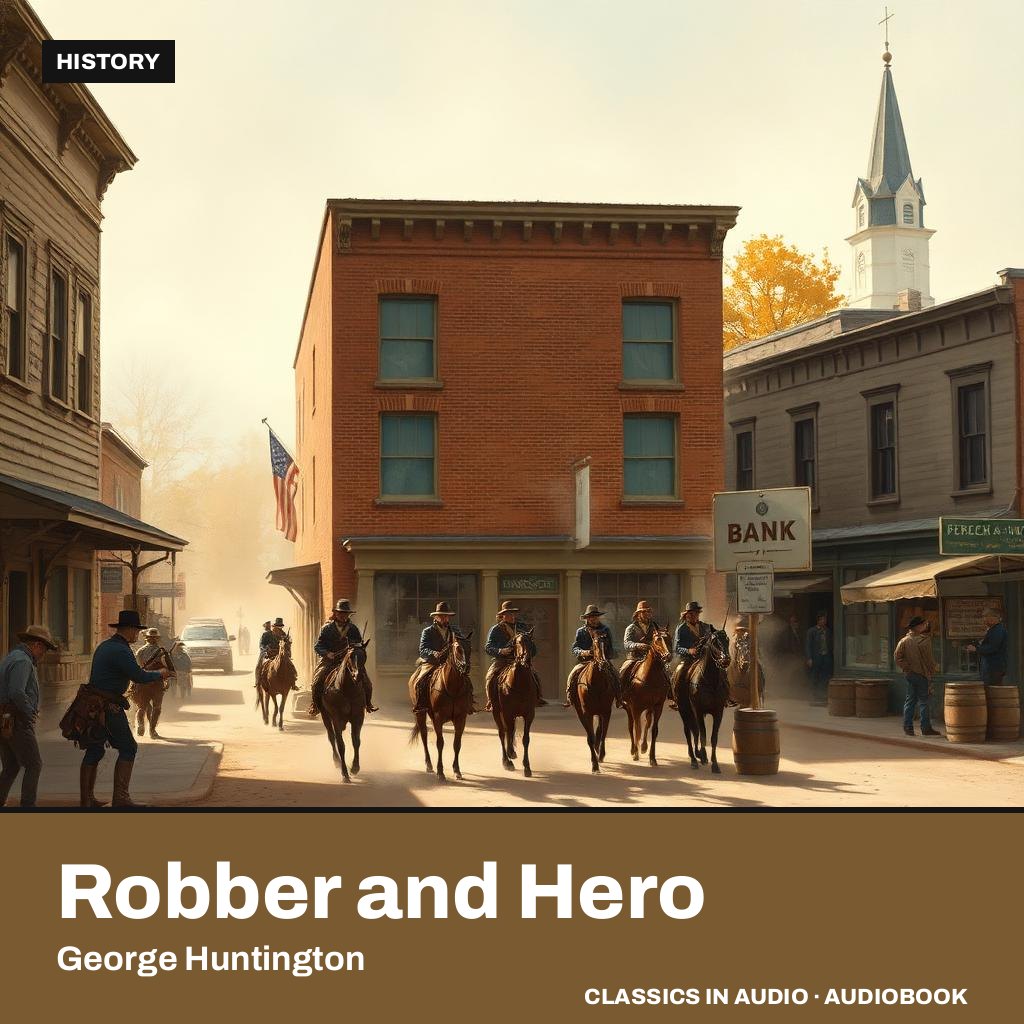
Robber and Hero
The Story of the Raid on the First National Bank of Northfield, Minnesota, by the James-Younger Band of Robbers, in 1876.
by George Huntington (1835–1916)
Unabridged audiobook · about 2 hr 20 min · English · read by a synthetic voice · MP3, no DRM
€3.90
Buy 2 audiobooks or more: −10%. Buy 5 or more: −20%.
Secure payment by Stripe. Your download link is e-mailed to you at once: the first 30 minutes are usually ready within a few minutes, and the rest follows while you listen. Listen online or download the MP3.
On 7 September 1876, a gang of armed riders entered the small Minnesota college town of Northfield and tried to rob the First National Bank. It went badly wrong. This book, published in the 1890s, tells the story of that raid, led by members of the James and Younger families, who had made their names as outlaws in Missouri after the Civil War.
George Huntington, who wrote this account some eighteen years after the event, begins weeks earlier, when a group of well-dressed, well-mounted strangers drifted through southern Minnesota posing as railway surveyors, land buyers and horse dealers. From there he follows the raid itself: the confrontation inside the bank, where cashier Joseph Lee Heywood refused to open the safe, the gunfire in the street as townspeople took up arms, and the long pursuit of the fugitives across the countryside. He draws on eyewitness testimony and contemporary newspaper reports, and he leaves out the grislier details.
Huntington writes less as a thriller author than as a memorialist. His chief interest is in the ordinary citizens who stood their ground, and the book was meant to raise money for a monument. It remains a useful, plainspoken record of one of the best-known failed robberies in the American West.
Text: Project Gutenberg edition no. 44415, read without its licence notices.
More history
 The Dogaressas of Venice (the Wives of the Doges)Edgcumbe Staley9 hr 17 min€4.90
 Miniatures of French HistoryHilaire Belloc5 hr 44 min€4.90
 The Catholic Church and HistoryHilaire Belloc2 hr 16 min€3.90
 The History of the Peloponnesian WarThucydides18 hr 37 min€6.90
 The Anabasis of AlexanderArrian13 hr 55 min€5.90
 AnabasisXenophon8 hr 32 min€4.90