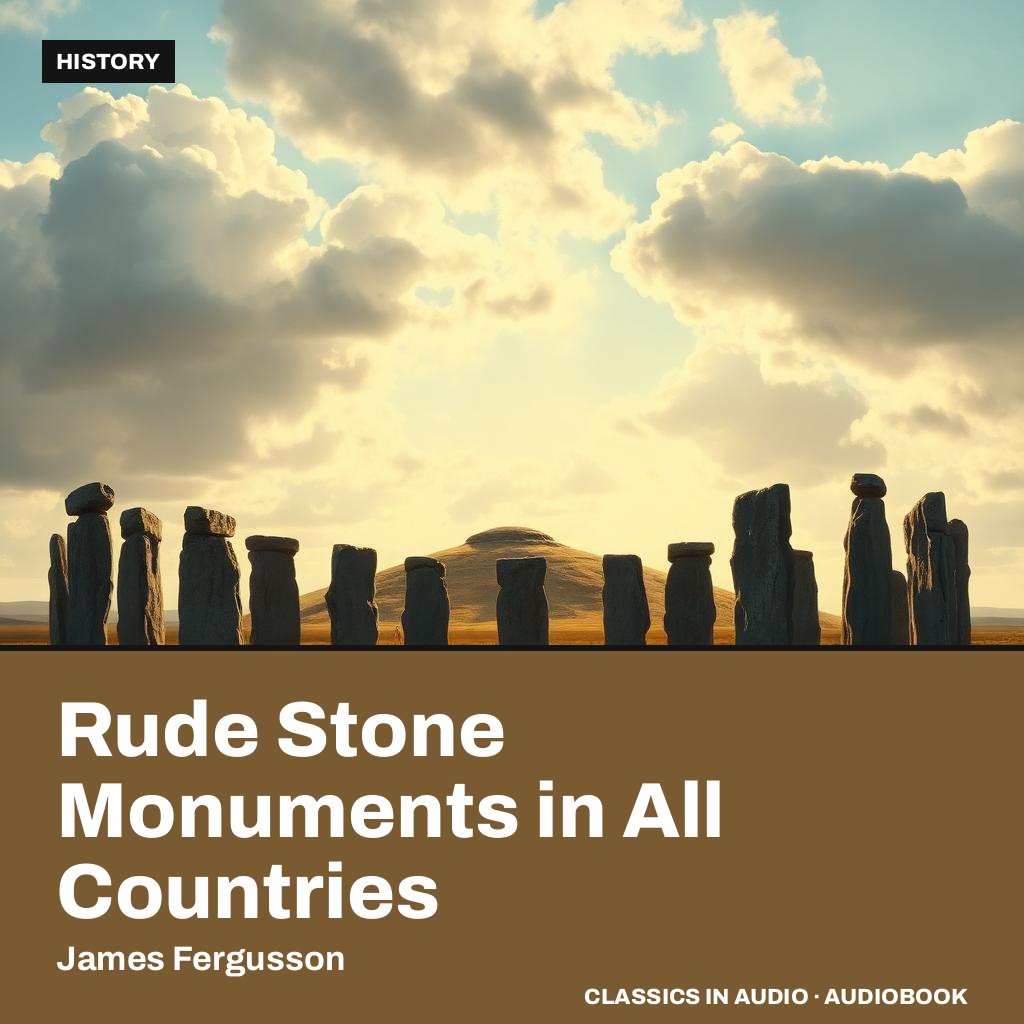
Rude Stone Monuments in All Countries
Their Age and Uses
by James Fergusson (1808–1886)
Unabridged audiobook · about 19 hr 35 min · English · read by a synthetic voice · MP3, no DRM
€6.90
Buy 2 audiobooks or more: −10%. Buy 5 or more: −20%.
Secure payment by Stripe. Your download link is e-mailed to you at once: the first 30 minutes are usually ready within a few minutes, and the rest follows while you listen. Listen online or download the MP3.
Rude Stone Monuments in All Countries is a nineteenth-century study of the standing stones, stone circles, dolmens and chambered mounds scattered from Britain and Brittany to Scandinavia, North Africa, India and beyond. Its central question is simple and still debated: who raised these huge unworked stones, and when? Fergusson takes it up with his usual impatience for vague answers.
The book is openly an argument rather than a catalogue. In his preface the author explains that the subject was so tangled with rival theories that he could not simply describe it. Were the circles temples, tombs or observatories? Were the dolmens graves or sacrificial altars? Were the monuments truly prehistoric, or built in periods that tradition and history record? Fergusson sets aside the Druid fantasies of earlier antiquaries and judges the stones as architecture, comparing them with other building traditions. He then pushes many of the monuments, Stonehenge and Avebury among them, into much later dates than most of his contemporaries accepted.
Fergusson (1808-1886) made a fortune in India as an indigo merchant before becoming a leading writer on architectural history. Many of his dating conclusions have since been overturned, which is part of the interest: this is a lively record of how Victorian scholars quarrelled over Europe's oldest monuments, with plenty of field observation behind the quarrel.
Text: Project Gutenberg edition no. 54620, read without its licence notices.
More history
 The Dogaressas of Venice (the Wives of the Doges)Edgcumbe Staley9 hr 17 min€4.90
 Miniatures of French HistoryHilaire Belloc5 hr 44 min€4.90
 The Catholic Church and HistoryHilaire Belloc2 hr 16 min€3.90
 The History of the Peloponnesian WarThucydides18 hr 37 min€6.90
 The Anabasis of AlexanderArrian13 hr 55 min€5.90
 AnabasisXenophon8 hr 32 min€4.90