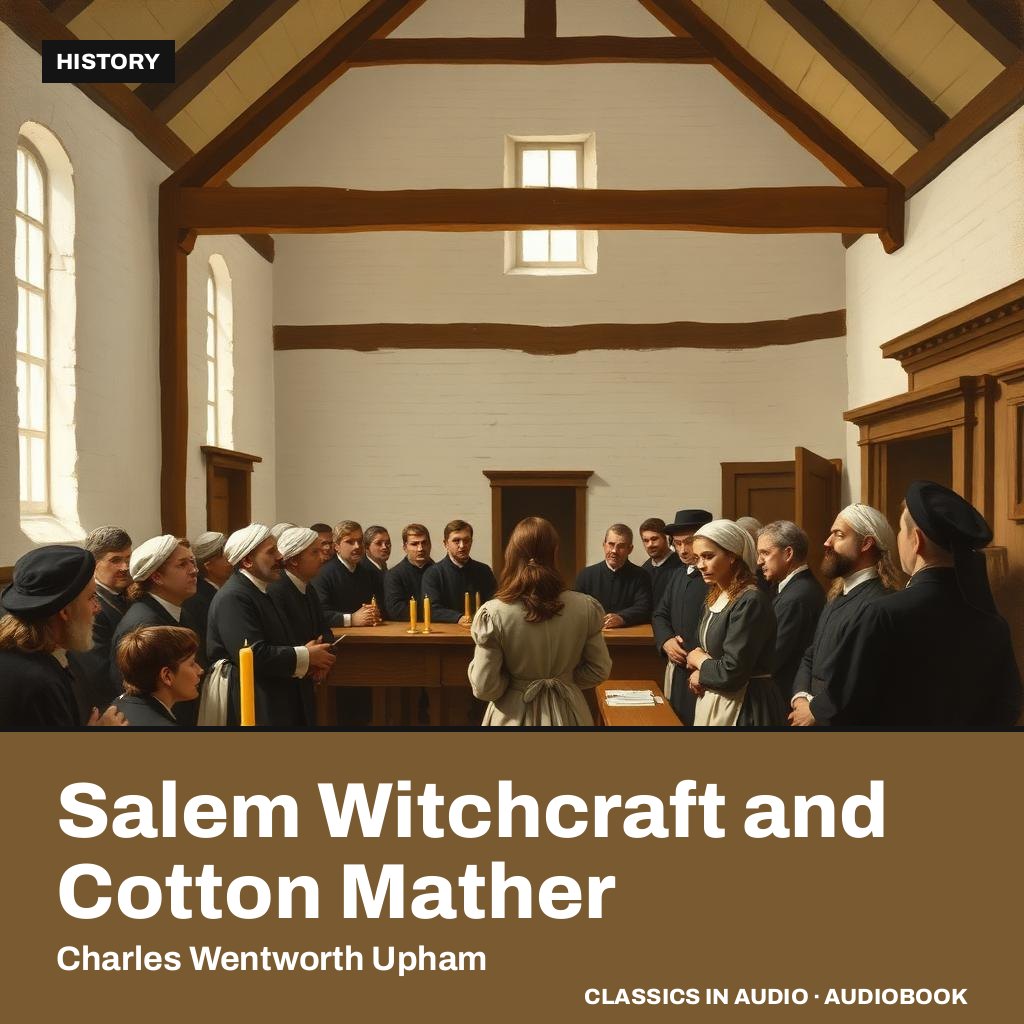
Salem Witchcraft and Cotton Mather
A Reply
by Charles Wentworth Upham (1802–1875)
Unabridged audiobook · about 8 hr 19 min · English · read by a synthetic voice · MP3, no DRM
€4.90
Buy 2 audiobooks or more: −10%. Buy 5 or more: −20%.
Secure payment by Stripe. Your download link is e-mailed to you at once: the first 30 minutes are usually ready within a few minutes, and the rest follows while you listen. Listen online or download the MP3.
In 1869 a review in the North American Review took issue with Charles Wentworth Upham's two-volume history of the Salem witch trials, and especially with his harsh verdict on the minister Cotton Mather. This book is Upham's answer. It is a polemic and a work of historical argument, written by a man who knew the ground well: Upham was a Unitarian minister, a congressman and a longtime resident of Salem itself.
The subject is the year 1692, when a special Court of Oyer and Terminer sat in Massachusetts and sent nineteen people to the gallows. Upham asks how far Mather, and his father Increase, shaped what happened. He starts with the afflicted Goodwin children in Boston, then moves through the new colonial charter, the arrival of Governor Phips, the court's creation, and the dispute over "spectral evidence", the claim that a victim's vision of an accused person's shape counted as proof. He examines Mather's letters, his book Wonders of the Invisible World, and the cases of John Proctor and George Burroughs. Later chapters trace how opinion of Mather changed over the next two centuries and weigh the writings of his critic Robert Calef.
It is worth hearing as a record of a historians' quarrel, showing how a nineteenth-century scholar sifted original documents to judge a famous episode of panic and injustice.
Text: Project Gutenberg edition no. 26978, read without its licence notices.
More by Charles Wentworth Upham
More history
 The Dogaressas of Venice (the Wives of the Doges)Edgcumbe Staley9 hr 17 min€4.90
 Miniatures of French HistoryHilaire Belloc5 hr 44 min€4.90
 The Catholic Church and HistoryHilaire Belloc2 hr 16 min€3.90
 The History of the Peloponnesian WarThucydides18 hr 37 min€6.90
 The Anabasis of AlexanderArrian13 hr 55 min€5.90
 AnabasisXenophon8 hr 32 min€4.90