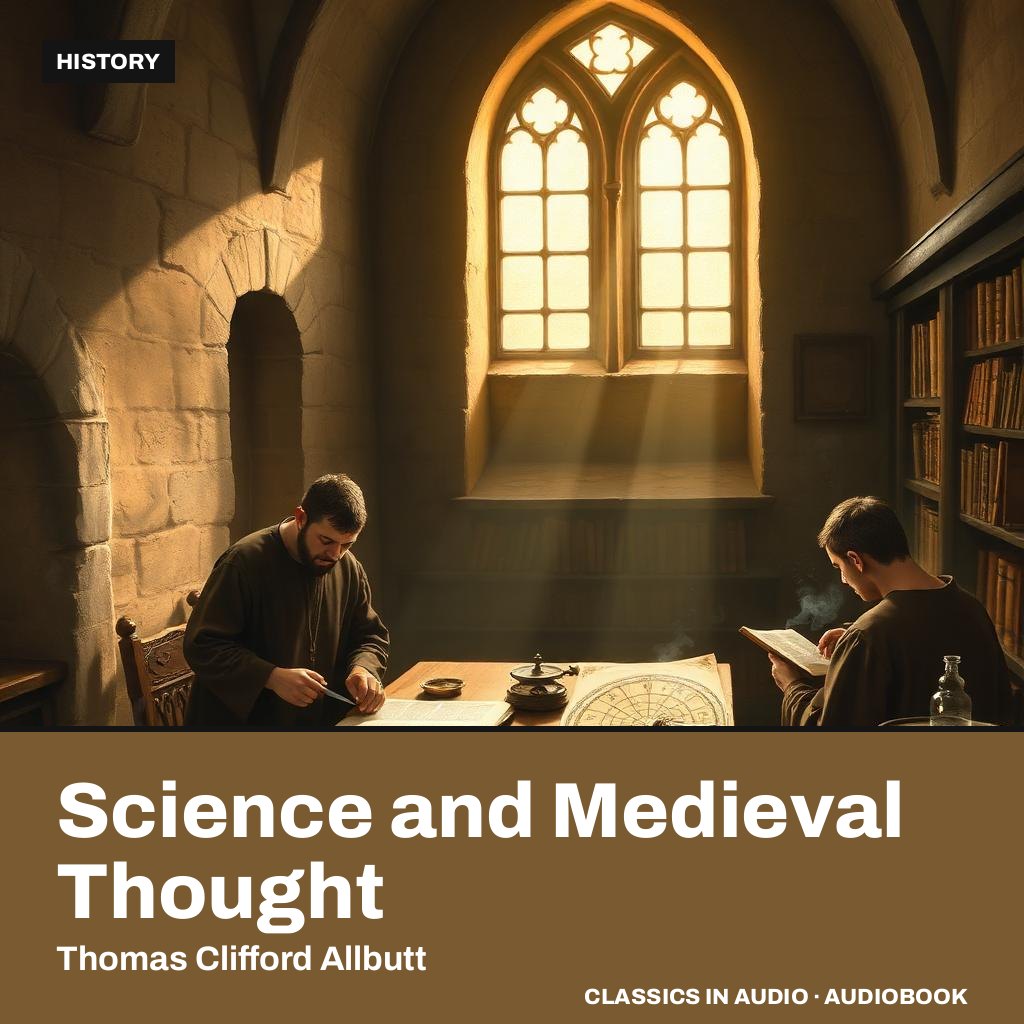
Science and Medieval Thought
The Harveian Oration Delivered Before the Royal College of Physicians, October 18, 1900
by Thomas Clifford Allbutt (1836–1925)
Unabridged audiobook · about 2 hr 31 min · English · read by a synthetic voice · MP3, no DRM
€3.90
Buy 2 audiobooks or more: −10%. Buy 5 or more: −20%.
Secure payment by Stripe. Your download link is e-mailed to you at once: the first 30 minutes are usually ready within a few minutes, and the rest follows while you listen. Listen online or download the MP3.
In October 1900, the physician and scholar T. Clifford Allbutt stood before the Royal College of Physicians in London to deliver the Harveian Oration, an annual lecture honouring William Harvey, who discovered the circulation of the blood. Allbutt, then Regius Professor of Physic at Cambridge, chose an unexpected subject: the thought of the Middle Ages and its place in the story of science.
His argument runs against the habit of his own century, which had treated medieval learning as dry pedantry to be thrown aside. Allbutt asks his audience to look back to an earlier time, when men pursued the meaning of life with real passion, and he traces the sources of that effort through Greek philosophy, Arab and Jewish commentators, and the schoolmen of the cathedral and university age. Roger Bacon, who defended experiment over argument alone, stands behind the whole lecture. The preface, written as the printed version went out in 1901, explains his purpose and his debts to scholars in France, Germany and England.
The book is a learned physician's attempt at fair history, written with some humour and a good deal of feeling. It is worth hearing now for its reminder that the roots of modern science were laid long before Galileo, Harvey and Newton.
Text: Project Gutenberg edition no. 38943, read without its licence notices.
More history
 The Dogaressas of Venice (the Wives of the Doges)Edgcumbe Staley9 hr 17 min€4.90
 Miniatures of French HistoryHilaire Belloc5 hr 44 min€4.90
 The Catholic Church and HistoryHilaire Belloc2 hr 16 min€3.90
 The History of the Peloponnesian WarThucydides18 hr 37 min€6.90
 The Anabasis of AlexanderArrian13 hr 55 min€5.90
 AnabasisXenophon8 hr 32 min€4.90