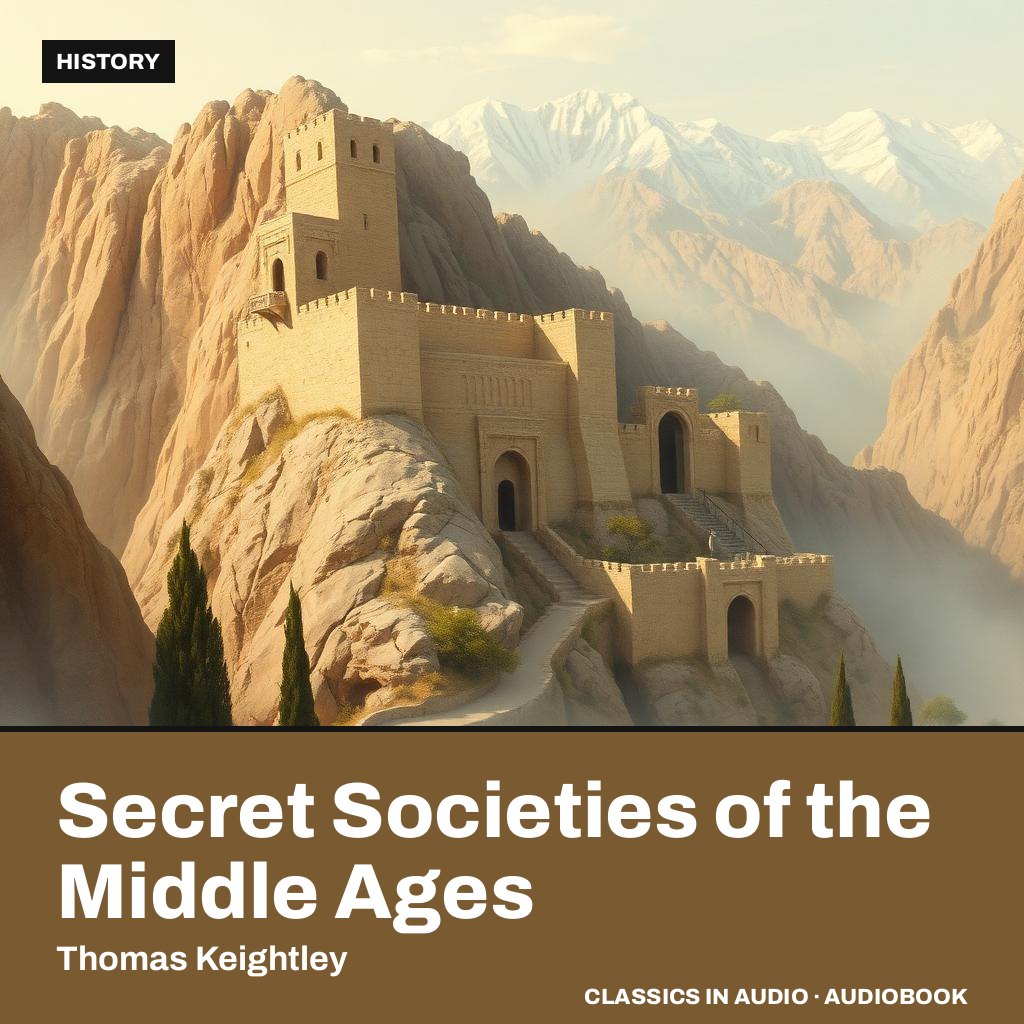
Secret Societies of the Middle Ages
by Thomas Keightley (1789–1872)
Unabridged audiobook · about 11 hr 37 min · English · read by a synthetic voice · MP3, no DRM
€5.90
Buy 2 audiobooks or more: −10%. Buy 5 or more: −20%.
Secure payment by Stripe. Your download link is e-mailed to you at once: the first 30 minutes are usually ready within a few minutes, and the rest follows while you listen. Listen online or download the MP3.
Thomas Keightley's study, first published in London in 1837 for the Library of Entertaining Knowledge, looks at two of the most feared and fabled brotherhoods of the medieval world: the Assassins and the Knights Templar. It is a work of popular history, written when the Crusades were still a subject of romance and rumour, and it sets out to separate record from legend.
The first part follows the Ismailite sect from its roots in the quarrels over Mohammed's succession, through the secret society of Cairo, to Hassan Sabah, who seized the mountain fortress of Alamoot in Persia. Keightley describes how the order was organised, where the word Assassin may come from, how Marco Polo's tale of a hidden paradise compares with Arab accounts, and how the sect finally fell to the Mongols. The second part turns to the Templars: the pilgrimages that drew Western knights to Jerusalem, the poverty of the order's first years, its rise to wealth and power, and the charges later made against it, including an alleged link with the Ismailites, which he examines and rejects.
Keightley was an Irish-born scholar best known for his books on folklore and fairy mythology, and he brings a collector's curiosity to sources and anecdotes. Listeners interested in the Crusades, or in how myths about secret orders began, will find a sceptical and readable guide.
Text: Project Gutenberg edition no. 38785, read without its licence notices.
More by Thomas Keightley
More history
 The Dogaressas of Venice (the Wives of the Doges)Edgcumbe Staley9 hr 17 min€4.90
 Miniatures of French HistoryHilaire Belloc5 hr 44 min€4.90
 The Catholic Church and HistoryHilaire Belloc2 hr 16 min€3.90
 The History of the Peloponnesian WarThucydides18 hr 37 min€6.90
 The Anabasis of AlexanderArrian13 hr 55 min€5.90
 AnabasisXenophon8 hr 32 min€4.90