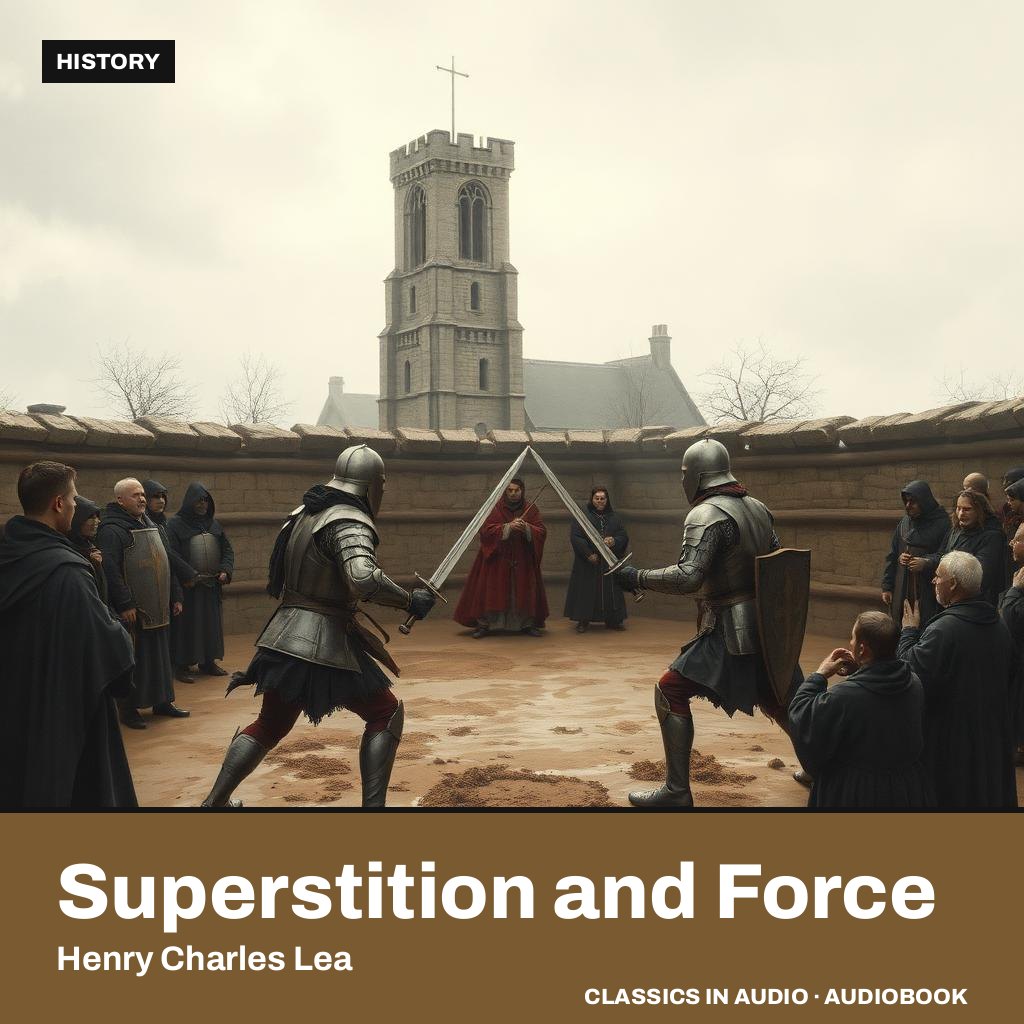
Superstition and Force
Essays on the Wager of Law, the Wager of Battle, the Ordeal, Torture
by Henry Charles Lea (1825–1909)
Unabridged audiobook · about 22 hr 23 min · English · read by a synthetic voice · MP3, no DRM
€7.90
Buy 2 audiobooks or more: −10%. Buy 5 or more: −20%.
Secure payment by Stripe. Your download link is e-mailed to you at once: the first 30 minutes are usually ready within a few minutes, and the rest follows while you listen. Listen online or download the MP3.
Henry Charles Lea, a Philadelphia publisher turned historian of medieval institutions, opens this study with a bold claim: the history of law is the history of civilization. His subject is how our ancestors settled disputes when no one could prove who was telling the truth. The answers they devised now look strange, and Lea sets them out with sober, documented detail.
The first essays follow the wager of law, in which an accused person cleared himself by swearing an oath, backed by a set number of neighbours or kinsmen who swore with him. Next comes the wager of battle, the judicial duel, fought by the parties or by hired champions, with the result taken as a verdict from Heaven. The third essay turns to the ordeal: fire, water, and other tests in which the body was made to answer for the soul. A final essay deals with torture. Lea draws on Germanic codes, Church records, and the customs of medieval France, England, and beyond, and he traces some of these practices back to prehistoric Aryan roots.
First published in the 1870s and revised in 1892, the book shows how people have reasoned about guilt, proof, and divine justice, and why such methods held on for centuries. It also suggests that old superstitions linger beneath modern rationality.
Text: Project Gutenberg edition no. 58750, read without its licence notices.
More by Henry Charles Lea
 The Inquisition in the Spanish DependenciesHenry Charles Lea21 hr 02 min€7.90
 An Historical Sketch of Sacerdotal Celibacy in the Christian ChurchHenry Charles Lea30 hr 16 min€9.90
More history
 The Dogaressas of Venice (the Wives of the Doges)Edgcumbe Staley9 hr 17 min€4.90
 Miniatures of French HistoryHilaire Belloc5 hr 44 min€4.90
 The Catholic Church and HistoryHilaire Belloc2 hr 16 min€3.90
 The History of the Peloponnesian WarThucydides18 hr 37 min€6.90
 The Anabasis of AlexanderArrian13 hr 55 min€5.90
 AnabasisXenophon8 hr 32 min€4.90