The Babylonian Story of the Deluge as Told by Assyrian Tablets from Nineveh
The Discovery of the Tablets at Nineveh by Layard, Rassam and Smith
by E. A. Wallis Budge (1857–1934)
Unabridged audiobook · about 1 hr 22 min · English · read by a synthetic voice · MP3, no DRM
€3.90
Buy 2 audiobooks or more: −10%. Buy 5 or more: −20%.
Secure payment by Stripe. Your download link is e-mailed to you at once: the first 30 minutes are usually ready within a few minutes, and the rest follows while you listen. Listen online or download the MP3.
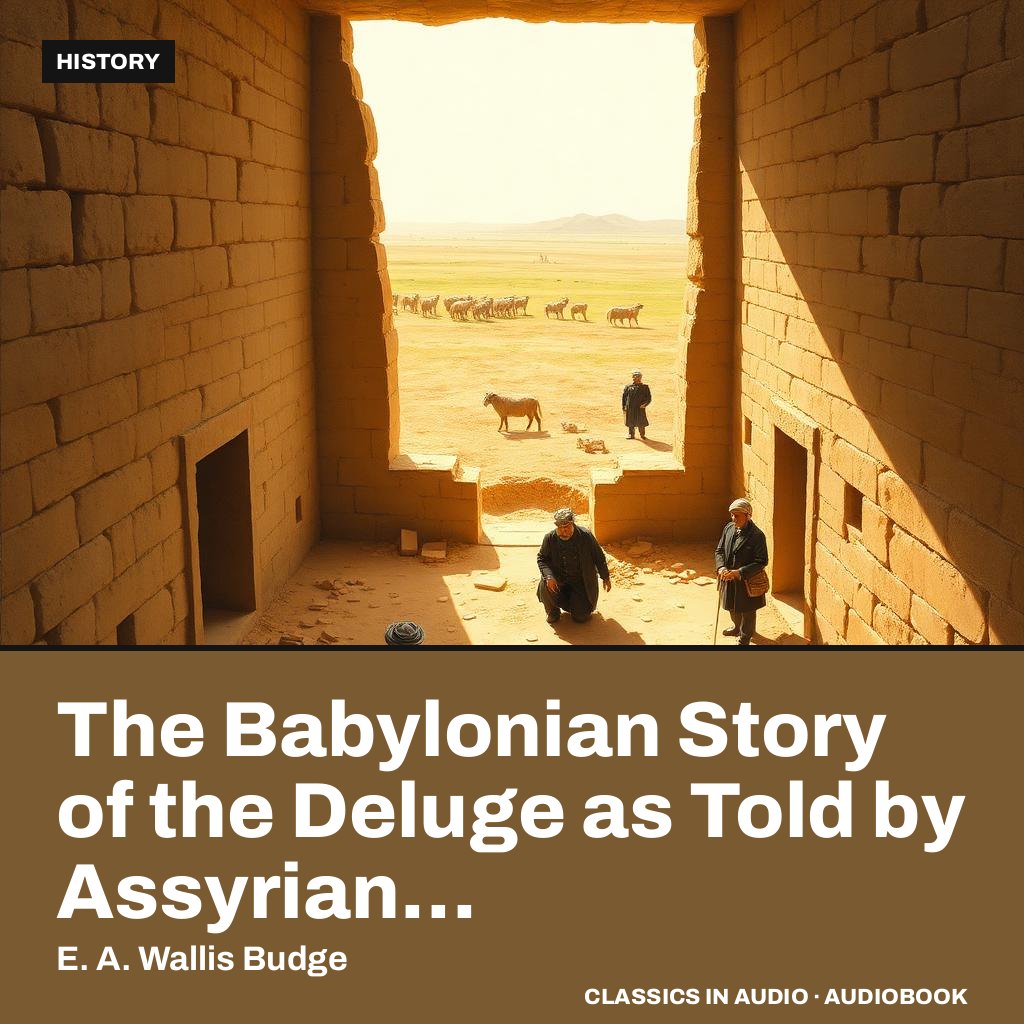
This short scholarly work by the British Museum Assyriologist E. A. Wallis Budge tells how the Babylonian account of the Flood came to light. It begins with the ruins of Nineveh, the Assyrian capital on the Tigris opposite modern Mosul, where two great mounds, Kuyunjik and Nabi Yunis, cover the palaces of kings such as Sennacherib and Ashurbanipal. Budge describes the city walls, the changing course of the river, and the local belief that the prophet Jonah lies buried on the hill.
The heart of the story is the excavation of 1852, when Austen Henry Layard and Hormuzd Rassam opened two small chambers in the south-west palace and found them filled knee-deep with baked clay tablets. Many had been broken when the city was burned by the Medes and Babylonians in the seventh century B.C. Budge explains how colophons on the tablets identified them as belonging to the library of the temple of Nebo, the god of scribes and wisdom, and how the clay was shipped carelessly to England. Later work by George Smith led to the Flood narrative itself. For anyone curious about how a lost literature was recovered, it shows the practical, sometimes clumsy, beginnings of Assyriology.
Text: Project Gutenberg edition no. 7096, read without its licence notices.
More by E. A. Wallis Budge
 The Book of the DeadE. A. Wallis Budge1 hr 09 min€3.90
 Legends of the GodsE. A. Wallis Budge5 hr 28 min€4.90
 The Literature of the Ancient EgyptiansE. A. Wallis Budge8 hr 58 min€4.90
 The Babylonian Legends of the CreationE. A. Wallis Budge1 hr 31 min€3.90
 Egyptian Ideas of the Future LifeE. A. Wallis Budge4 hr 19 min€3.90
More history
 The Dogaressas of Venice (the Wives of the Doges)Edgcumbe Staley9 hr 17 min€4.90
 Miniatures of French HistoryHilaire Belloc5 hr 44 min€4.90
 The Catholic Church and HistoryHilaire Belloc2 hr 16 min€3.90
 The History of the Peloponnesian WarThucydides18 hr 37 min€6.90
 The Anabasis of AlexanderArrian13 hr 55 min€5.90
 AnabasisXenophon8 hr 32 min€4.90