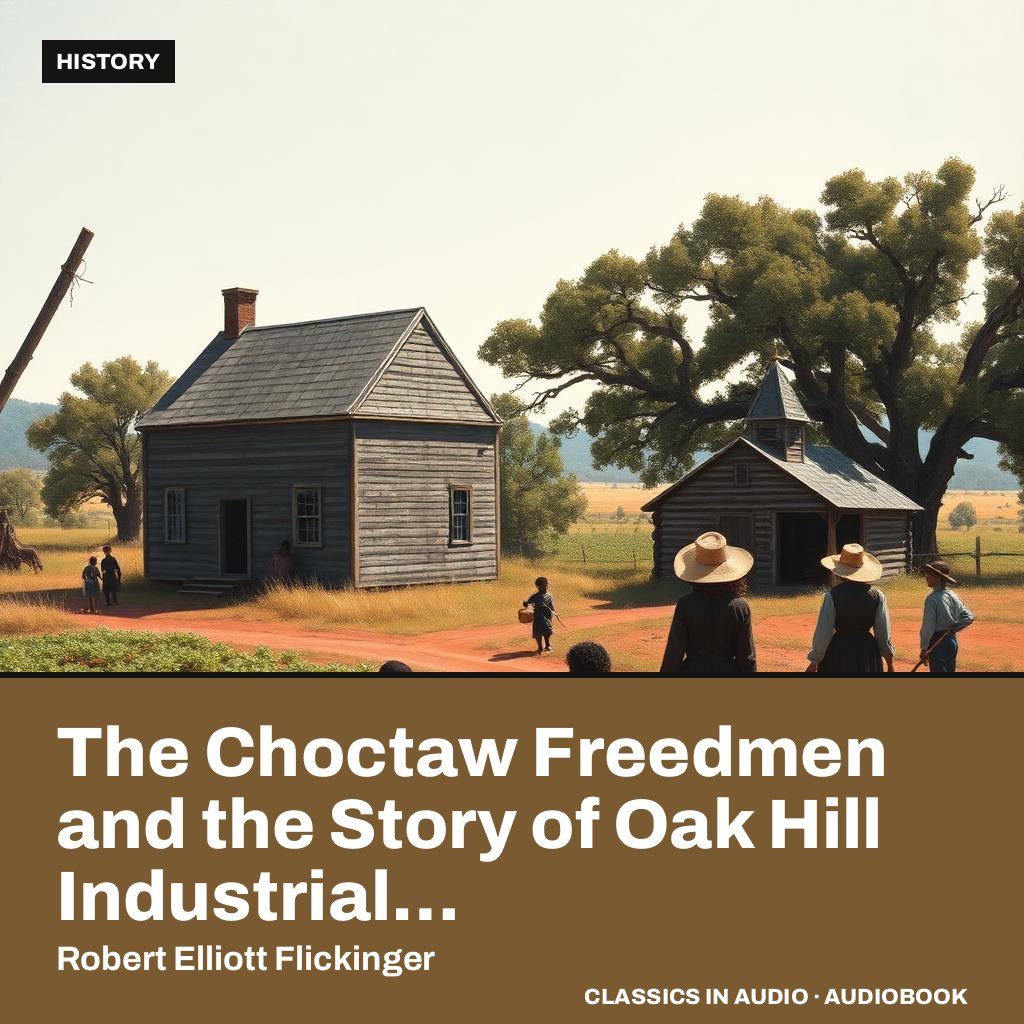
The Choctaw Freedmen and the Story of Oak Hill Industrial Academy
by Robert Elliott Flickinger (1846–1937)
Unabridged audiobook · about 11 hr 16 min · English · read by a synthetic voice · MP3, no DRM
€5.90
Buy 2 audiobooks or more: −10%. Buy 5 or more: −20%.
Secure payment by Stripe. Your download link is e-mailed to you at once: the first 30 minutes are usually ready within a few minutes, and the rest follows while you listen. Listen online or download the MP3.
This is a local and institutional history of Oak Hill Industrial Academy, a boarding school for the Freedmen of the Choctaw Nation in Indian Territory, in what is now southeastern Oklahoma. The Choctaw had held enslaved people before the Civil War, and their former slaves and descendants then faced the question of what freedom would mean. The Presbyterian Church opened the school in 1886 with Eliza Hartford as its first white teacher. The story runs through log buildings, a closure in 1904, a reopening, and the building of Elliott Hall, after which the school took the name Alice Lee Elliott Memorial.
Robert Elliott Flickinger, born in 1846, served as superintendent of the academy and as pastor of the Oak Hill Church, so he writes as a participant. He covers the teachers and students, the farm work that helped pupils pay their way, Bible study, and the churches founded by the pioneer preacher Charles W. Stewart. Later chapters turn to the question of religion in public schools, with a look at France.
The book appeared in 1914 and carries the outlook of its time and its mission board. It is worth hearing for the detail it keeps about a small, little-documented community, and for its view of Reconstruction-era education far from the usual settings.
Text: Project Gutenberg edition no. 23321, read without its licence notices.
More history
 The Dogaressas of Venice (the Wives of the Doges)Edgcumbe Staley9 hr 17 min€4.90
 Miniatures of French HistoryHilaire Belloc5 hr 44 min€4.90
 The Catholic Church and HistoryHilaire Belloc2 hr 16 min€3.90
 The History of the Peloponnesian WarThucydides18 hr 37 min€6.90
 The Anabasis of AlexanderArrian13 hr 55 min€5.90
 AnabasisXenophon8 hr 32 min€4.90