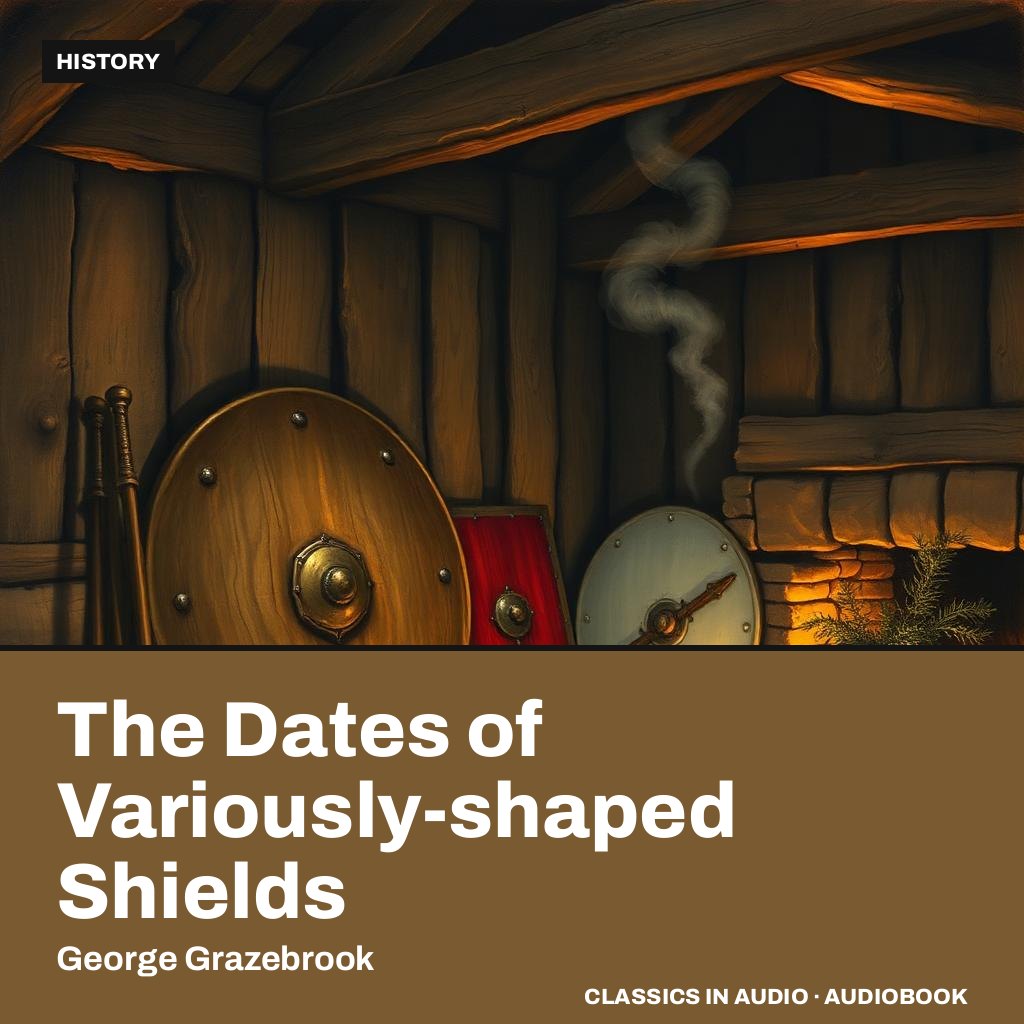
The Dates of Variously-shaped Shields
with Coincident Dates and Examples
by George Grazebrook (1831–1917)
Unabridged audiobook · about 2 hr 23 min · English · read by a synthetic voice · MP3, no DRM
€3.90
Buy 2 audiobooks or more: −10%. Buy 5 or more: −20%.
Secure payment by Stripe. Your download link is e-mailed to you at once: the first 30 minutes are usually ready within a few minutes, and the rest follows while you listen. Listen online or download the MP3.
George Grazebrook's study sets out to answer a question that trips up many students of medieval art: how old is a shield? Heraldic shields changed shape over the centuries, and Grazebrook uses those changes as a dating tool. He treats each century from the eleventh to the fifteenth in turn, then follows a system of shield names devised by his friend J. Paul Rylands, giving the earliest and latest examples he found of each form, with references for every statement.
The main evidence comes from seals, along with stone carvings and manuscript illustrations. Many of these are labelled only "circa" because nobody has pinned them down. Grazebrook argues that a well-classified record of shield shapes could date such items within a few years, and he points out cases where earlier writers guessed wrongly and built conclusions on those guesses. He also covers mantlings, wreaths, and other additions to the shield.
The opening chapter looks at the big round wooden shields of Saxons and Normans, drawing on Norse sagas, Anglo-Saxon poetry, and finds from grave mounds. It asks why linden wood was favoured and whether red shields marked the common soldier. Grazebrook, a Victorian antiquary, wrote for students, travellers, and anyone who wants to read the carved and sealed evidence of Britain's past with more confidence.
Text: Project Gutenberg edition no. 47761, read without its licence notices.
More history
 The Dogaressas of Venice (the Wives of the Doges)Edgcumbe Staley9 hr 17 min€4.90
 Miniatures of French HistoryHilaire Belloc5 hr 44 min€4.90
 The Catholic Church and HistoryHilaire Belloc2 hr 16 min€3.90
 The History of the Peloponnesian WarThucydides18 hr 37 min€6.90
 The Anabasis of AlexanderArrian13 hr 55 min€5.90
 AnabasisXenophon8 hr 32 min€4.90