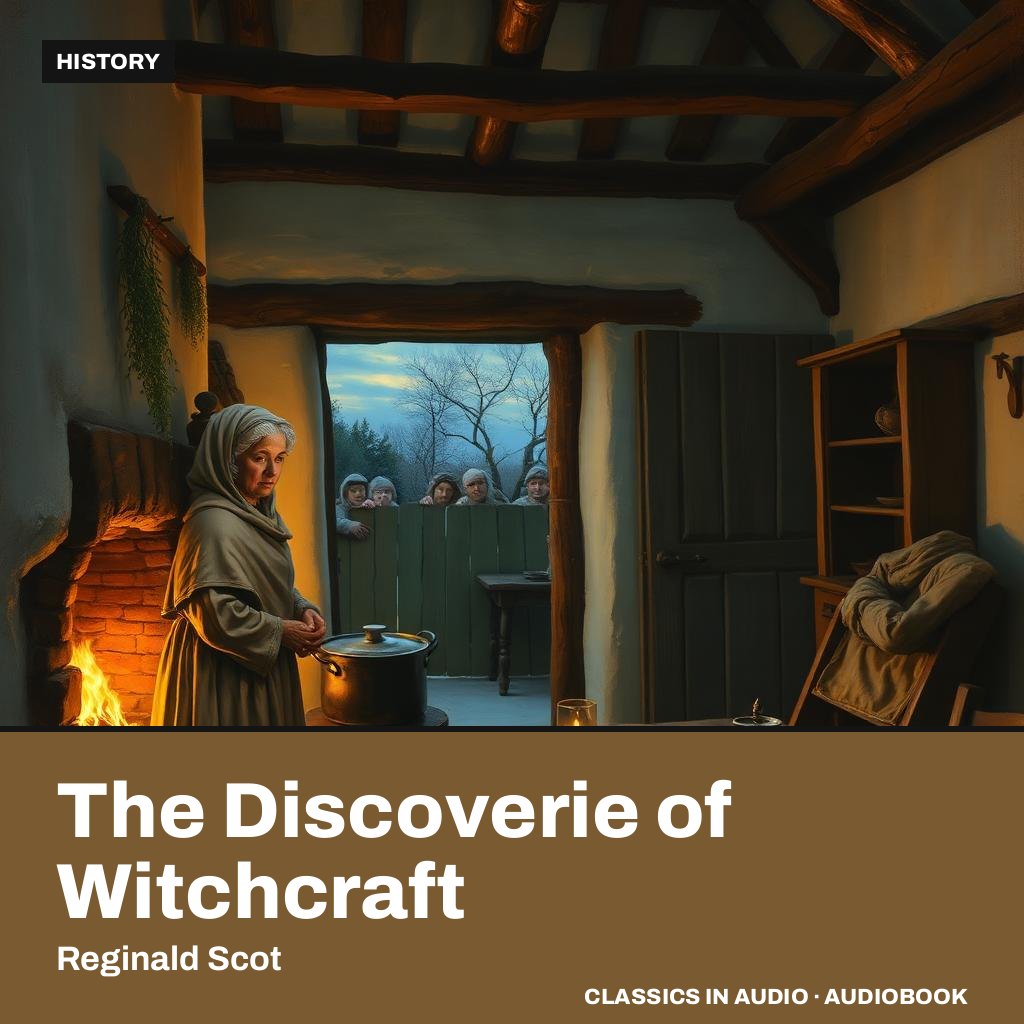
The Discoverie of Witchcraft
Unabridged audiobook · about 28 hr 17 min · English · read by a synthetic voice · MP3, no DRM
€7.90
Buy 2 audiobooks or more: −10%. Buy 5 or more: −20%.
Secure payment by Stripe. Your download link is e-mailed to you at once: the first 30 minutes are usually ready within a few minutes, and the rest follows while you listen. Listen online or download the MP3.
Reginald Scot's The Discoverie of Witchcraft, first printed in 1584, is an Elizabethan attack on the belief that witches could harm people by supernatural means. Scot, a Kentish gentleman and member of Parliament, wrote as a sceptic at a time when the persecution of witches was gathering force in England. He picks apart the evidence used in trials: confessions drawn from frightened, elderly and often poor women, tales passed along as fact, and the learned writings of continental demonologists. He also draws on the work of the physician Johann Weyer, whose earlier arguments he helped bring to English readers.
The book is more varied than its title suggests. Scot sets out to show how tricks and illusions can pass for marvels, and he includes a detailed section on conjuring that is often counted among the earliest English books on the subject of stage magic. He also treats melancholy and other illnesses as possible causes of what accusers called bewitchment. King James later ordered the book burned, and Shakespeare and Middleton are thought to have borrowed from it.
This edition was prepared by Brinsley Nicholson in the nineteenth century. For anyone curious about how fear, law and belief shaped early modern Europe, it records one man arguing for mercy and evidence while the crowd around him wanted neither.
Text: Project Gutenberg edition no. 60766, read without its licence notices.
More history
 The Dogaressas of Venice (the Wives of the Doges)Edgcumbe Staley9 hr 17 min€4.90
 Miniatures of French HistoryHilaire Belloc5 hr 44 min€4.90
 The Catholic Church and HistoryHilaire Belloc2 hr 16 min€3.90
 The History of the Peloponnesian WarThucydides18 hr 37 min€6.90
 The Anabasis of AlexanderArrian13 hr 55 min€5.90
 AnabasisXenophon8 hr 32 min€4.90