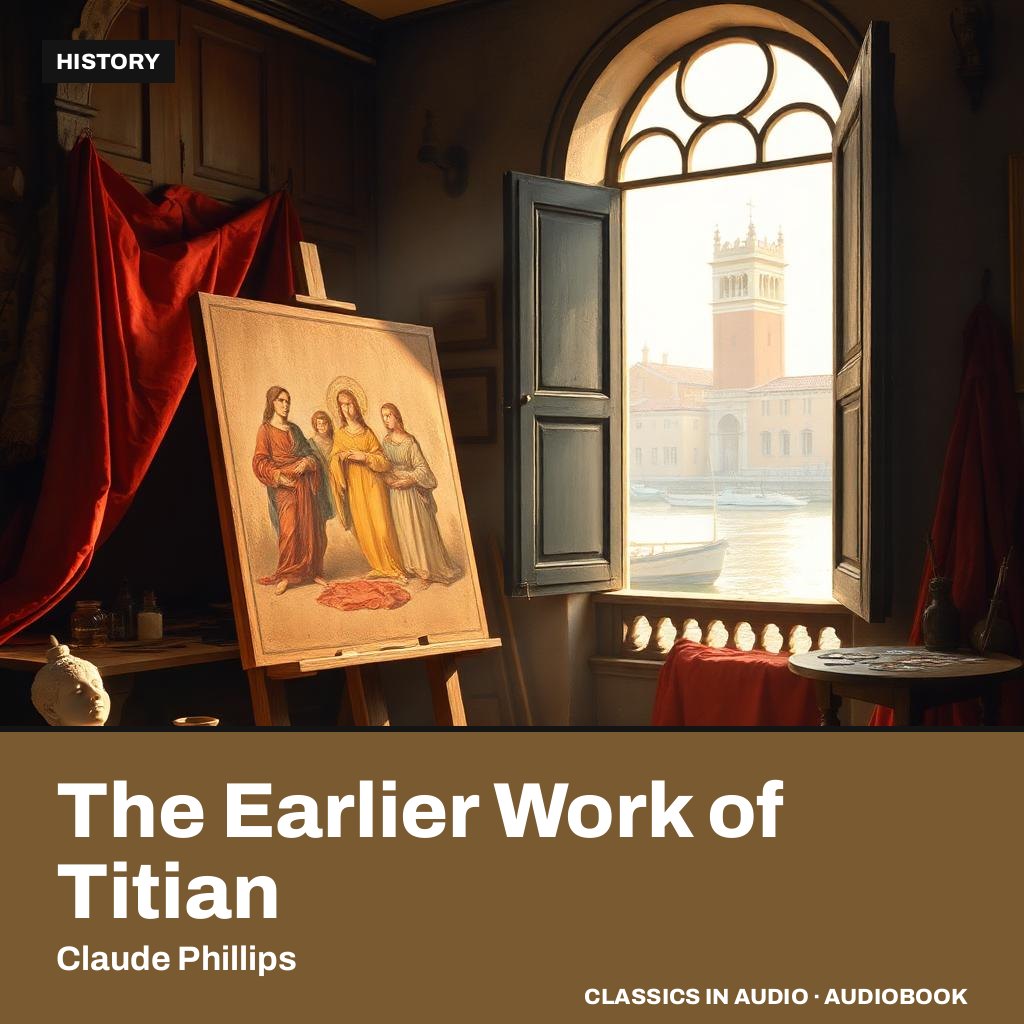
The Earlier Work of Titian
by Claude Phillips (1846–1924)
Unabridged audiobook · about 2 hr 50 min · English · read by a synthetic voice · MP3, no DRM
€3.90
Buy 2 audiobooks or more: −10%. Buy 5 or more: −20%.
Secure payment by Stripe. Your download link is e-mailed to you at once: the first 30 minutes are usually ready within a few minutes, and the rest follows while you listen. Listen online or download the MP3.
The Earlier Work of Titian is a work of art criticism that follows the Venetian painter from his youth up to the middle of his career. The book is organised around the pictures themselves, and the list of plates alone takes the reader from the Gypsy Madonna in Vienna and the Baptism of Christ in Rome to the Bacchus and Ariadne in London, the Assunta in Venice and the altar-piece of the Pesaro family in the Frari. Sacred scenes, mythologies, portraits and frescoes are all covered, and the author often compares one picture with another or with a work by a rival.
Sir Claude Phillips, an English critic who became the first Keeper of the Wallace Collection, opens with a confident case for Titian's place among the Italian masters. He weighs him against Leonardo, Michelangelo and Raphael, and against fellow Venetians such as Giorgione, Lotto and Moretto, then considers his achievement in altar-pieces, portraits and landscape. Phillips writes with the opinions and polish of a Edwardian connoisseur, and he is not afraid to prefer one painter to another.
The book suits anyone planning a visit to a gallery, or anyone who wants to hear a scholar of the period describe how Venetian painting developed in the early sixteenth century, from the lingering influence of Giovanni Bellini to a confident style of Titian's own.
Text: Project Gutenberg edition no. 12626, read without its licence notices.
More history
 The Dogaressas of Venice (the Wives of the Doges)Edgcumbe Staley9 hr 17 min€4.90
 Miniatures of French HistoryHilaire Belloc5 hr 44 min€4.90
 The Catholic Church and HistoryHilaire Belloc2 hr 16 min€3.90
 The History of the Peloponnesian WarThucydides18 hr 37 min€6.90
 The Anabasis of AlexanderArrian13 hr 55 min€5.90
 AnabasisXenophon8 hr 32 min€4.90