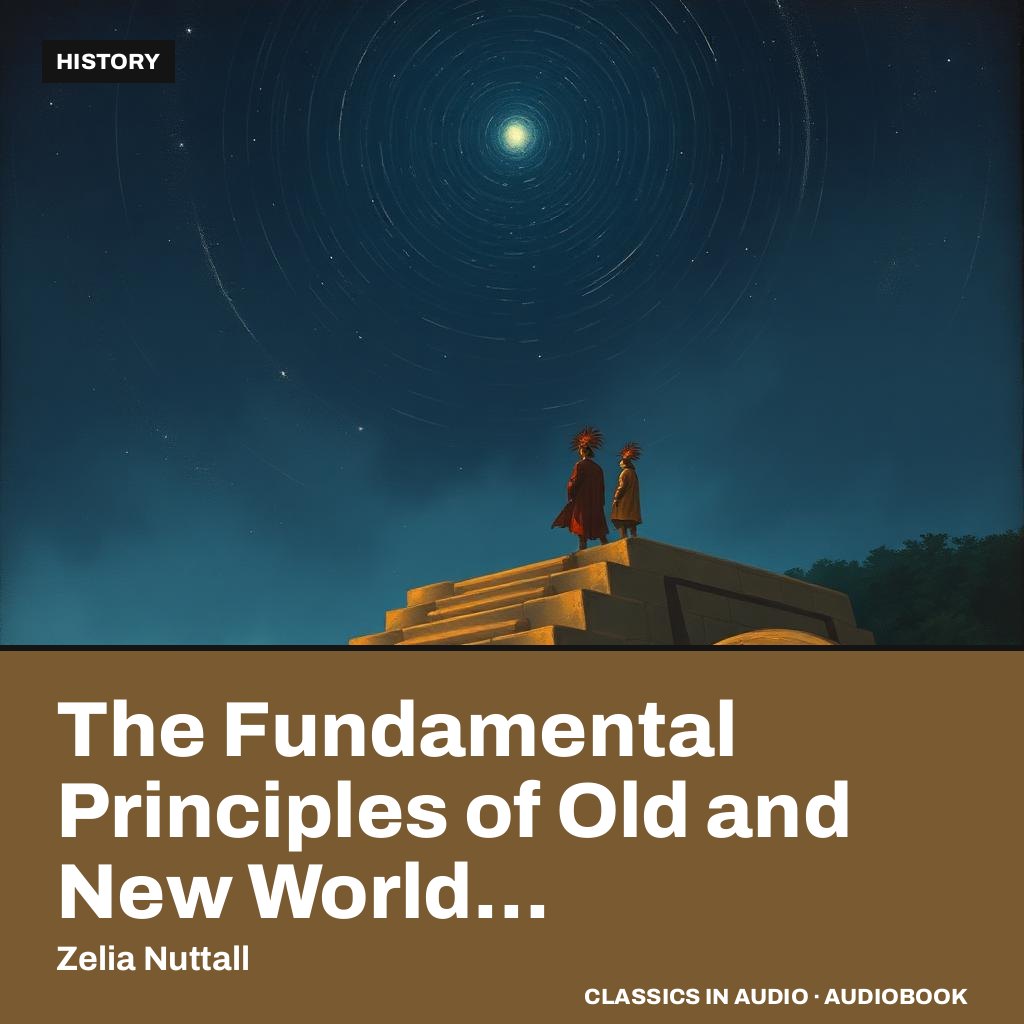
The Fundamental Principles of Old and New World Civilizations
A Comparative Research Based on a Study of the Ancient Mexican Religious, Sociological, and Calendrical Systems
by Zelia Nuttall (1858–1933)
Unabridged audiobook · about 24 hr 44 min · English · read by a synthetic voice · MP3, no DRM
€7.90
Buy 2 audiobooks or more: −10%. Buy 5 or more: −20%.
Secure payment by Stripe. Your download link is e-mailed to you at once: the first 30 minutes are usually ready within a few minutes, and the rest follows while you listen. Listen online or download the MP3.
Zelia Nuttall's 1901 study begins with a small question: where did the swastika found in ancient Mexico come from? She traces it to the night sky, to the turning of the stars around the celestial pole. From there the book grows far beyond its first plan. Nuttall compares the calendars, religious ideas and social organization of the Aztecs, the Maya, the Zuñi and the Peruvians, and finds the same scheme of a state laid out in numbered divisions that mirror the heavens.
She then follows the same ideas across the Atlantic and the Pacific, into China, western Asia, Egypt, Greece, Rome and western Europe. Her argument is that these likenesses are too many and too close to be chance, and that pre-Columbian contact deserves serious consideration. She says plainly that she is not advancing a final theory, and she asks specialists to test her evidence.
Nuttall was an American archaeologist who made her name with work on Mexican codices and ancient Mexican history. The book was published by Harvard's Peabody Museum and shows its age in method and conclusions. It is still a striking record of how a scholar of her day tried to read a whole hemisphere's cosmology, and of an argument about contact between worlds that has not gone away.
Text: Project Gutenberg edition no. 32066, read without its licence notices.
More history
 The Dogaressas of Venice (the Wives of the Doges)Edgcumbe Staley9 hr 17 min€4.90
 Miniatures of French HistoryHilaire Belloc5 hr 44 min€4.90
 The Catholic Church and HistoryHilaire Belloc2 hr 16 min€3.90
 The History of the Peloponnesian WarThucydides18 hr 37 min€6.90
 The Anabasis of AlexanderArrian13 hr 55 min€5.90
 AnabasisXenophon8 hr 32 min€4.90