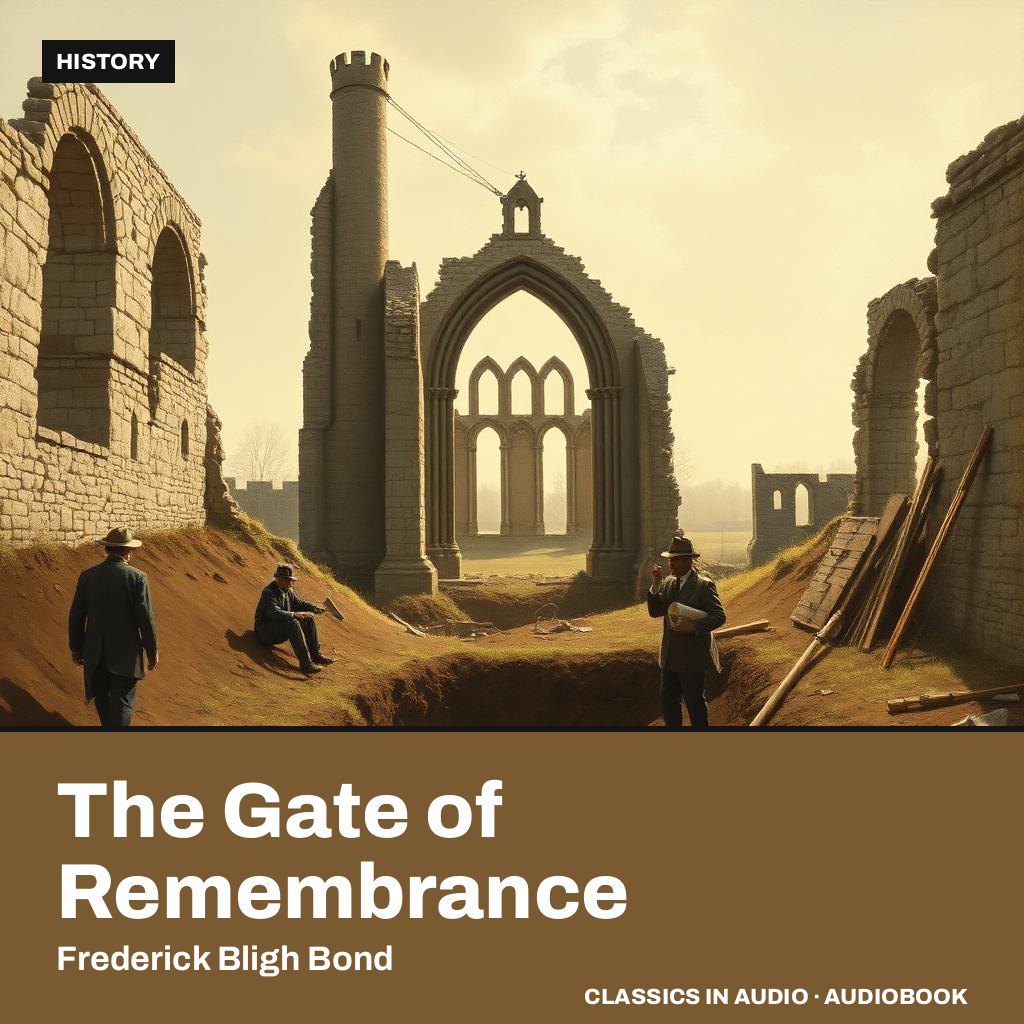
The Gate of Remembrance
The Story of the Psychological Experiment Which Resulted in the Discovery of the Edgar Chapel at Glastonbury
by Frederick Bligh Bond (1864–1945)
Unabridged audiobook · about 4 hr 11 min · English · read by a synthetic voice · MP3, no DRM
€3.90
Buy 2 audiobooks or more: −10%. Buy 5 or more: −20%.
Secure payment by Stripe. Your download link is e-mailed to you at once: the first 30 minutes are usually ready within a few minutes, and the rest follows while you listen. Listen online or download the MP3.
In 1907 the architect Frederick Bligh Bond, newly appointed to direct excavations at the ruined Glastonbury Abbey in Somerset, began an experiment that he later described in this book. With a friend, identified by the initials J.A., he sat with pencil and paper and let the friend's hand write automatically while he asked questions about the abbey's lost buildings. The pages that resulted, in a mixture of Latin, medieval English and modern prose, were said to come from monks long dead and to describe the layout of chapels that no one had yet uncovered.
Bond then set out to test the messages with the spade. The book lays out the scripts, the plans he drew from them, and the walls and foundations, including the Edgar Chapel at the abbey's east end, that his workmen found. The opening pages of this second edition turn to the strangeness of the writing itself and ask how it might have come about, whether from buried memory, telepathy between the two sitters, or some wider store of remembrance.
Bond was a trained church architect, and his account reads as the work of a man weighing evidence while keeping his own convictions in plain view. Readers will find it both a curious document of Edwardian psychical research and a record of one of England's best-known ecclesiastical ruins.
Text: Project Gutenberg edition no. 48568, read without its licence notices.
More history
 The Dogaressas of Venice (the Wives of the Doges)Edgcumbe Staley9 hr 17 min€4.90
 Miniatures of French HistoryHilaire Belloc5 hr 44 min€4.90
 The Catholic Church and HistoryHilaire Belloc2 hr 16 min€3.90
 The History of the Peloponnesian WarThucydides18 hr 37 min€6.90
 The Anabasis of AlexanderArrian13 hr 55 min€5.90
 AnabasisXenophon8 hr 32 min€4.90