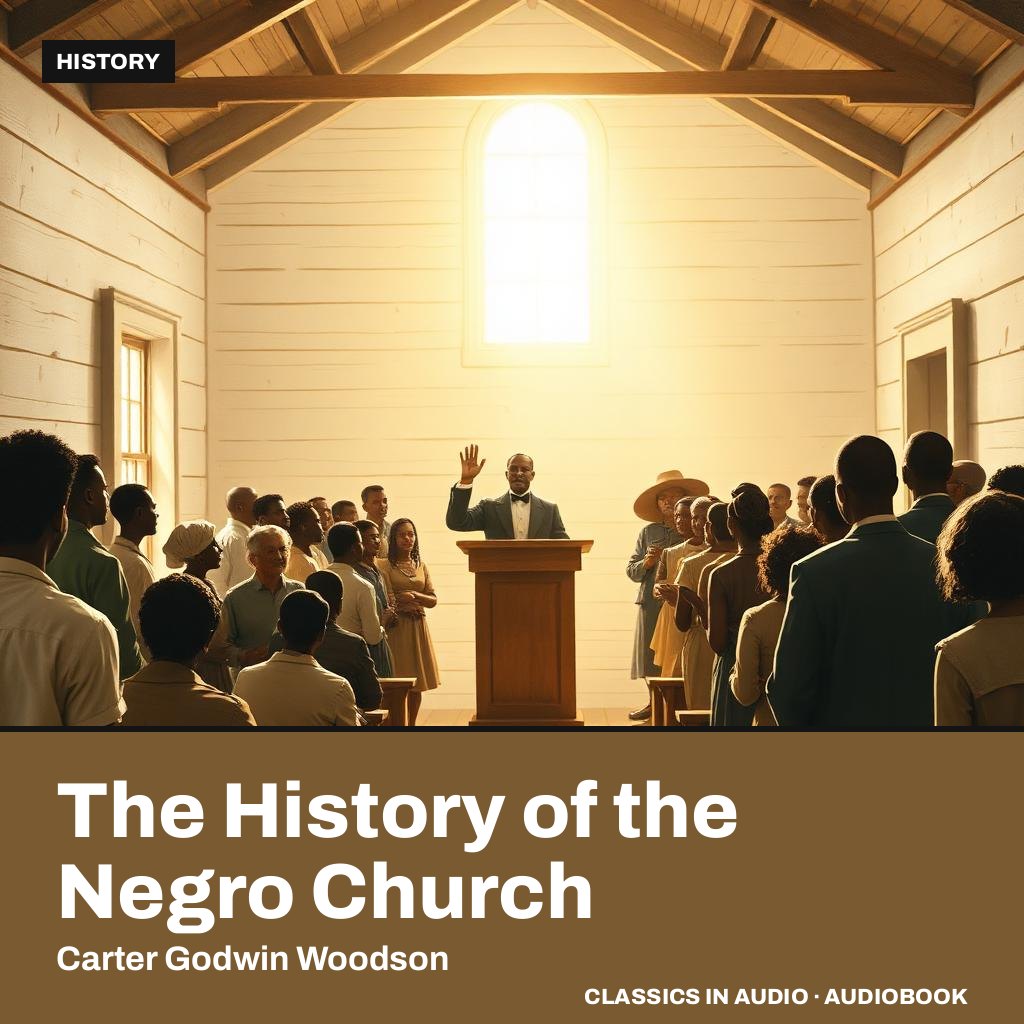
The History of the Negro Church
by Carter Godwin Woodson (1875–1950)
Unabridged audiobook · about 8 hr 01 min · English · read by a synthetic voice · MP3, no DRM
€4.90
Buy 2 audiobooks or more: −10%. Buy 5 or more: −20%.
Secure payment by Stripe. Your download link is e-mailed to you at once: the first 30 minutes are usually ready within a few minutes, and the rest follows while you listen. Listen online or download the MP3.
The History of the Negro Church traces how Black Christianity took shape in the Americas, from the first European missionaries to the congregations of the early twentieth century. Carter G. Woodson wrote it in 1921, and he opens with a hard question: should enslaved Africans be brought into the Christian faith at all? Colonial planters feared that baptism and instruction might lead slaves to expect freedom, and the royal decrees meant to protect them were largely ignored.
From there the book follows the people and institutions that grew out of that struggle. It covers pioneer preachers, the break from white-led churches, and the founding of independent denominations. It goes on to the Civil War, the pull of politics after emancipation, schooling and religious education, and the church's widening social work. Chapters on figures such as Richard Allen, Andrew Bryan, Lott Cary and Daniel A. Payne put individual lives at the centre of the story.
Woodson, the son of formerly enslaved parents, earned a Harvard doctorate and founded the Association for the Study of Negro Life and History. He admits in his preface that gaps in denominational records limited what he could document. Even so, the book remains a useful account of how one of the central institutions of African American life was built and who built it.
Text: Project Gutenberg edition no. 38963, read without its licence notices.
More by Carter Godwin Woodson

More history
 The Dogaressas of Venice (the Wives of the Doges)Edgcumbe Staley9 hr 17 min€4.90
 Miniatures of French HistoryHilaire Belloc5 hr 44 min€4.90
 The Catholic Church and HistoryHilaire Belloc2 hr 16 min€3.90
 The History of the Peloponnesian WarThucydides18 hr 37 min€6.90
 The Anabasis of AlexanderArrian13 hr 55 min€5.90
 AnabasisXenophon8 hr 32 min€4.90