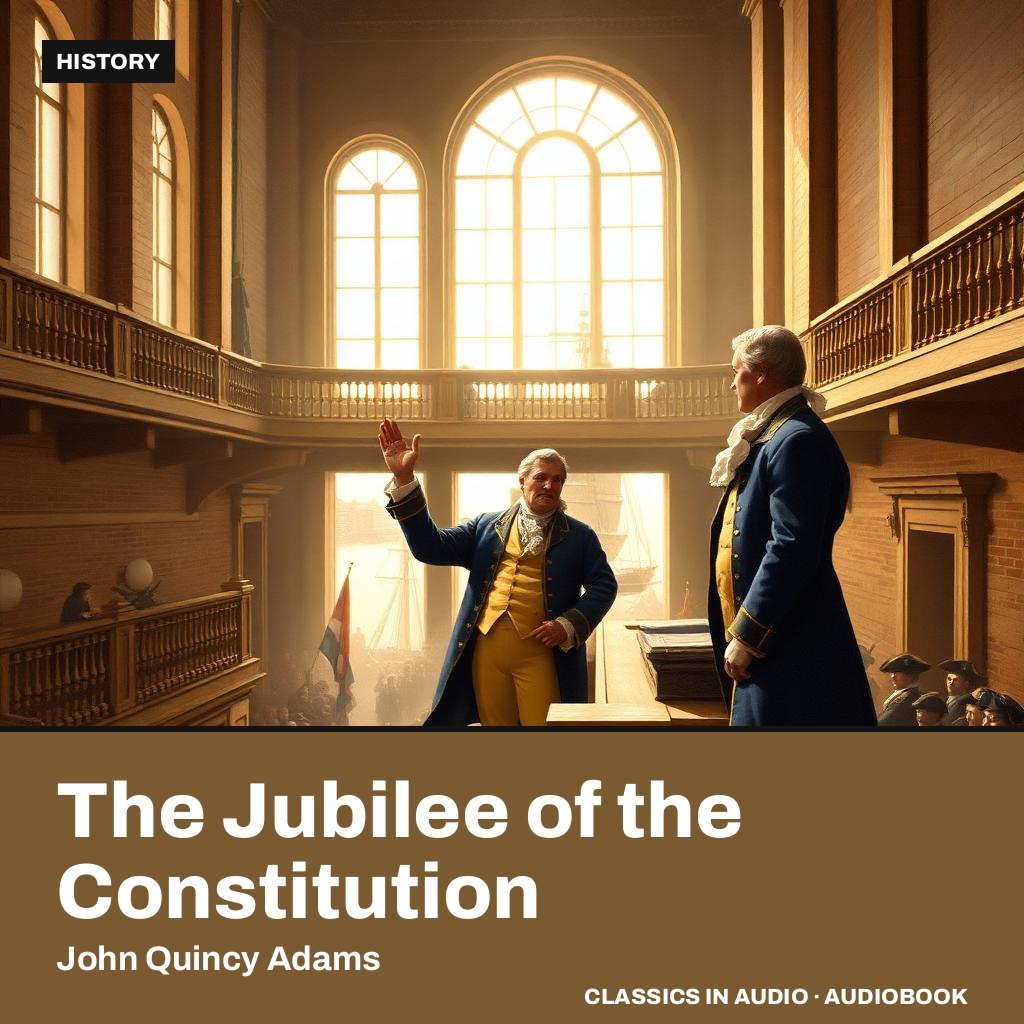
The Jubilee of the Constitution
Delivered at New York, April 30, 1839, Before the New York Historical Society
by John Quincy Adams (1767–1848)
Unabridged audiobook · about 53 min · English · read by a synthetic voice · MP3, no DRM
€3.90
Buy 2 audiobooks or more: −10%. Buy 5 or more: −20%.
Secure payment by Stripe. Your download link is e-mailed to you at once: the first 30 minutes are usually ready within a few minutes, and the rest follows while you listen. Listen online or download the MP3.
On April 30, 1839, John Quincy Adams stood before the New York Historical Society to mark fifty years since George Washington took the presidential oath in New York City. The occasion was the jubilee of the Constitution, and Adams used it to argue about where the American Union came from and what held it together.
He begins with Washington on the eve of office, imagined as a warrior receiving a suit of armor, with the Constitution as its shield. From there he moves back through the story: thirteen colonies settled by quarrelling sects and nationalities, the Seven Years' War, the attempt by Parliament to tax colonists without their consent, and the appeals to Magna Charta and the rights of Englishmen that went unanswered. He then reads the Declaration of Independence as an act of the people, and asks why the colonies still lacked a lawful national government once independence was won.
Adams was the sixth president, the son of John Adams, and by 1839 a long-serving congressman from Massachusetts. He had known the founding generation personally. The speech is a close argument about sovereignty, written when the Union was already under strain, and it still frames debates about what the Constitution means.
Text: Project Gutenberg edition no. 896, read without its licence notices.
More by John Quincy Adams
More history
 The Dogaressas of Venice (the Wives of the Doges)Edgcumbe Staley9 hr 17 min€4.90
 Miniatures of French HistoryHilaire Belloc5 hr 44 min€4.90
 The Catholic Church and HistoryHilaire Belloc2 hr 16 min€3.90
 The History of the Peloponnesian WarThucydides18 hr 37 min€6.90
 The Anabasis of AlexanderArrian13 hr 55 min€5.90
 AnabasisXenophon8 hr 32 min€4.90