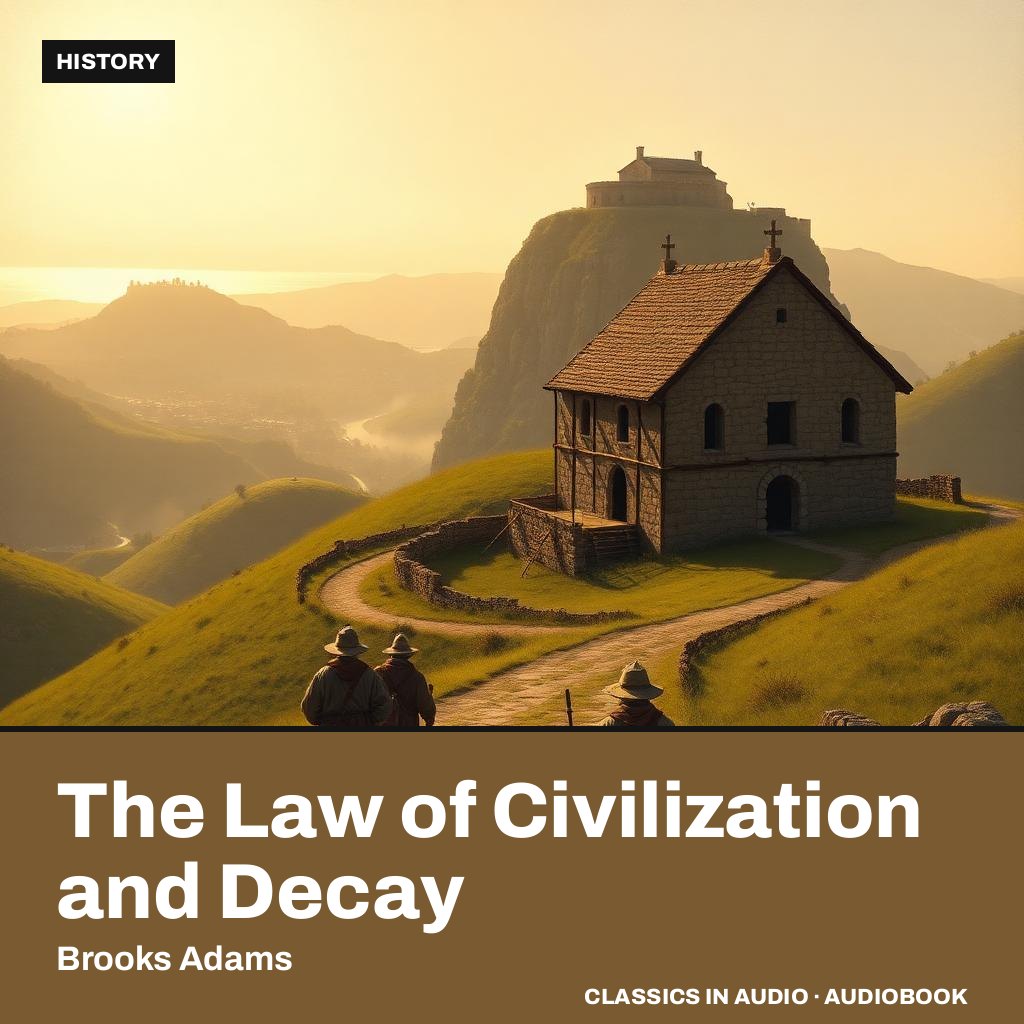
The Law of Civilization and Decay
An Essay on History
by Brooks Adams (1848–1927)
Unabridged audiobook · about 10 hr 43 min · English · read by a synthetic voice · MP3, no DRM
€5.90
Buy 2 audiobooks or more: −10%. Buy 5 or more: −20%.
Secure payment by Stripe. Your download link is e-mailed to you at once: the first 30 minutes are usually ready within a few minutes, and the rest follows while you listen. Listen online or download the MP3.
Brooks Adams's The Law of Civilization and Decay (1895) is an essay in the philosophy of history that tries to treat the rise and fall of societies as a matter of physical law. Its starting point is that human communities are forms of animal life, and that they differ in the energy nature has given them. Adams argues that societies swing between two poles, scattered and fearful on one side, concentrated and commercial on the other, and that the dominant instinct of each phase shapes its religion, its art and its money.
The path he takes is unusual. He begins with the Reformation and Puritan Massachusetts, then works back through the schoolmen, the Crusades and the pilgrimage roads to Palestine. Along the way he examines Gothic cathedrals and castles, the failure of pure architecture in trading cities such as Venice and Florence, and the coinage as a record of mercantile life. His claim that instinct, not conscious thought, steers most human action is sharply put.
Adams, grandson and great-grandson of American presidents, was a lawyer and historian who distrusted finance and progress alike. His conclusions are debatable, but the book is a bold, argumentative attempt to find a pattern in a thousand years of European history, and it still provokes.
Text: Project Gutenberg edition no. 44908, read without its licence notices.
More by Brooks Adams
 The Theory of Social RevolutionsBrooks Adams4 hr 23 min€3.90
 The Emancipation of MassachusettsBrooks Adams12 hr 53 min€5.90
More history
 The Dogaressas of Venice (the Wives of the Doges)Edgcumbe Staley9 hr 17 min€4.90
 Miniatures of French HistoryHilaire Belloc5 hr 44 min€4.90
 The Catholic Church and HistoryHilaire Belloc2 hr 16 min€3.90
 The History of the Peloponnesian WarThucydides18 hr 37 min€6.90
 The Anabasis of AlexanderArrian13 hr 55 min€5.90
 AnabasisXenophon8 hr 32 min€4.90