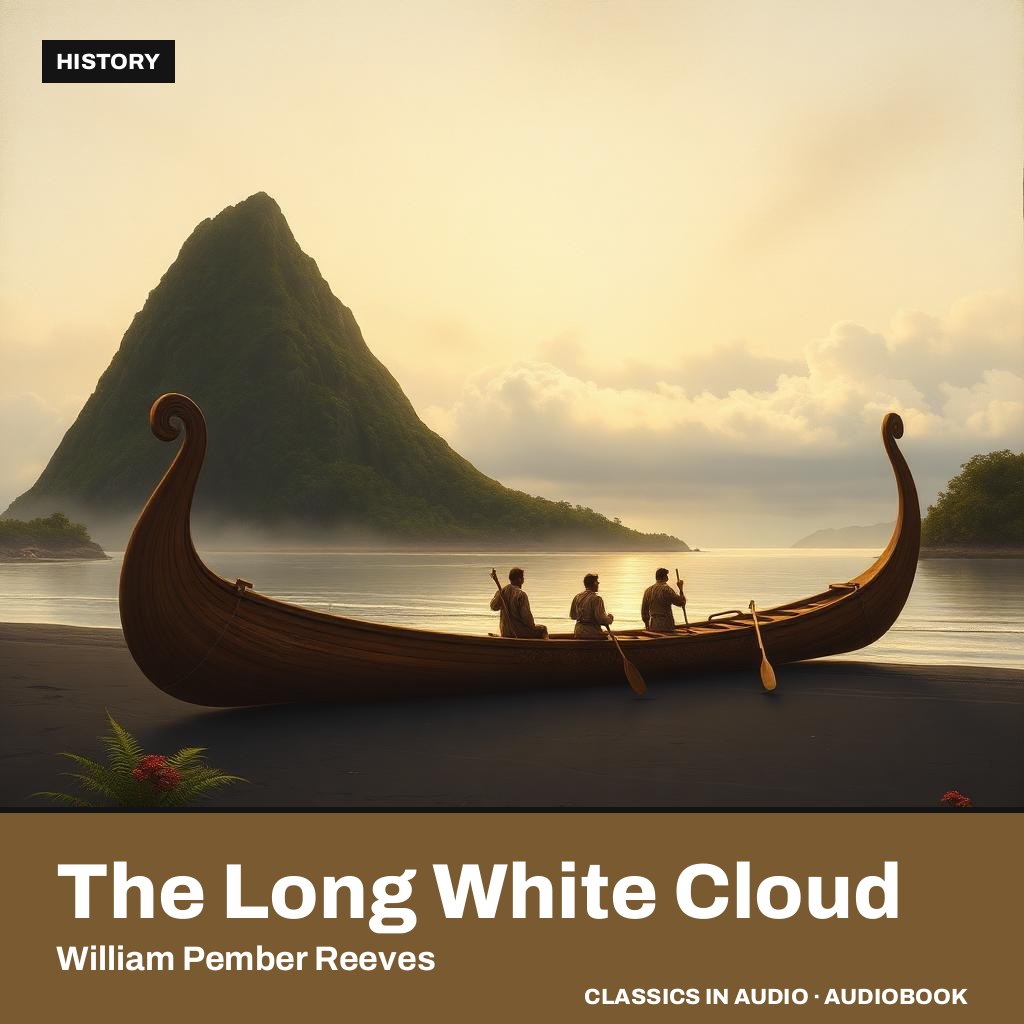
The Long White Cloud
"Ao Tea Roa"
by William Pember Reeves (1857–1932)
Unabridged audiobook · about 10 hr 04 min · English · read by a synthetic voice · MP3, no DRM
€5.90
Buy 2 audiobooks or more: −10%. Buy 5 or more: −20%.
Secure payment by Stripe. Your download link is e-mailed to you at once: the first 30 minutes are usually ready within a few minutes, and the rest follows while you listen. Listen online or download the MP3.
The Long White Cloud is a narrative history of New Zealand, from the arrival of its first Polynesian settlers to the early 1890s, when the book was written. The title is a rendering of Aotearoa, the Maori name for the islands. William Pember Reeves, a New Zealand-born journalist and politician who served as a minister in the government of the 1890s, writes as someone who knew the country and some of its leading figures at first hand.
The chapters follow the story in order. They begin with the Maori, their society, their beliefs and their canoe voyages, then turn to European navigators, whalers, missionaries and traders in a land with no settled government. The musket wars, the colonising schemes of Edward Gibbon Wakefield, the treaty and the wars over land that followed are all covered, along with the gold rushes, the pastoral provinces and the public works policy. The later chapters examine the young colony's bold political experiments in labour and land law.
Reeves sets out to avoid both the promoter's brochure and the traveller's sketch, and he keeps an eye on landscape: glaciers, fiords, volcanic districts and forest. His opinions belong to his time, which is part of the interest. The book shows how a small, distant colony saw its own beginnings, and how it came to be seen as a testing ground for new ideas about the state.
Text: Project Gutenberg edition no. 12411, read without its licence notices.
More history
 The Dogaressas of Venice (the Wives of the Doges)Edgcumbe Staley9 hr 17 min€4.90
 Miniatures of French HistoryHilaire Belloc5 hr 44 min€4.90
 The Catholic Church and HistoryHilaire Belloc2 hr 16 min€3.90
 The History of the Peloponnesian WarThucydides18 hr 37 min€6.90
 The Anabasis of AlexanderArrian13 hr 55 min€5.90
 AnabasisXenophon8 hr 32 min€4.90