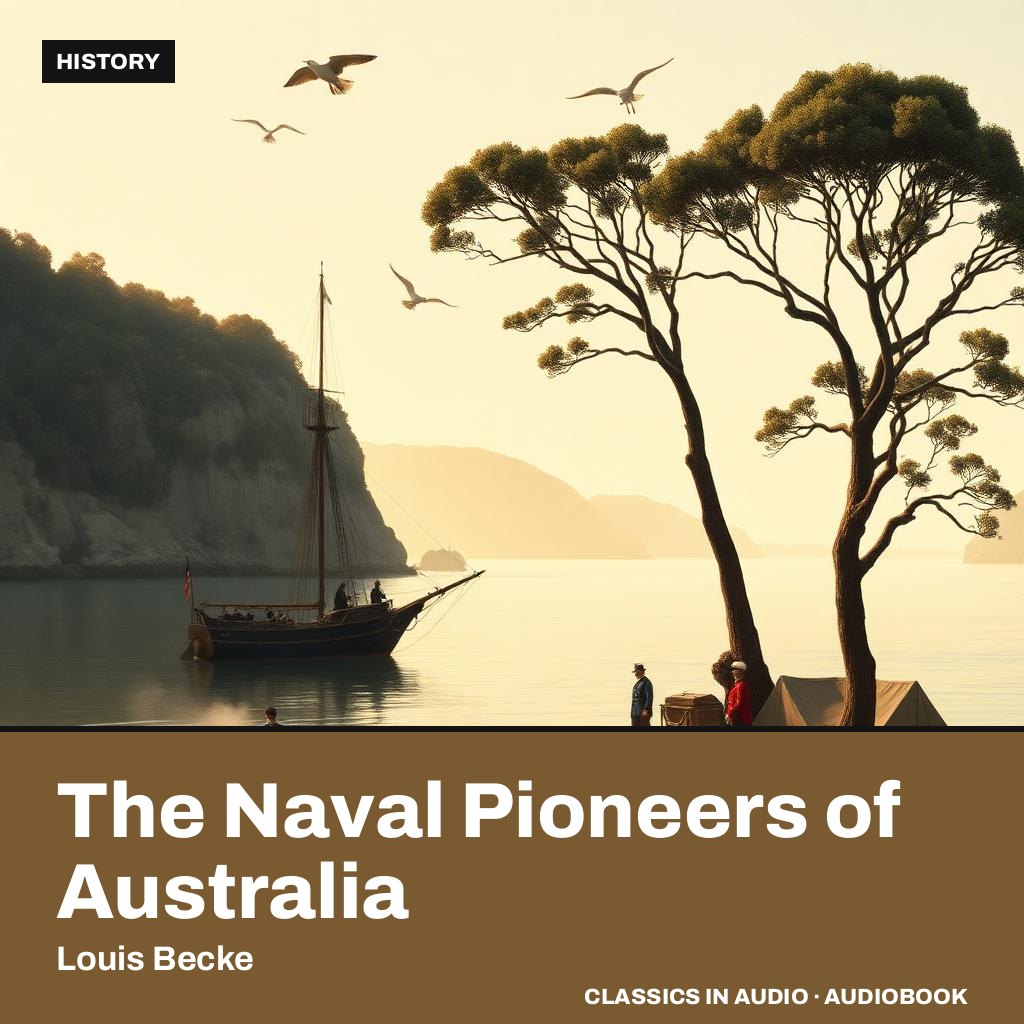
The Naval Pioneers of Australia
by Louis Becke (1855–1913)
Unabridged audiobook · about 6 hr 34 min · English · read by a synthetic voice · MP3, no DRM
€4.90
Buy 2 audiobooks or more: −10%. Buy 5 or more: −20%.
Secure payment by Stripe. Your download link is e-mailed to you at once: the first 30 minutes are usually ready within a few minutes, and the rest follows while you listen. Listen online or download the MP3.
Before Australia had parliaments, railways or gold rushes, it had ships. This history, published in London in 1899, tells the story of the continent through the sailors who found it, charted it and then governed its first colony. It opens with the Portuguese, Spanish and Dutch, whose captains were chasing a vast southern land that mapmakers imagined around the pole, and who touched the western coast almost by accident.
The chapters then follow a line of British naval figures: William Dampier, James Cook, Arthur Phillip, who founded New South Wales and became its first governor, and the successors Hunter, King and Bligh. Along the way come the surgeon George Bass and Matthew Flinders, the navigators who mapped the coast, and Flinders's long captivity abroad. William Bligh appears twice, once for the Bounty mutiny and again as a governor facing trouble ashore.
Louis Becke, born in New South Wales, wrote many tales of the Pacific islands from his own years of trading and wandering there, and he wrote this book with Walter Jeffery. They say plainly that general histories give sailors a chapter or two at most, and they set out to gather the scattered records of that naval age in one place. The result is an account of exploration, hardship and command at the far end of the world.
Text: Project Gutenberg edition no. 12992, read without its licence notices.
More by Louis Becke
 Tom WallisLouis Becke5 hr 59 min€4.90
 By Rock and Pool on an Austral Shore, and Other StoriesLouis Becke5 hr 51 min€4.90
 Rídan the Devil, and Other StoriesLouis Becke6 hr 48 min€4.90
More history
 The Dogaressas of Venice (the Wives of the Doges)Edgcumbe Staley9 hr 17 min€4.90
 Miniatures of French HistoryHilaire Belloc5 hr 44 min€4.90
 The Catholic Church and HistoryHilaire Belloc2 hr 16 min€3.90
 The History of the Peloponnesian WarThucydides18 hr 37 min€6.90
 The Anabasis of AlexanderArrian13 hr 55 min€5.90
 AnabasisXenophon8 hr 32 min€4.90