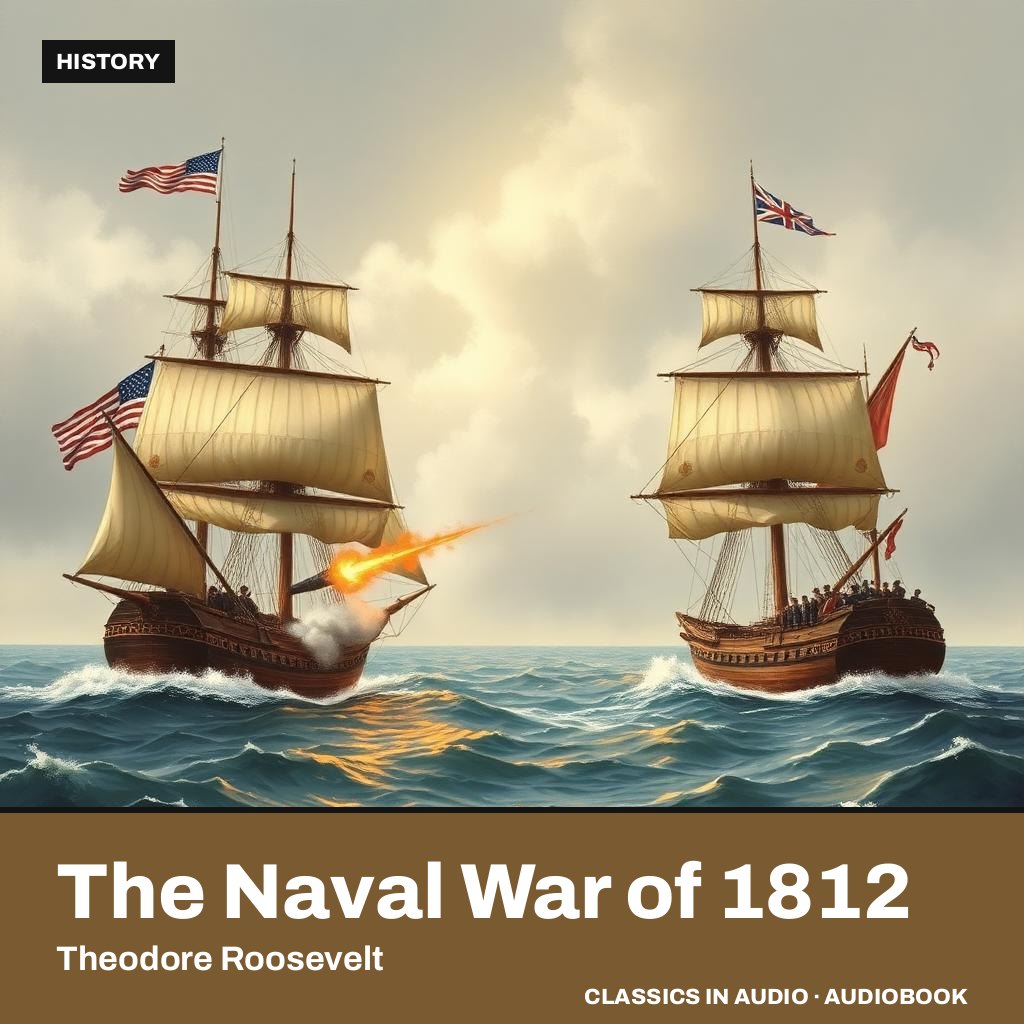
The Naval War of 1812
Or the History of the United States Navy During the Last War with Great Britain to Which Is Appended an Account of the Battle of New Orleans
by Theodore Roosevelt (1858–1919)
Unabridged audiobook · about 15 hr 07 min · English · read by a synthetic voice · MP3, no DRM
€6.90
Buy 2 audiobooks or more: −10%. Buy 5 or more: −20%.
Secure payment by Stripe. Your download link is e-mailed to you at once: the first 30 minutes are usually ready within a few minutes, and the rest follows while you listen. Listen online or download the MP3.
Theodore Roosevelt was twenty-three when he began this history of the American navy in the War of 1812, and it was his first book. The war pitted the young United States against the Royal Navy, then the largest fleet in the world. Roosevelt follows the single-ship duels between frigates and sloops, the raids of American cruisers, and the fighting on the Great Lakes, and he finishes with an account of the Battle of New Orleans in January 1815.
What sets the book apart is its method. Roosevelt says plainly that earlier accounts were either partisan or careless, so he sets British and American sources against each other. He compares official letters, logbooks and contracts, counts guns and crews, and calls out contradictions when he finds them. He also admits where the American logs are thin or silent. The result is a narrative of ship against ship that argues from numbers, weights of broadside and seamanship.
Roosevelt later became president and served earlier as Assistant Secretary of the Navy, and his lasting interest in sea power shows on every page. Listeners who like military history, or who want to see how a historian weighs rival claims about the same battle, will find plenty to follow here.
Text: Project Gutenberg edition no. 9104, read without its licence notices.
More by Theodore Roosevelt
 Theodore RooseveltTheodore Roosevelt20 hr 28 min€7.90
 African and European AddressesTheodore Roosevelt5 hr 05 min€4.90
 Through the Brazilian WildernessTheodore Roosevelt10 hr 35 min€5.90
 State of the Union AddressesTheodore Roosevelt15 hr 23 min€6.90
 The Rough RidersTheodore Roosevelt5 hr 53 min€4.90
 A Book-Lover's Holidays in the OpenTheodore Roosevelt7 hr 43 min€4.90
More history
 The Dogaressas of Venice (the Wives of the Doges)Edgcumbe Staley9 hr 17 min€4.90
 Miniatures of French HistoryHilaire Belloc5 hr 44 min€4.90
 The Catholic Church and HistoryHilaire Belloc2 hr 16 min€3.90
 The History of the Peloponnesian WarThucydides18 hr 37 min€6.90
 The Anabasis of AlexanderArrian13 hr 55 min€5.90
 AnabasisXenophon8 hr 32 min€4.90