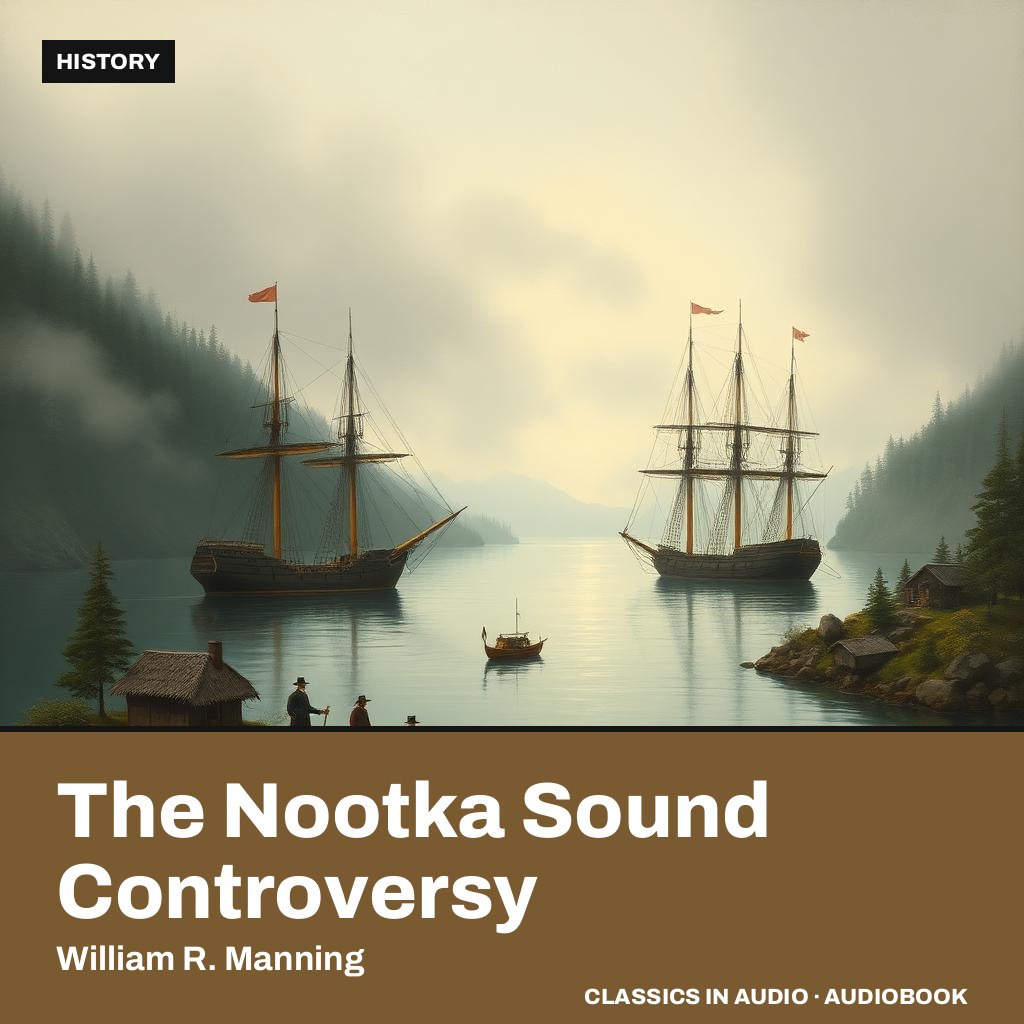
The Nootka Sound Controversy
A Dissertation
by William R. Manning (1871–1942)
Unabridged audiobook · about 7 hr 40 min · English · read by a synthetic voice · MP3, no DRM
€4.90
Buy 2 audiobooks or more: −10%. Buy 5 or more: −20%.
Secure payment by Stripe. Your download link is e-mailed to you at once: the first 30 minutes are usually ready within a few minutes, and the rest follows while you listen. Listen online or download the MP3.
In the spring of 1789, a Spanish expedition from Mexico and an English trading venture from India each sailed for Nootka Sound, a small inlet on the western shore of Vancouver Island, each meaning to claim it. Neither knew of the other. The Spanish commander arrived first and took possession. When the Englishmen came, a quarrel followed, ships were seized, and crews were sent to Mexico as prisoners. What looked like a scuffle between two obscure sea captains soon pushed Britain and Spain to the edge of war.
This doctoral dissertation follows the dispute from the first plans for occupying the port, through the imprisonments, the failed attempts at settlement, the arming of fleets and the search for allies, to the convention that ended the crisis. It also looks at how the United States, and revolutionary France with its family compact tie to Spain, bore on the negotiations.
William R. Manning, a historian who taught at Chicago when he finished it in 1904, worked in the archives at Seville, Madrid, London and Paris and transcribed more than five hundred pages of unpublished documents. He set out to correct the errors of earlier, partisan accounts. The result is a detailed study of fur-trade rivalry, imperial claims and diplomacy on the Pacific coast of North America at the close of the eighteenth century.
Text: Project Gutenberg edition no. 53719, read without its licence notices.
More history
 The Dogaressas of Venice (the Wives of the Doges)Edgcumbe Staley9 hr 17 min€4.90
 Miniatures of French HistoryHilaire Belloc5 hr 44 min€4.90
 The Catholic Church and HistoryHilaire Belloc2 hr 16 min€3.90
 The History of the Peloponnesian WarThucydides18 hr 37 min€6.90
 The Anabasis of AlexanderArrian13 hr 55 min€5.90
 AnabasisXenophon8 hr 32 min€4.90