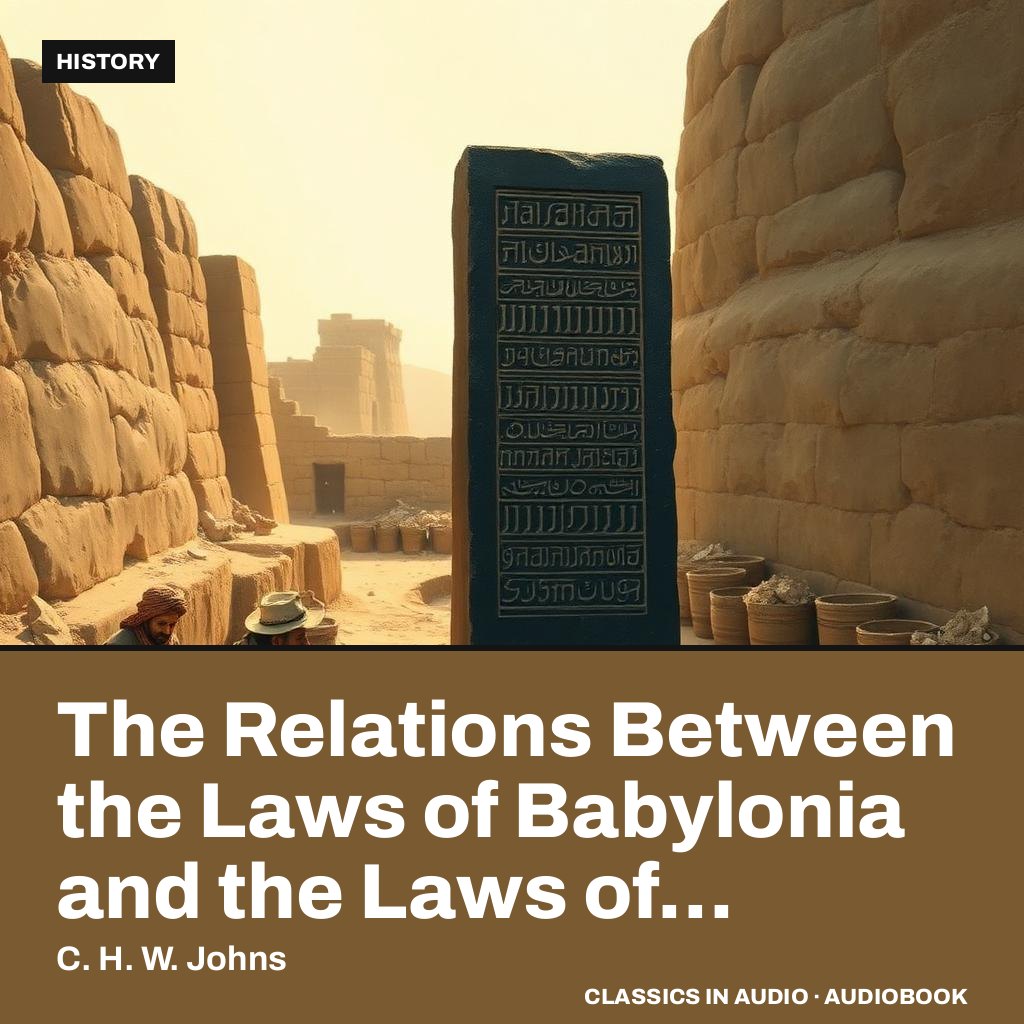
The Relations Between the Laws of Babylonia and the Laws of the Hebrew Peoples
The Schweich Lectures
by C. H. W. Johns (1857–1920)
Unabridged audiobook · about 4 hr 40 min · English · read by a synthetic voice · MP3, no DRM
€3.90
Buy 2 audiobooks or more: −10%. Buy 5 or more: −20%.
Secure payment by Stripe. Your download link is e-mailed to you at once: the first 30 minutes are usually ready within a few minutes, and the rest follows while you listen. Listen online or download the MP3.
In 1901 French archaeologists at Susa, in what is now Iran, unearthed a tall black stone inscribed with nearly three hundred laws issued by Hammurabi, king of Babylon around 1750 BCE. This book, a set of the Schweich Lectures, asks what that discovery means for the study of the Hebrew Bible. Until then the laws of Moses had often been treated as the oldest legal system with a trustworthy record. Here was a code far older, more complete and more detailed than anyone expected.
C. H. W. Johns, an Assyriologist at Cambridge, spent years reading the contracts, letters and court records of ancient Babylonia, and he produced one of the first English translations of the code. He sets the two bodies of law side by side and weighs where they resemble each other, where they part company, and what shared Semitic habits of thought might explain both. He also reflects on how comparative law grew up, and on the arguments that broke out among Bible scholars once the stone came to light.
The lectures belong to the early twentieth century, when cuneiform scholarship was changing quickly. They suit listeners curious about the origins of law, the world of the Old Testament, and the way a single find can unsettle settled opinion.
Text: Project Gutenberg edition no. 46050, read without its licence notices.
More by C. H. W. Johns
More history
 The Dogaressas of Venice (the Wives of the Doges)Edgcumbe Staley9 hr 17 min€4.90
 Miniatures of French HistoryHilaire Belloc5 hr 44 min€4.90
 The Catholic Church and HistoryHilaire Belloc2 hr 16 min€3.90
 The History of the Peloponnesian WarThucydides18 hr 37 min€6.90
 The Anabasis of AlexanderArrian13 hr 55 min€5.90
 AnabasisXenophon8 hr 32 min€4.90