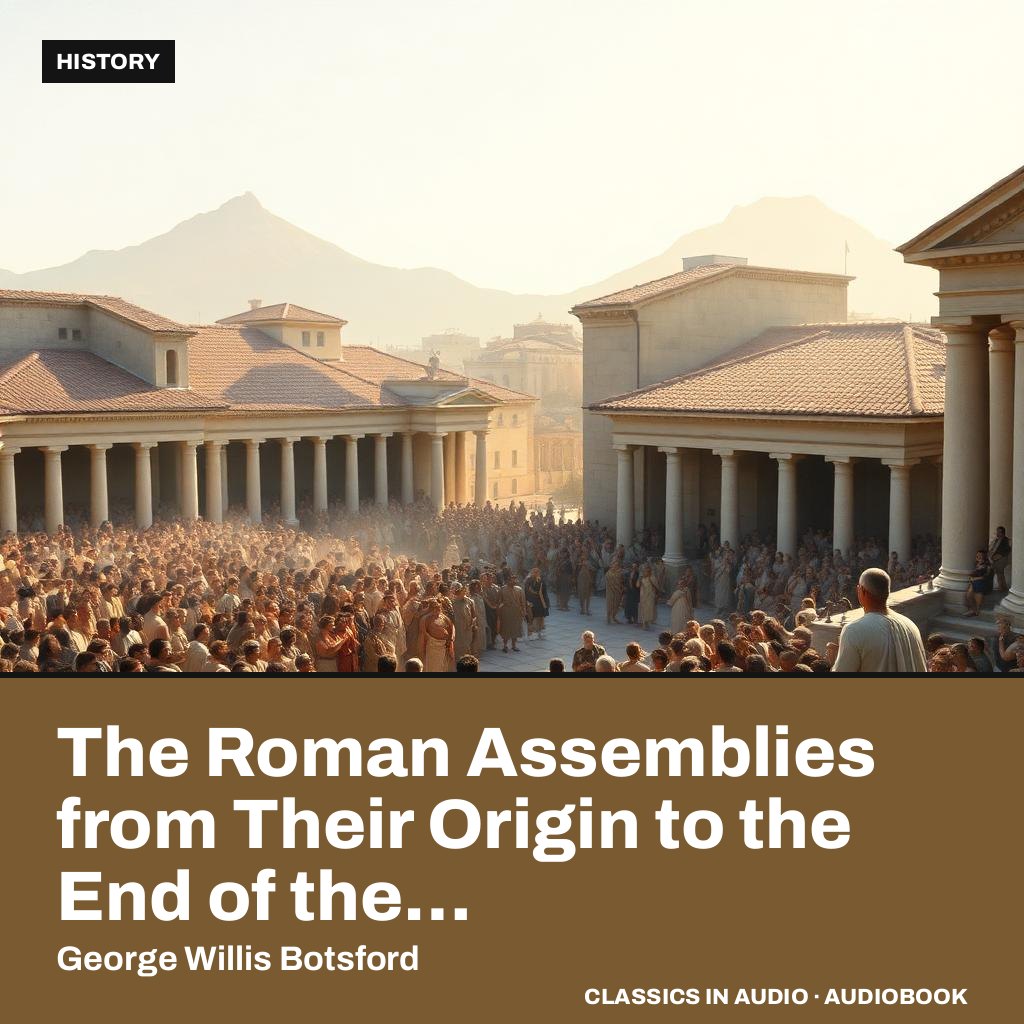
The Roman Assemblies from Their Origin to the End of the Republic
by George Willis Botsford (1862–1917)
Unabridged audiobook · about 22 hr 50 min · English · read by a synthetic voice · MP3, no DRM
€7.90
Buy 2 audiobooks or more: −10%. Buy 5 or more: −20%.
Secure payment by Stripe. Your download link is e-mailed to you at once: the first 30 minutes are usually ready within a few minutes, and the rest follows while you listen. Listen online or download the MP3.
This is a scholarly study of how the citizens of ancient Rome gathered to vote, legislate, elect magistrates and sit in judgment. George Willis Botsford, a historian who taught ancient history at Columbia University, published it in 1909 as both a reference work and an argument. He set out to read the sources afresh, pushing back against theories of Niebuhr and Mommsen that had long shaped the subject.
The book begins with the populus itself, the Roman people, and the three primitive tribes tied to the legendary founding of the city. It then follows the machinery of public life: the thirty-five tribes, the centuries and property classes, the taking of auspices before any meeting, and the differences between the curiate, centuriate and tribal assemblies. Later chapters trace legislation from the early Republic through the Gracchi and Sulla to the final years of the Republic, and they close with the statutes, the procedure and the days on which assemblies could meet.
For listeners curious about how a city-state governed itself, and how far the Roman people really held power, it offers a careful, detailed account. It rewards patience, and it shows how voting, religion and class were bound together in Roman politics.
Text: Project Gutenberg edition no. 68419, read without its licence notices.
More history
 The Dogaressas of Venice (the Wives of the Doges)Edgcumbe Staley9 hr 17 min€4.90
 Miniatures of French HistoryHilaire Belloc5 hr 44 min€4.90
 The Catholic Church and HistoryHilaire Belloc2 hr 16 min€3.90
 The History of the Peloponnesian WarThucydides18 hr 37 min€6.90
 The Anabasis of AlexanderArrian13 hr 55 min€5.90
 AnabasisXenophon8 hr 32 min€4.90