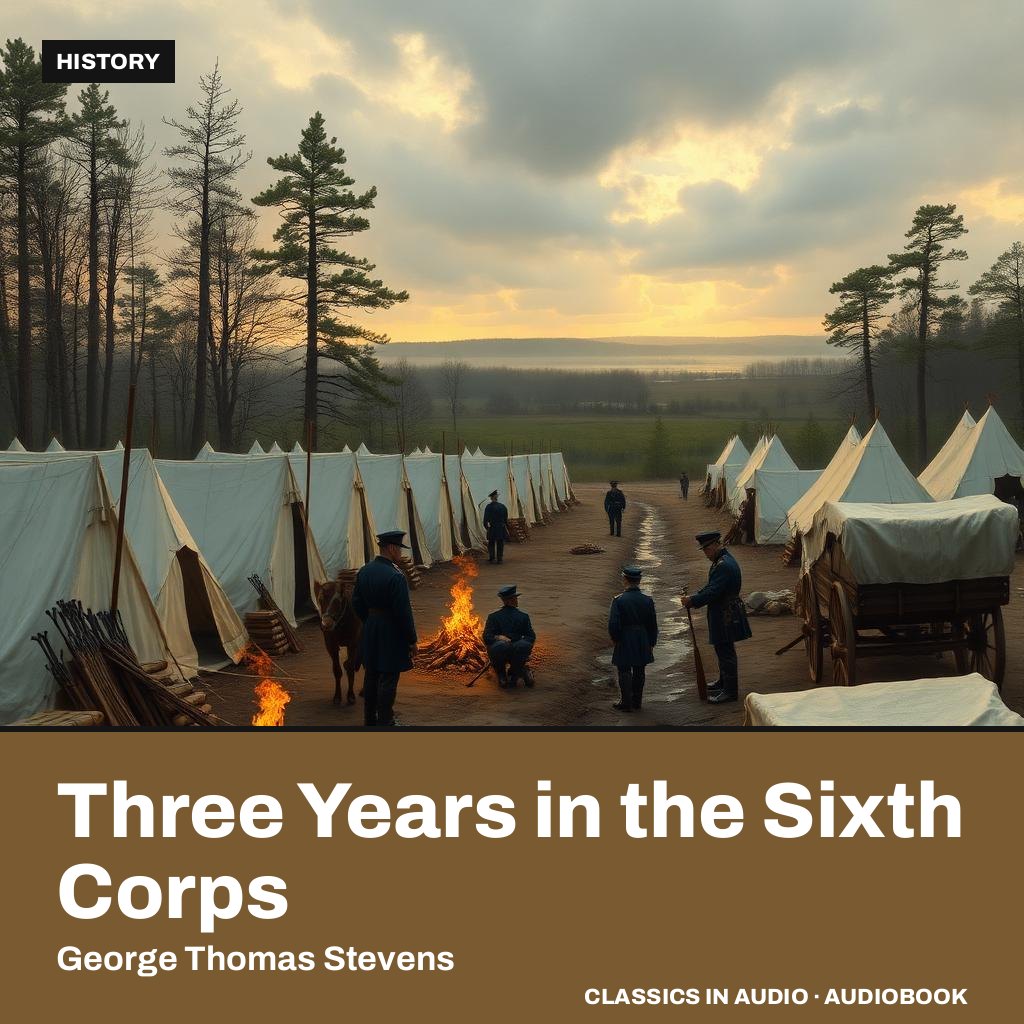
Three Years in the Sixth Corps
A Concise Narrative of Events in the Army of the Potomac, from 1861 to the Close of the Rebellion, April, 1865
by George Thomas Stevens (1832–1921)
Unabridged audiobook · about 13 hr 02 min · English · read by a synthetic voice · MP3, no DRM
€5.90
Buy 2 audiobooks or more: −10%. Buy 5 or more: −20%.
Secure payment by Stripe. Your download link is e-mailed to you at once: the first 30 minutes are usually ready within a few minutes, and the rest follows while you listen. Listen online or download the MP3.
George T. Stevens was a surgeon who marched with the 77th New York Volunteers, a regiment raised around Saratoga in 1861. This regimental and corps history, published in Albany in 1866, follows that regiment and the Sixth Corps of the Army of the Potomac from the first weeks of the war to the Confederate collapse in April 1865.
The book begins with recruits leaving upstate New York and drilling in camps near Washington. It then follows the army onto the Virginia Peninsula, through the siege of Yorktown, the charge of the Vermont brigade at Lee's Mills, the fighting at Williamsburg, and the fever-ridden camps along the Chickahominy. Later chapters cover the Seven Days, Fredericksburg, the Wilderness, and the defence of Washington at Fort Stevens. Stevens built the narrative from notes made on the spot, checked against official reports and officers' letters, and he drew many of the illustrations himself.
What sets it apart is the view from the ranks and the hospital tent. Marches, mud, sickness, short rations, and sudden battles all get their space, and Stevens writes plainly about them. For anyone who wants to know what the war felt like day to day for one corps, it is a thorough and sober record.
Text: Project Gutenberg edition no. 21976, read without its licence notices.
More history
 The Dogaressas of Venice (the Wives of the Doges)Edgcumbe Staley9 hr 17 min€4.90
 Miniatures of French HistoryHilaire Belloc5 hr 44 min€4.90
 The Catholic Church and HistoryHilaire Belloc2 hr 16 min€3.90
 The History of the Peloponnesian WarThucydides18 hr 37 min€6.90
 The Anabasis of AlexanderArrian13 hr 55 min€5.90
 AnabasisXenophon8 hr 32 min€4.90