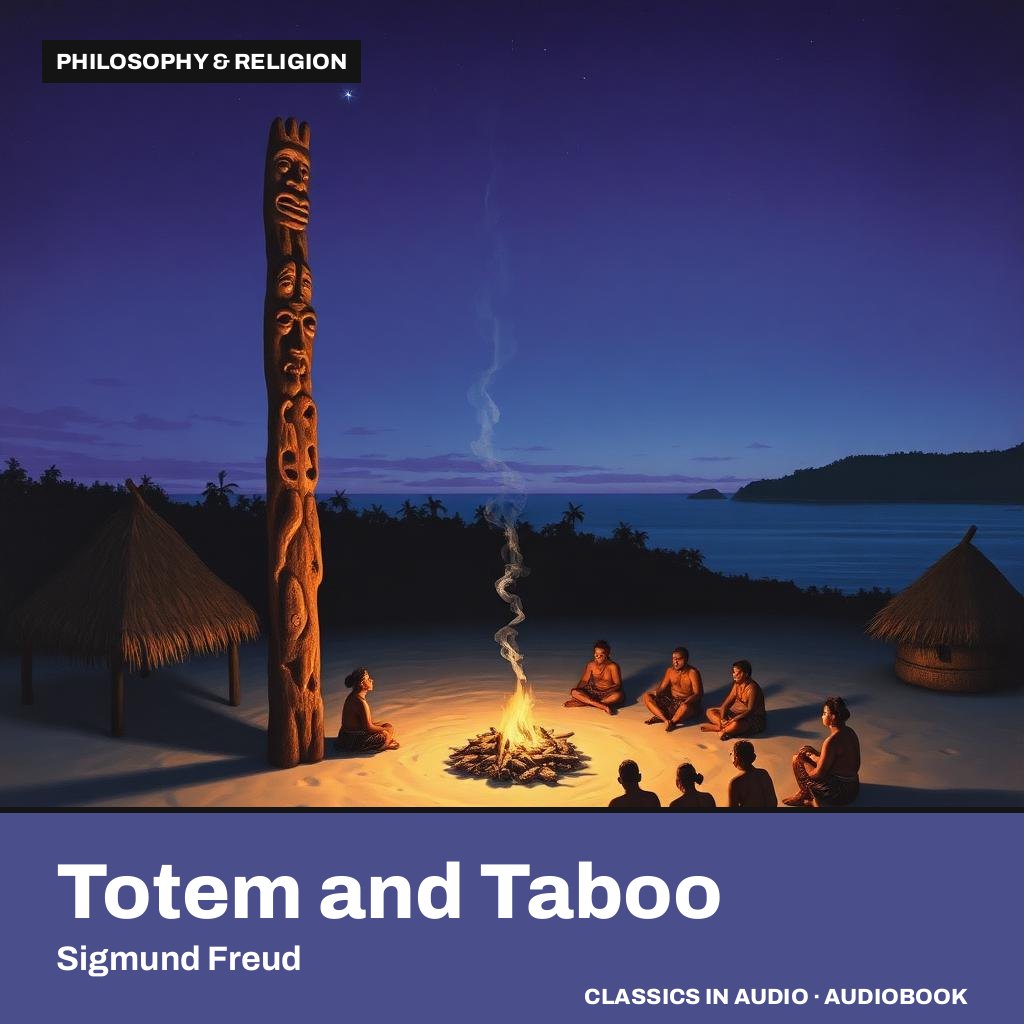
Totem and Taboo
Resemblances Between the Psychic Lives of Savages and Neurotics
by Sigmund Freud (1856–1939)
Unabridged audiobook · about 6 hr 02 min · English · read by a synthetic voice · MP3, no DRM
€4.90
Buy 2 audiobooks or more: −10%. Buy 5 or more: −20%.
Secure payment by Stripe. Your download link is e-mailed to you at once: the first 30 minutes are usually ready within a few minutes, and the rest follows while you listen. Listen online or download the MP3.
Totem and Taboo is a work of speculative anthropology and psychoanalysis, first published as four essays in 1912 and 1913 in the journal Imago. Sigmund Freud, the Viennese physician who founded psychoanalysis, turns his attention from the consulting room to the customs of Aboriginal Australians, Pacific islanders and other peoples as described by the ethnographers of his day. His question is why societies forbid so much, and why those prohibitions are surrounded by such fear.
The four chapters take up the dread of incest, the double feelings of love and hostility that lie behind taboo, the belief that thoughts can act upon the world, and the return of totemism in the fantasies of children. Freud sets the rituals of supposed primitive peoples beside the compulsions of his neurotic patients and argues that they share a structure. He closes with a bold hypothesis about the origins of society, which he admits sounds improbable.
Much of his anthropological evidence has since been rejected, and the book is now read as a document of its time. It remains worth hearing for its ambition, for its influence on twentieth-century thought, and for a question that still stands: where do our rules come from? This is the 1919 English version by A. A. Brill, who introduced psychoanalysis to America.
Text: Project Gutenberg edition no. 41214, read without its licence notices.
More by Sigmund Freud
 The Interpretation of DreamsSigmund Freud20 hr 00 min€6.90
 A General Introduction to PsychoanalysisSigmund Freud15 hr 24 min€6.90
 Three Contributions to the Theory of SexSigmund Freud4 hr 19 min€3.90
 Dream PsychologySigmund Freud5 hr 14 min€4.90
 Psychopathology of Everyday LifeSigmund Freud6 hr 54 min€4.90
 Leonardo da VinciSigmund Freud2 hr 20 min€3.90





