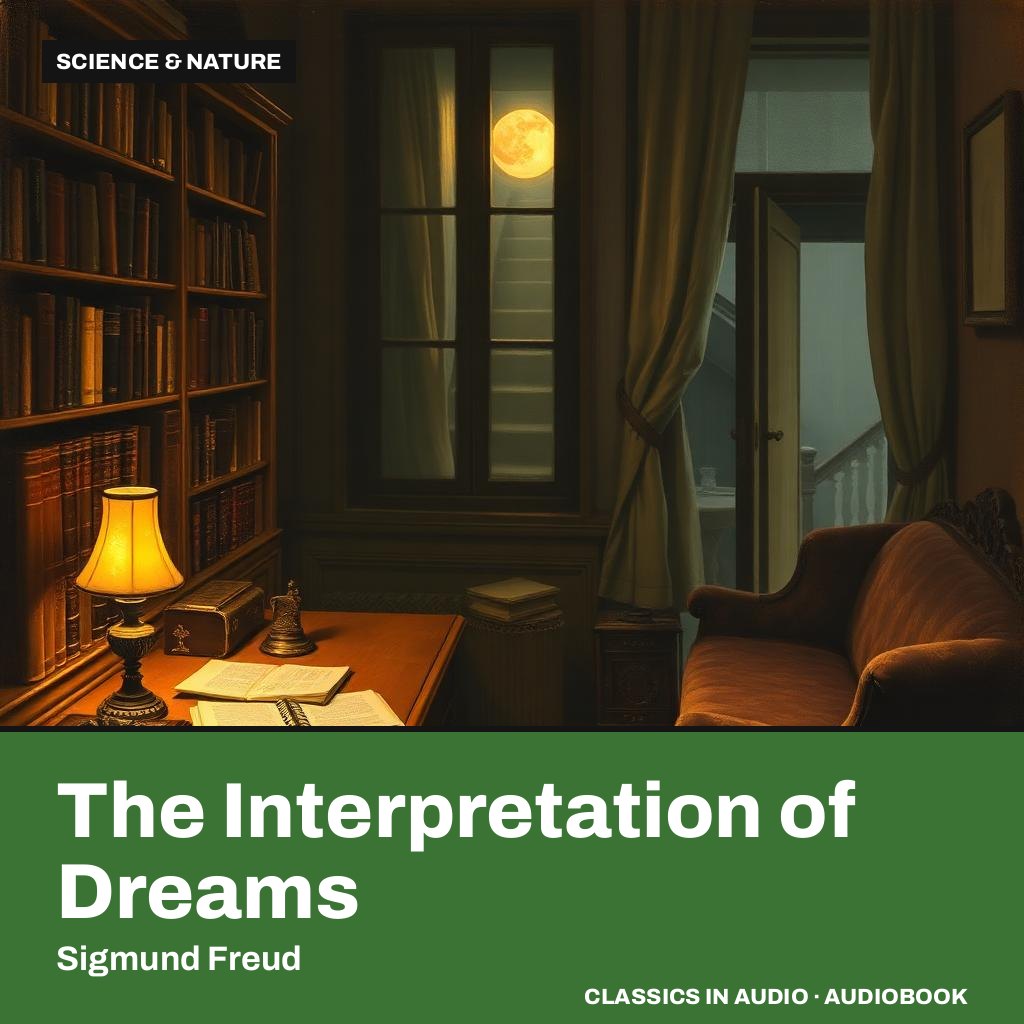
The Interpretation of Dreams
by Sigmund Freud (1856–1939)
Unabridged audiobook · about 20 hr 00 min · English · read by a synthetic voice · MP3, no DRM
€6.90
Buy 2 audiobooks or more: −10%. Buy 5 or more: −20%.
Secure payment by Stripe. Your download link is e-mailed to you at once: the first 30 minutes are usually ready within a few minutes, and the rest follows while you listen. Listen online or download the MP3.
The Interpretation of Dreams is Sigmund Freud's argument that dreams are not random noise but meaningful mental events, and that they can be read like a coded text. First published in 1899 and dated 1900, it sets out his method: take a dream, break it into its parts, and follow the dreamer's associations until a hidden wish comes into view. Freud trained as a physician in Vienna, and the book grew out of his work with nervous patients.
Most of the dreams on the page are his own. As the preface explains, he chose them over his patients' dreams to avoid the tangle of illness, even though it meant exposing private episodes of his life. He also admits that he softened some of the details. In a later preface he says the work became part of his self-analysis after his father's death. The result is part scientific treatise, part intellectual diary, set among the doctors, professors and critics of late nineteenth-century Central Europe.
The book introduces ideas now woven into everyday speech: wish fulfilment, the unconscious, the difference between what a dream shows and what it means. A. A. Brill, a pioneer of psychoanalysis in America, made this English translation. Whether or not one accepts Freud's conclusions, the book shows how a new way of thinking about the mind was first put together.
Text: Project Gutenberg edition no. 66048, read without its licence notices.
More by Sigmund Freud
 A General Introduction to PsychoanalysisSigmund Freud15 hr 24 min€6.90
 Three Contributions to the Theory of SexSigmund Freud4 hr 19 min€3.90
 Dream PsychologySigmund Freud5 hr 14 min€4.90
 Totem and TabooSigmund Freud6 hr 02 min€4.90
 Psychopathology of Everyday LifeSigmund Freud6 hr 54 min€4.90
 Leonardo da VinciSigmund Freud2 hr 20 min€3.90
More science & nature
 Body-build and Its InheritanceCharles Benedict Davenport7 hr 56 min€4.90
 On the Origin of Species By Means of Natural SelectionCharles Darwin15 hr 22 min€6.90
 The Origin of Species by Means of Natural SelectionCharles Darwin20 hr 41 min€7.90
 Novum OrganumFrancis Bacon8 hr 50 min€4.90
 The Magic of Jewels and CharmsGeorge Frederick Kunz13 hr 31 min€5.90
 The Descent of Man, and Selection in Relation to SexCharles Darwin30 hr 23 min€9.90