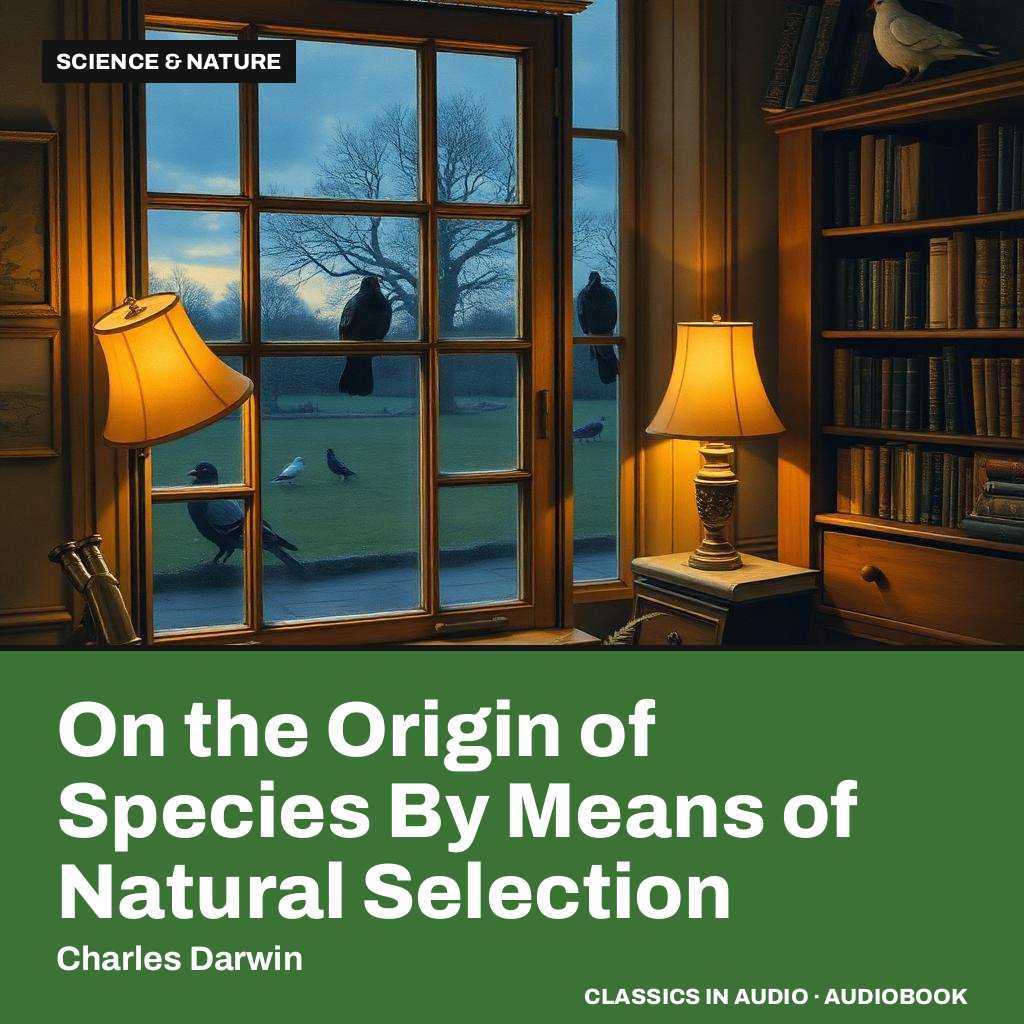
On the Origin of Species By Means of Natural Selection
Or, the Preservation of Favoured Races in the Struggle for Life
by Charles Darwin (1809–1882)
Unabridged audiobook · about 15 hr 22 min · English · read by a synthetic voice · MP3, no DRM
€6.90
Buy 2 audiobooks or more: −10%. Buy 5 or more: −20%.
Secure payment by Stripe. Your download link is e-mailed to you at once: the first 30 minutes are usually ready within a few minutes, and the rest follows while you listen. Listen online or download the MP3.
Charles Darwin's book, first published in November 1859, sets out a single large argument: that living species were not separately fixed in form but descended, with modification, from earlier ones, and that the chief engine of change is natural selection. He builds the case slowly, beginning not with wild nature but with the pigeon fanciers, cattle breeders and gardeners of Victorian England, whose deliberate choices show how far a species can be bent within a few generations.
From there he moves outward to variation among wild plants and animals, the pressure of too many young chasing too little food, and the long reach of geology. He also takes on the objections himself, devoting chapters to the eye, to instinct in bees and ants, to sterile hybrids, and to the gaps in the fossil record. Island birds, scattered plants and the layering of rock all become evidence in a plain, patient case.
Darwin was a naturalist who had spent nearly five years as a young man aboard HMS Beagle, and he worked over his ideas for more than twenty years before publishing. Listeners now can hear how a book that changed biology was assembled: cautious, detailed, and openly aware of its own weak points.
Text: Project Gutenberg edition no. 1228, read without its licence notices.
More by Charles Darwin
 The Origin of Species by Means of Natural SelectionCharles Darwin20 hr 41 min€7.90
 The Descent of Man, and Selection in Relation to SexCharles Darwin30 hr 23 min€9.90
 The Voyage of the BeagleCharles Darwin19 hr 29 min€6.90
 The Expression of the Emotions in Man and AnimalsCharles Darwin10 hr 35 min€5.90
 The Autobiography of Charles DarwinCharles Darwin2 hr 05 min€3.90
 The Foundations of the Origin of SpeciesCharles Darwin8 hr 52 min€4.90
More science & nature
 Body-build and Its InheritanceCharles Benedict Davenport7 hr 56 min€4.90
 The Interpretation of DreamsSigmund Freud20 hr 00 min€6.90
 Novum OrganumFrancis Bacon8 hr 50 min€4.90
 The Magic of Jewels and CharmsGeorge Frederick Kunz13 hr 31 min€5.90
 A General Introduction to PsychoanalysisSigmund Freud15 hr 24 min€6.90
 Three Contributions to the Theory of SexSigmund Freud4 hr 19 min€3.90