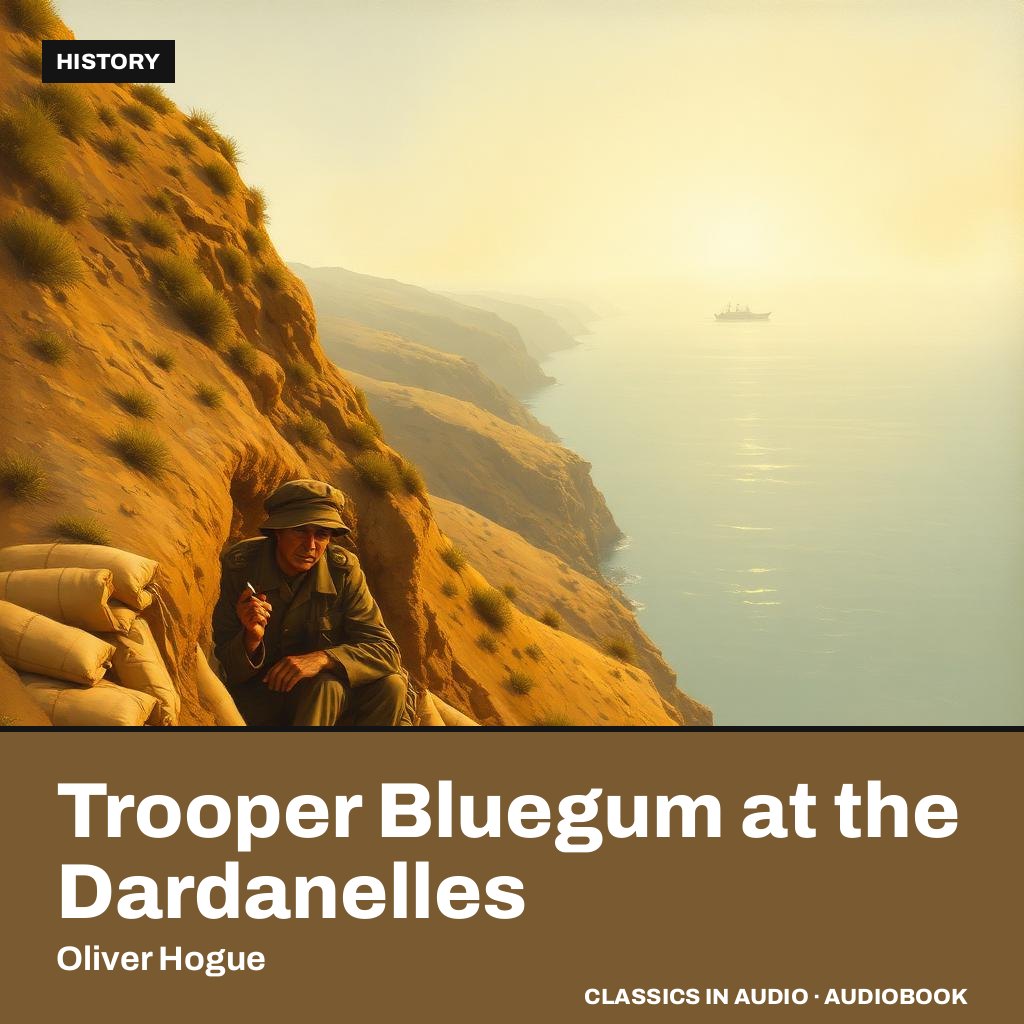
Trooper Bluegum at the Dardanelles
Descriptive Narratives of the More Desperate Engagements on the Gallipoli Peninsula
by Oliver Hogue (1880–1919)
Unabridged audiobook · about 4 hr 51 min · English · read by a synthetic voice · MP3, no DRM
€3.90
Buy 2 audiobooks or more: −10%. Buy 5 or more: −20%.
Secure payment by Stripe. Your download link is e-mailed to you at once: the first 30 minutes are usually ready within a few minutes, and the rest follows while you listen. Listen online or download the MP3.
Trooper Bluegum at the Dardanelles is a first-hand account of the Gallipoli campaign in 1915, written by an Australian officer who was also a working newspaperman. Oliver Hogue, a Sydney journalist, left the literary staff of the Sydney Morning Herald to enlist in the Light Horse, and the sketches collected here first appeared in that paper under the name Trooper Bluegum. He rose from trooper to lieutenant and served as orderly to the commander of the Second Light Horse Brigade.
The chapters follow the Australian and New Zealand troops from the voyage out to the cramped, shell-swept ground at Anzac Cove and the heights above it, including some of the hardest engagements on the peninsula. Hogue wrote much of it in dugouts between spells of fighting, and the immediacy shows. He is especially interested in the soldiers themselves: their jokes under fire, their patience with bad food and worse weather, and their casual contempt for danger.
The book is partisan and of its moment, shaped by wartime censorship and loyalty to the men beside him. That is part of its value. It records how the campaign looked and sounded to a participant while it was still being fought, and how a young nation understood its first great test.
Text: Project Gutenberg edition no. 46097, read without its licence notices.
More history
 The Dogaressas of Venice (the Wives of the Doges)Edgcumbe Staley9 hr 17 min€4.90
 Miniatures of French HistoryHilaire Belloc5 hr 44 min€4.90
 The Catholic Church and HistoryHilaire Belloc2 hr 16 min€3.90
 The History of the Peloponnesian WarThucydides18 hr 37 min€6.90
 The Anabasis of AlexanderArrian13 hr 55 min€5.90
 AnabasisXenophon8 hr 32 min€4.90