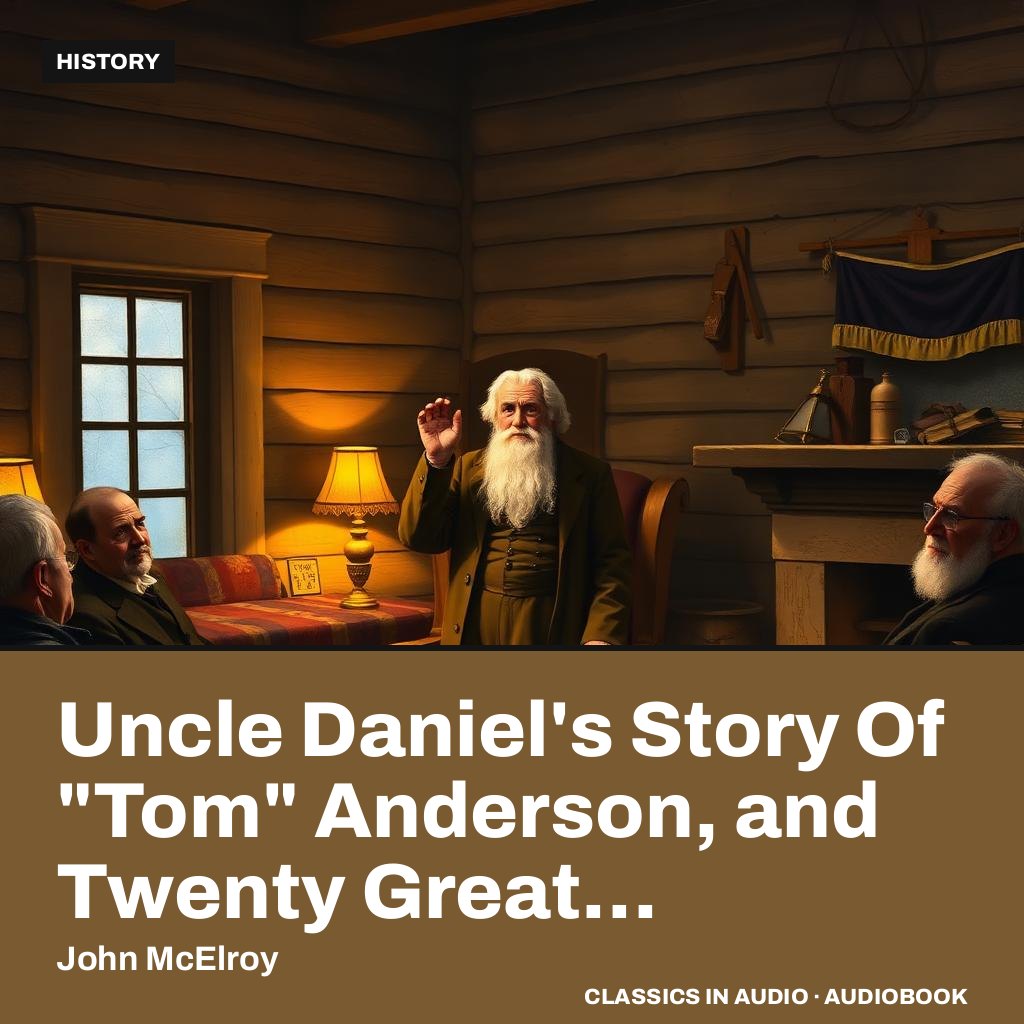
Uncle Daniel's Story Of "Tom" Anderson, and Twenty Great Battles
by John McElroy (1846–1929)
Unabridged audiobook · about 13 hr 40 min · English · read by a synthetic voice · MP3, no DRM
€5.90
Buy 2 audiobooks or more: −10%. Buy 5 or more: −20%.
Secure payment by Stripe. Your download link is e-mailed to you at once: the first 30 minutes are usually ready within a few minutes, and the rest follows while you listen. Listen online or download the MP3.
Uncle Daniel's Story is a Civil War narrative framed as an old man's evening recollection. On 22 February 1884, in a small Indiana town, neighbors gather at the home of Daniel Lyon, a white-haired veteran of eighty-five, and a Union colonel asks him for a story from the war. He stands, shaken with feeling, then sits among them and begins. What follows is presented as true, though the book belongs to the fiction shelf and should be heard as a novelized tale built on real campaigns.
The story opens in 1861, when Daniel's nephew Tom Anderson, a lawyer raised in Mississippi but born in Ohio, visits with his wife and small daughter. A Union flag is torn to shreds by a mob in the street, and the young men must decide where their duty lies. From that porch conversation the narrative moves toward the battlefield, and the title promises twenty great battles seen through one family's fortunes.
John McElroy, the author, served as a Union soldier in the war and was captured and held at Andersonville, a experience he later wrote about at length. That background gives the book its plain, earnest authority. Today it offers a window into how veterans and their audiences remembered the conflict a generation afterward, with divided households, grief and loyalty at its center.
Text: Project Gutenberg edition no. 31769, read without its licence notices.
More by John McElroy
 AndersonvilleJohn McElroy17 hr 43 min€6.90
 The Struggle for MissouriJohn McElroy9 hr 16 min€4.90
 The Red AcornJohn McElroy7 hr 35 min€4.90
More history
 The Dogaressas of Venice (the Wives of the Doges)Edgcumbe Staley9 hr 17 min€4.90
 Miniatures of French HistoryHilaire Belloc5 hr 44 min€4.90
 The Catholic Church and HistoryHilaire Belloc2 hr 16 min€3.90
 The History of the Peloponnesian WarThucydides18 hr 37 min€6.90
 The Anabasis of AlexanderArrian13 hr 55 min€5.90
 AnabasisXenophon8 hr 32 min€4.90