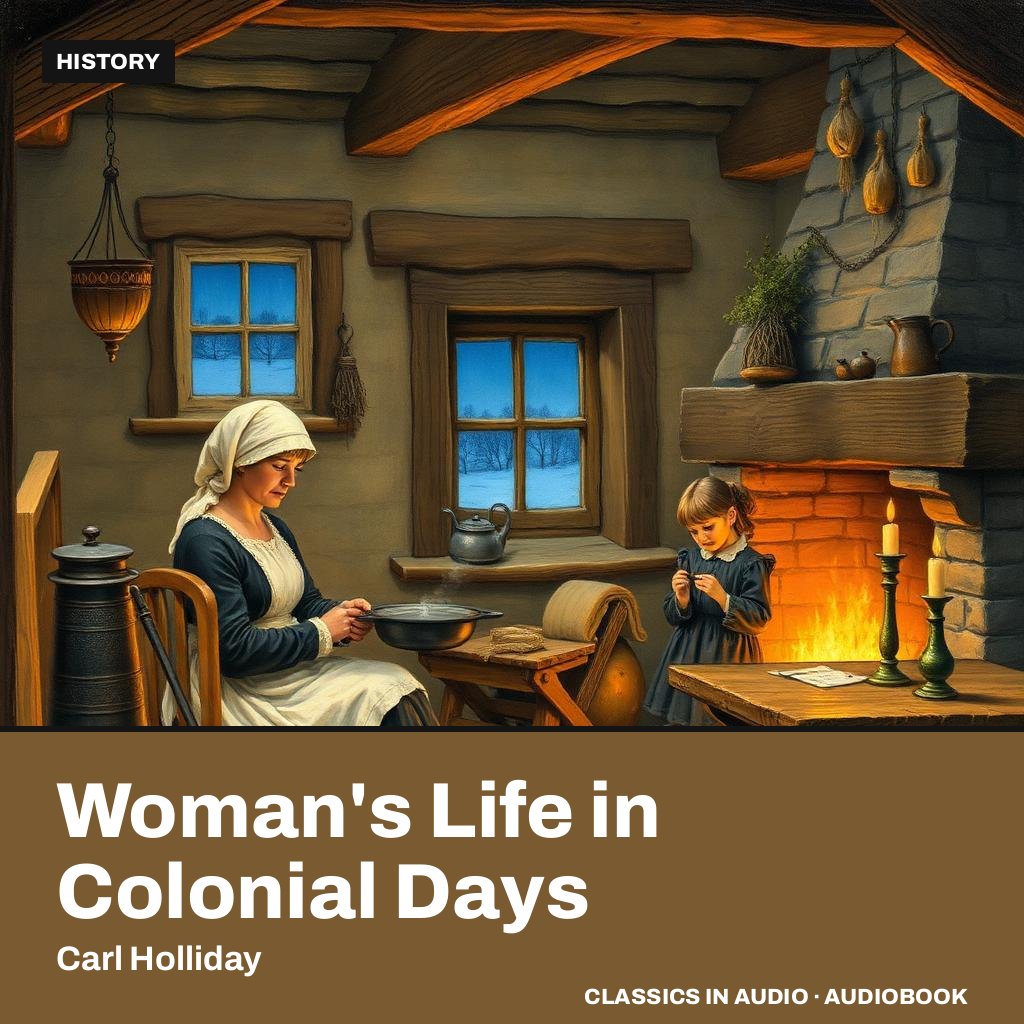
Woman's Life in Colonial Days
by Carl Holliday (1879–1936)
Unabridged audiobook · about 8 hr 26 min · English · read by a synthetic voice · MP3, no DRM
€4.90
Buy 2 audiobooks or more: −10%. Buy 5 or more: −20%.
Secure payment by Stripe. Your download link is e-mailed to you at once: the first 30 minutes are usually ready within a few minutes, and the rest follows while you listen. Listen online or download the MP3.
Woman's Life in Colonial Days is a social history of women in the English colonies of North America before the Revolution, from the hungry first winters of settlement to the households of the eighteenth century. Carl Holliday, an American scholar of literature and a teacher at several universities, built the book from sermons, diaries, letters, court records and the work of earlier historians. He set out to correct the picture of colonial women as joyless and silenced.
The chapters take up religion, education and home life, and the contents list shows how wide the ground is. There are the terrifying sermons and poems that shaped a girl's conscience, the rules of the Sabbath, and the dame's schools where reading and sewing came first. Anne Hutchinson appears as a woman who held meetings, argued doctrine and was banished for it. The witchcraft panic is treated as a fear that grew in a community with few outlets for feeling. The book also compares the Puritan North with Virginia and the Dutch settlements, and it names women such as Eliza Pinckney and Abigail Adams, whose learning stood out against general ignorance.
Holliday insists that these women loved, hoped and thought much as their descendants do. Listeners curious about how ordinary American households began will find plenty of evidence here.
Text: Project Gutenberg edition no. 15488, read without its licence notices.
More history
 The Dogaressas of Venice (the Wives of the Doges)Edgcumbe Staley9 hr 17 min€4.90
 Miniatures of French HistoryHilaire Belloc5 hr 44 min€4.90
 The Catholic Church and HistoryHilaire Belloc2 hr 16 min€3.90
 The History of the Peloponnesian WarThucydides18 hr 37 min€6.90
 The Anabasis of AlexanderArrian13 hr 55 min€5.90
 AnabasisXenophon8 hr 32 min€4.90