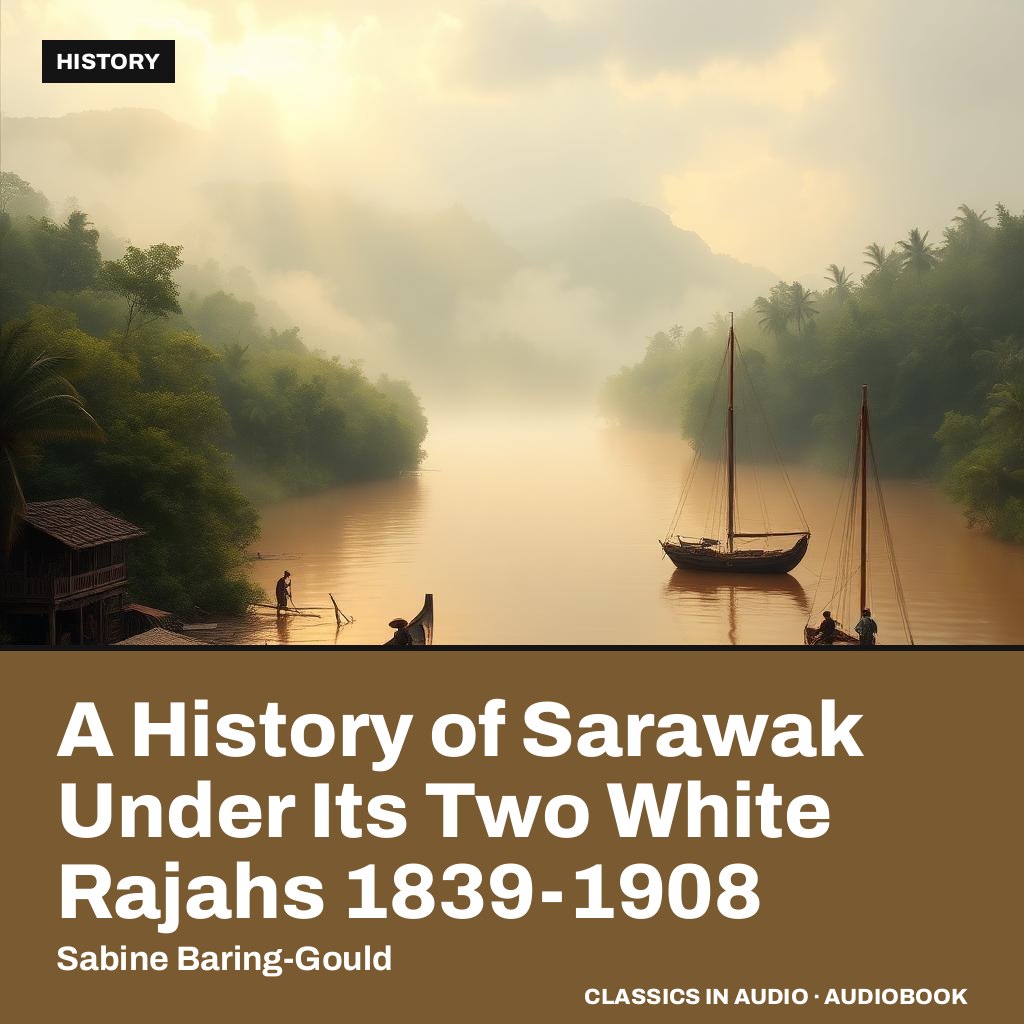
A History of Sarawak Under Its Two White Rajahs 1839-1908
by Sabine Baring-Gould (1834–1924)
Unabridged audiobook · about 16 hr 16 min · English · read by a synthetic voice · MP3, no DRM
€6.90
Buy 2 audiobooks or more: −10%. Buy 5 or more: −20%.
Secure payment by Stripe. Your download link is e-mailed to you at once: the first 30 minutes are usually ready within a few minutes, and the rest follows while you listen. Listen online or download the MP3.
This is a political and biographical history of Sarawak, the territory on the north-west coast of Borneo that an English adventurer, James Brooke, took over in 1841 and that passed to his nephew Charles after his death in 1868. The book follows the family's rule up to 1908, and it opens with the land itself: its jungles and rivers, the peoples who lived there, and the older Malay sultanates of Brunei that once held it.
The story begins with Brooke's arrival at a province in revolt, where he was offered the rule in return for ending an uprising. From there it covers the struggle against coastal piracy, the dealings with sultans and local chiefs, and the effort to protect the Dayaks and Malays under a small government with very few outside resources. Charles Brooke wrote a preface that explains his own aims, and he handed over his family papers so the account would rest on firsthand records.
Sabine Baring-Gould, the Devon clergyman and prolific author best known for the hymn "Onward, Christian Soldiers", wrote it with Charles Bampfylde, who had served as an official in Sarawak. Today it is a revealing source on British imperial adventure in Southeast Asia, told with the confidence and blind spots of the men who built the state.
Text: Project Gutenberg edition no. 52873, read without its licence notices.
More by Sabine Baring-Gould
 Cornish Characters and Strange EventsSabine Baring-Gould22 hr 05 min€7.90
 The Book of Were-WolvesSabine Baring-Gould5 hr 05 min€4.90
 Grettir the OutlawSabine Baring-Gould6 hr 20 min€4.90
 Legends of Old Testament Characters, from the Talmud and Other SourcesSabine Baring-Gould13 hr 29 min€5.90
 Curious Myths of the Middle AgesSabine Baring-Gould4 hr 32 min€3.90
 The Lost and Hostile GospelsSabine Baring-Gould9 hr 12 min€4.90
More history
 The Dogaressas of Venice (the Wives of the Doges)Edgcumbe Staley9 hr 17 min€4.90
 Miniatures of French HistoryHilaire Belloc5 hr 44 min€4.90
 The Catholic Church and HistoryHilaire Belloc2 hr 16 min€3.90
 The History of the Peloponnesian WarThucydides18 hr 37 min€6.90
 The Anabasis of AlexanderArrian13 hr 55 min€5.90
 AnabasisXenophon8 hr 32 min€4.90