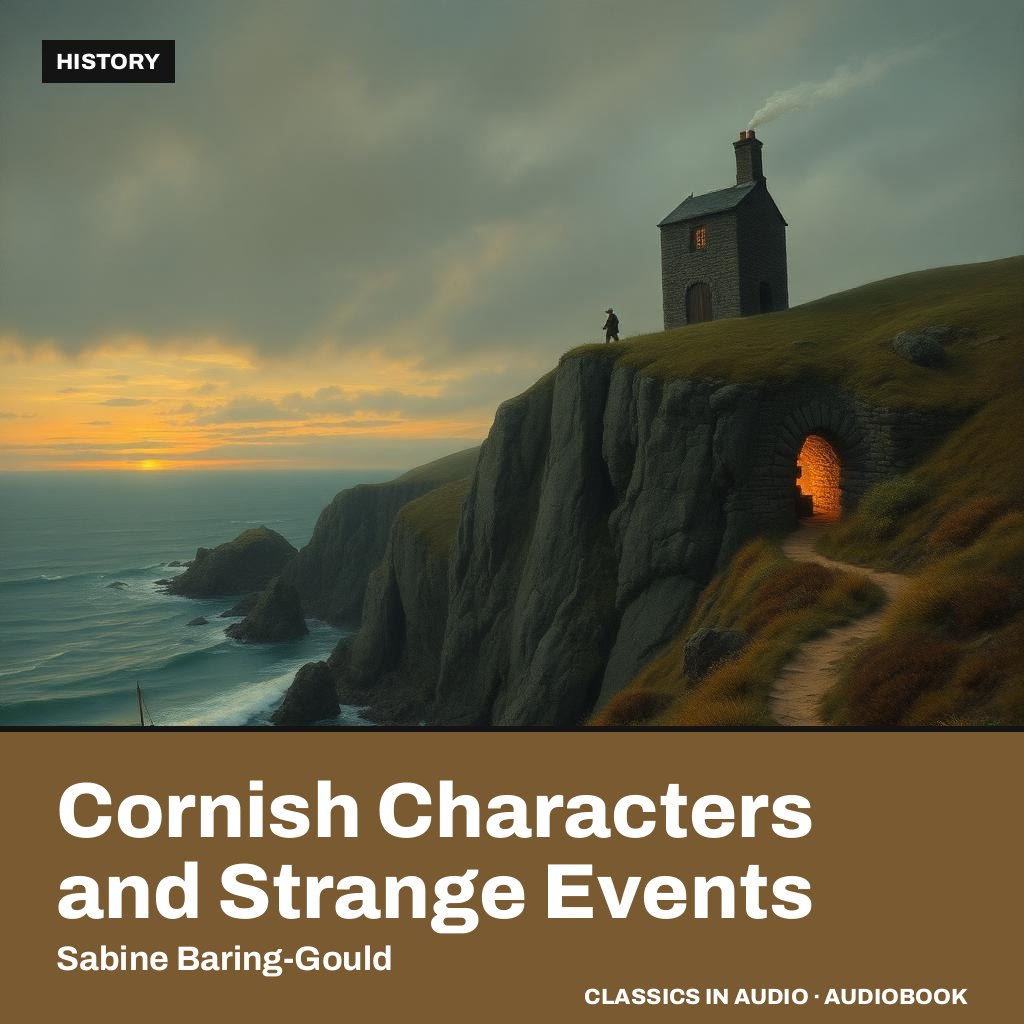
Cornish Characters and Strange Events
by Sabine Baring-Gould (1834–1924)
Unabridged audiobook · about 22 hr 05 min · English · read by a synthetic voice · MP3, no DRM
€7.90
Buy 2 audiobooks or more: −10%. Buy 5 or more: −20%.
Secure payment by Stripe. Your download link is e-mailed to you at once: the first 30 minutes are usually ready within a few minutes, and the rest follows while you listen. Listen online or download the MP3.
Cornish Characters and Strange Events is a large gathering of biographical sketches and local tales from Cornwall, the far western county of England. Sabine Baring-Gould, a Devon clergyman and prolific writer who also gave the world the hymn "Onward, Christian Soldiers", chose not to repeat the lives of the county's greatest figures, which can be found in reference works. He went instead after the lesser-known: smugglers and wreckers, miners and mine owners, wrestlers, inventors, eccentrics, clergymen, adventurers and a few rogues.
The contents run from the geologist William Pengelly and the astronomer John Couch Adams to Dolly Pentreath, remembered as a last speaker of the Cornish language, and from a lifesaving rocket apparatus inventor to a ghost at Botathan. There are murders, shipwrecks, a dispute over the Logan Rock, and the story of a girl said to have been fed by fairies. The period stretches from the Middle Ages to the nineteenth century.
The book is worth hearing today for its odd, particular detail. Baring-Gould shows how granite cliffs, deep mines and fervent chapel religion shaped people who were stubborn, inventive and sometimes outrageous. It is a companion to his Devonshire Characters, and suits anyone who likes history told through individual lives.
Text: Project Gutenberg edition no. 41775, read without its licence notices.
More by Sabine Baring-Gould
 The Book of Were-WolvesSabine Baring-Gould5 hr 05 min€4.90
 A History of Sarawak Under Its Two White Rajahs 1839-1908Sabine Baring-Gould16 hr 16 min€6.90
 Grettir the OutlawSabine Baring-Gould6 hr 20 min€4.90
 Legends of Old Testament Characters, from the Talmud and Other SourcesSabine Baring-Gould13 hr 29 min€5.90
 Curious Myths of the Middle AgesSabine Baring-Gould4 hr 32 min€3.90
 The Lost and Hostile GospelsSabine Baring-Gould9 hr 12 min€4.90
More history
 The Dogaressas of Venice (the Wives of the Doges)Edgcumbe Staley9 hr 17 min€4.90
 Miniatures of French HistoryHilaire Belloc5 hr 44 min€4.90
 The Catholic Church and HistoryHilaire Belloc2 hr 16 min€3.90
 The History of the Peloponnesian WarThucydides18 hr 37 min€6.90
 The Anabasis of AlexanderArrian13 hr 55 min€5.90
 AnabasisXenophon8 hr 32 min€4.90