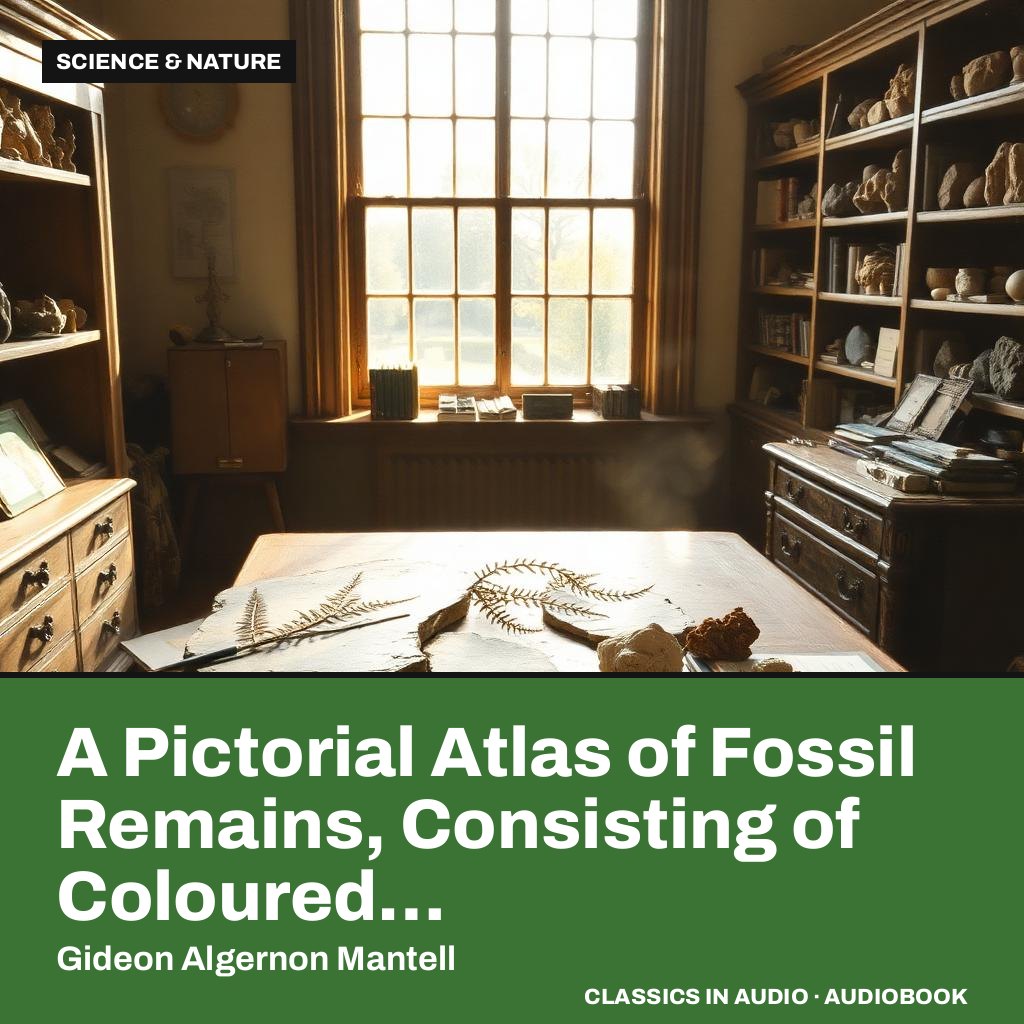
A Pictorial Atlas of Fossil Remains, Consisting of Coloured Illustrations Selected from Parkinson's "Organic Remains of a Former World," and Artis's "Antediluvian Phytology."
by Gideon Algernon Mantell (1790–1852)
Unabridged audiobook · about 4 hr 58 min · English · read by a synthetic voice · MP3, no DRM
€3.90
Buy 2 audiobooks or more: −10%. Buy 5 or more: −20%.
Secure payment by Stripe. Your download link is e-mailed to you at once: the first 30 minutes are usually ready within a few minutes, and the rest follows while you listen. Listen online or download the MP3.
This is a picture book of fossils, first published in London in 1850. Its seventy-four plates, with nearly nine hundred figures, were gathered from two earlier works: James Parkinson's Organic Remains of a Former World and James Artis's Antediluvian Phytology. Each plate is paired with a short description and, where possible, the scientific names in use at mid-century, along with the places where the specimens were found.
The first part covers plants of the coal age: silicified wood, ferns pressed into coal shale, the jointed stems of calamites, and the scarred trunks and roots of Sigillaria and Lepidodendron. It also includes fossil fruits from the London clay of the Isle of Sheppey. The second part turns to animals, beginning with corals, sponges and other zoophytes preserved in limestone and flint, and set beside a living sea lily for comparison.
Gideon Mantell was a Sussex surgeon who became one of Britain's foremost fossil collectors, and he is remembered for his work on the Iguanodon. Here he writes as a guide for the general reader. The book shows how Victorian naturalists looked at ancient life, and why a fern leaf in a lump of shale could still seem startling.
Text: Project Gutenberg edition no. 64434, read without its licence notices.
More science & nature
 Body-build and Its InheritanceCharles Benedict Davenport7 hr 56 min€4.90
 On the Origin of Species By Means of Natural SelectionCharles Darwin15 hr 22 min€6.90
 The Interpretation of DreamsSigmund Freud20 hr 00 min€6.90
 The Origin of Species by Means of Natural SelectionCharles Darwin20 hr 41 min€7.90
 Novum OrganumFrancis Bacon8 hr 50 min€4.90
 The Magic of Jewels and CharmsGeorge Frederick Kunz13 hr 31 min€5.90