Ancient Calendars and Constellations
Unabridged audiobook · about 5 hr 25 min · English · read by a synthetic voice · MP3, no DRM
€4.90
Buy 2 audiobooks or more: −10%. Buy 5 or more: −20%.
Secure payment by Stripe. Your download link is e-mailed to you at once: the first 30 minutes are usually ready within a few minutes, and the rest follows while you listen. Listen online or download the MP3.
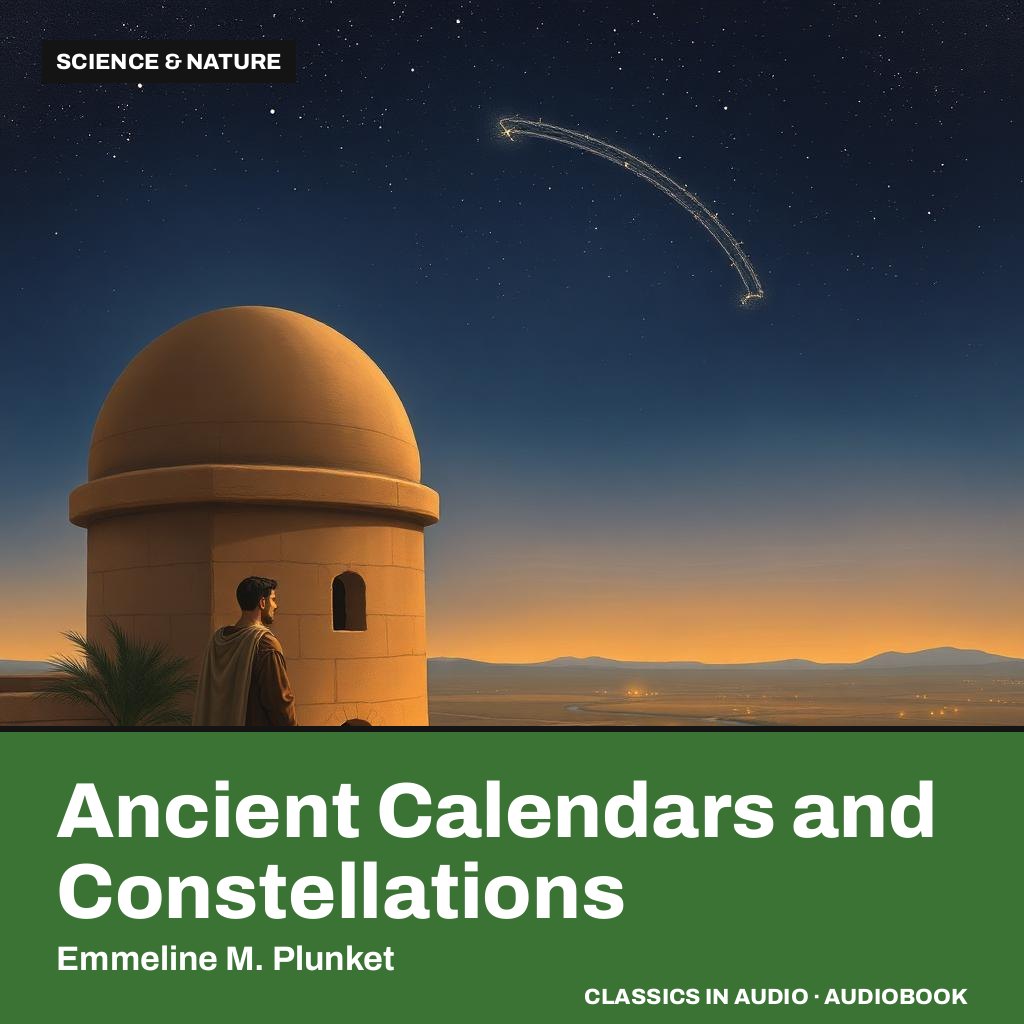
Ancient Calendars and Constellations is a work of speculative scholarship from 1903, in which the Hon. Emmeline M. Plunket asks how the earliest astronomers chose the constellation that opened their year. Her starting point is a puzzle in Babylonian lore. The Accadian calendar began with the month Nisan and the sign Aries, yet at the dates then proposed for its origin the sun did not enter Aries at the spring equinox. Plunket suggests that the calendar was instead fixed when the winter solstice fell in Aries, around 6000 B.C.
She follows that single clue across several cultures. The chapters turn from the Accadian and Median calendars to the astronomy of the Rig Veda, the Zoroastrian figure of Ahura Mazda, ancient Indian reckoning and the Chinese calendar, with remarks on the Chaldeans. Along the way she offers astronomical readings of old myths. Her tool is a precessional globe, which shows how the slow shift of the heavens changed the night sky over thousands of years. Diagrams made from it fill the second part of the book.
Plunket was an amateur writing for general readers, and she admits that some papers are technical. Many of her dates and theories have since been revised, so the book also records how Victorian and Edwardian students pictured the dawn of star-watching. Listeners curious about the sky, the calendar and ancient myth will find an unusual line of reasoning to follow.
Text: Project Gutenberg edition no. 70052, read without its licence notices.
More science & nature
 Body-build and Its InheritanceCharles Benedict Davenport7 hr 56 min€4.90
 On the Origin of Species By Means of Natural SelectionCharles Darwin15 hr 22 min€6.90
 The Interpretation of DreamsSigmund Freud20 hr 00 min€6.90
 The Origin of Species by Means of Natural SelectionCharles Darwin20 hr 41 min€7.90
 Novum OrganumFrancis Bacon8 hr 50 min€4.90
 The Magic of Jewels and CharmsGeorge Frederick Kunz13 hr 31 min€5.90