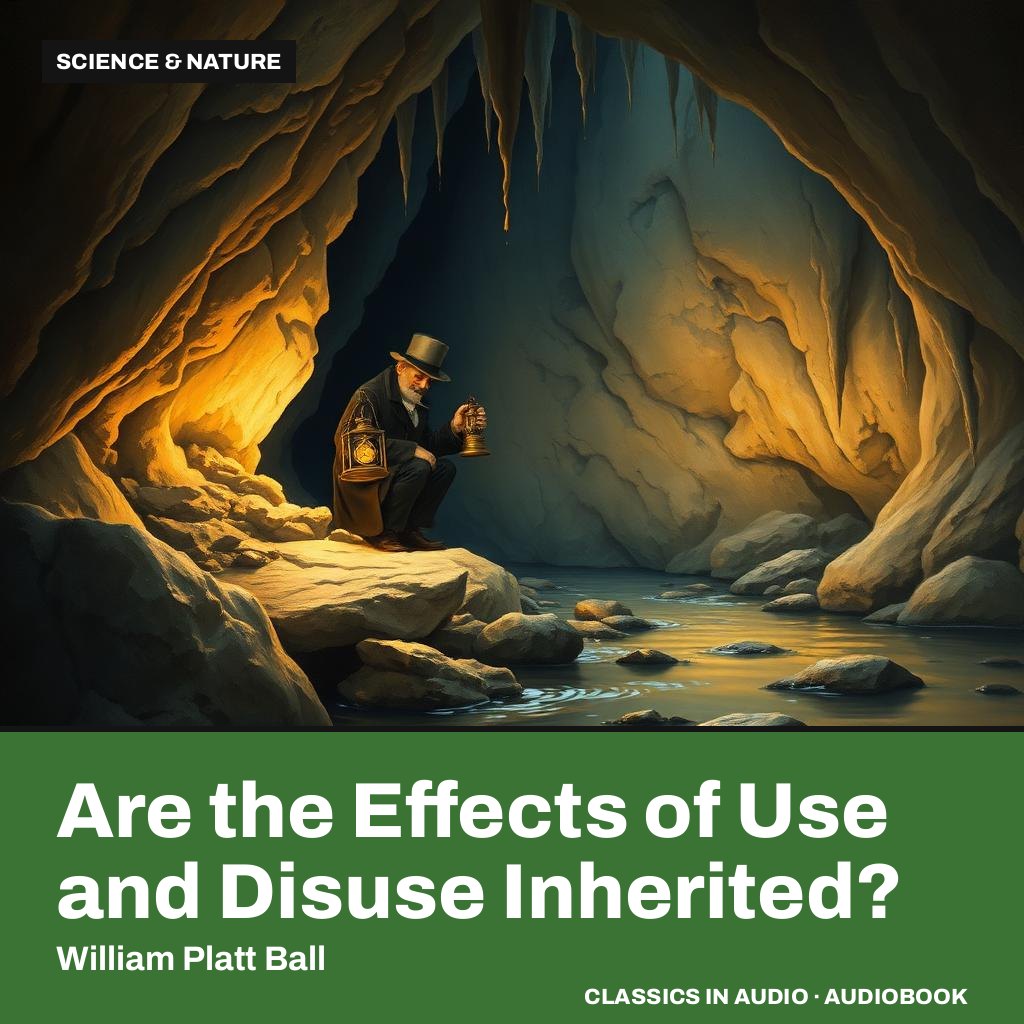
Are the Effects of Use and Disuse Inherited?
An Examination of the View Held by Spencer and Darwin
by William Platt Ball (1844–1917)
Unabridged audiobook · about 2 hr 26 min · English · read by a synthetic voice · MP3, no DRM
€3.90
Buy 2 audiobooks or more: −10%. Buy 5 or more: −20%.
Secure payment by Stripe. Your download link is e-mailed to you at once: the first 30 minutes are usually ready within a few minutes, and the rest follows while you listen. Listen online or download the MP3.
In the late nineteenth century, biologists argued over a deceptively simple question: if a blacksmith builds up his arms or a student sharpens his mind, do his children inherit the gain? This short treatise takes the question on directly. W. P. Ball, an English writer on evolution, sets out to test the view, which Jean-Baptiste Lamarck had championed and which both Herbert Spencer and Charles Darwin partly accepted, that the effects of use and disuse are passed down.
Ball works through the evidence case by case. He looks at the shrinking jaws and crowded teeth of civilized people, the weak biting muscles of lap-dogs, blind cave crabs, the giraffe's long neck, the reduced wings of birds on oceanic islands, and the tameness of domestic rabbits. He asks in each instance whether natural selection explains the facts without any inheritance of habit. He also considers alleged inherited injuries, such as epilepsy in guinea-pigs and the motmot's trimmed tail.
Ball's concern is not only zoology. He argues that if acquired traits are not inherited, then education and social reform cannot by themselves guard a civilization against decline. Whatever one makes of his conclusions, the book shows scientists reasoning about heredity before genetics gave the debate its modern footing.
Text: Project Gutenberg edition no. 26438, read without its licence notices.
More science & nature
 Body-build and Its InheritanceCharles Benedict Davenport7 hr 56 min€4.90
 On the Origin of Species By Means of Natural SelectionCharles Darwin15 hr 22 min€6.90
 The Interpretation of DreamsSigmund Freud20 hr 00 min€6.90
 The Origin of Species by Means of Natural SelectionCharles Darwin20 hr 41 min€7.90
 Novum OrganumFrancis Bacon8 hr 50 min€4.90
 The Magic of Jewels and CharmsGeorge Frederick Kunz13 hr 31 min€5.90